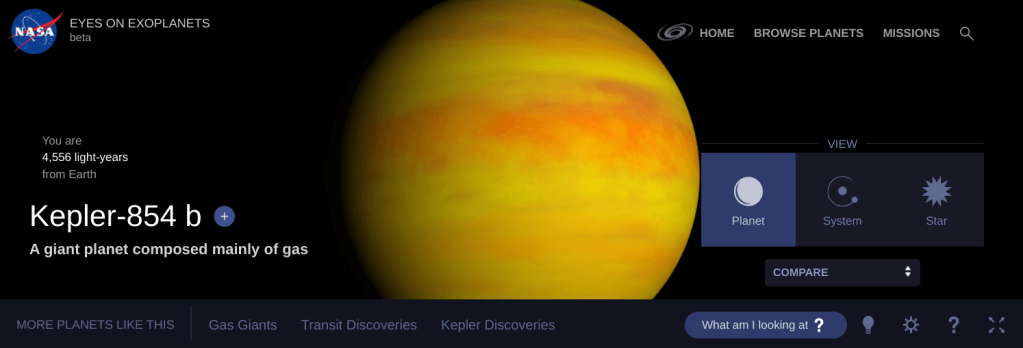
Phys.org had a good story on the reclassification of objects captured by the NASA’s Kepler Space Telescope once believed to be exoplanets. New evidence indicates three “exoplanets” – Kepler-854b, Kepler-840b, and Kepler-699b – are actually stars (hence, the NASA image above will need to be modified).
The article notes that the three objects are too large to be considered planets, being between two and four times the size of Jupiter. The results were part of a study from the Astronomical Journal. A fourth exoplanet, Kepler-747 b, might also be a star.
After updated information indicated Kepler-854b was about three times the size of Jupiter, one of the study authors said, “There’s no way the universe can make a planet of that size…It just doesn’t exist.”
While the team reviewed about 2,000 Kepler exoplanets to find these four questionable items, it is likely that more will be found in the future among other reported exoplanets. Fortunately, that still leaves us with plenty of real exoplanets to study.
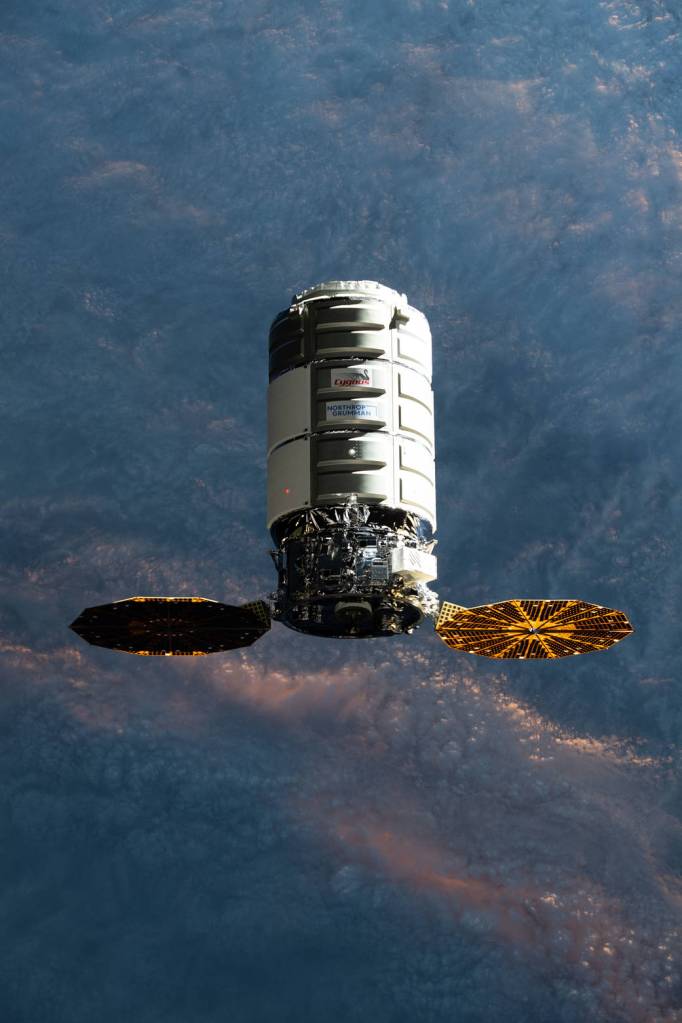
Image(Credit): Northrop Grumman’s Cygnus space freighter approaching the International Space Station (NASA).
Over the weekend, the Washington Post published an editorial by Homer Hickam, former NASA engineer and advisor to the National Space Council, titled, “Our space partnership with Russia can’t go on.” In the piece, Mr. Hickam argues that the International Space Station (ISS) has accomplished its goals and the US can now move onto other projects without the Russians:
With our flourishing commercial space companies, who are already cutting metal on their own future space stations, plus our federal government’s Artemis moon program, the United States is entering a new golden age of space exploration. The Russians, meanwhile, are stuck in the past with antiquated spacecraft and nowhere to go except the ISS.
Mr. Hickam appears to believe pushing out the Russians may mean the end of the ISS. Of course, this is just one man’s view, and whatever we do we need to do it in conjunction with our other ISS partners.
We could continue to maintain the ISS through 2030, as planned, and schedule more useful science even without the Russians as partners. This may make sense until we have another viable station that we can use, such as NASA’s planned lunar Gateway. Russia will not be part of the Gateway given that it is working with China on other lunar plans, so we do not need to worry about another breakup.
It would be better if Russia had focused on its space accomplishments rather than territorial ambitions as it prepares for the future. Joint space programs are a great way to use rockets for peaceful missions. I am not against a space race that pushes us even farther into space, yet I would prefer it be fueled by scientific achievement rather than nationalist angst.
Image(Credit): Artist rendering of the Artemis lunar Gateway (NASA).
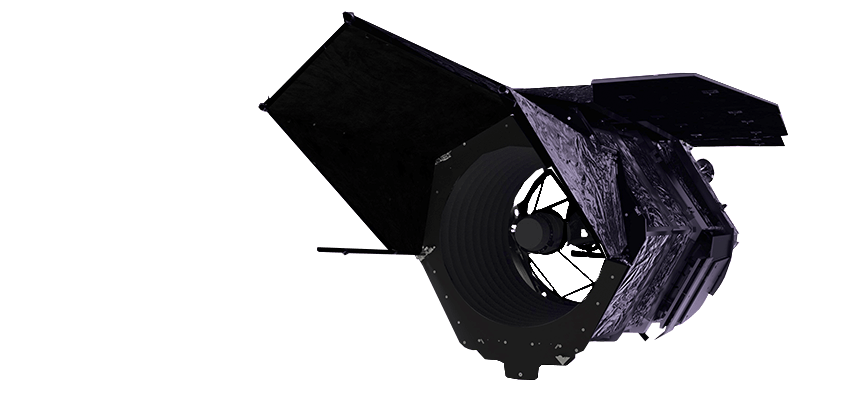
Source/Credit: Nancy Grace Roman Space Telescope from NASA.
With all the excitement about the James Webb Space Telescope coming online shortly, we do not want to forget about another space telescope in development. NASA’s Nancy Grace Roman Space Telescope, expected to be launched in 2027, will be even more productive than the Hubble Space Telescope. NASA noted the new space telescope will be:
Providing the same crisp infrared resolution as Hubble over a field of view 200 times larger, Roman will conduct sweeping cosmic surveys that would take hundreds of years using Hubble. Roman will map stars, galaxies, and dark matter to explore the formation and evolution of large cosmic structures, like clusters and superclusters of galaxies, and investigate dark energy, which is thought to accelerate the expansion of the universe.
The Nancy Grace Roman Space Telescope will also have a Coronagraph Instrument that will be able to detect more exoplanets, including smaller, rocky exoplanets similar to Earth. By using the parent star’s reflected light on a larger exoplanet, this instrument will also allow astronomers to analyze the colors of the exoplanet’s atmosphere and learn more about the content of that atmosphere (complementing other studies of large exoplanets, one of which was noted here earlier). If successful, this technology could be refined further to one day help to detect oxygen, methane, and other elements/compounds in the atmosphere of distant, Earth-sized exoplanets.
Astronomer Vanessa Bailey from NASA’s Jet Propulsion Laboratory stated:
To image Earth-like planets, we’ll need 10,000 times better performance than today’s instruments provide…The Coronagraph Instrument will perform several hundred times better than current instruments, so we will be able to see Jupiter-like planets that are more than 100 million times fainter than their host stars.
The telescope is named after Nancy Grace Roman, who was NASA’s first chief astronomer and also known as the “Mother of Hubble” for her efforts in making the Hubble Space Telescope a reality. You can read more about her here.
You may have remembered this NASA tweet from September 2020:
HR 6819 is the closest black hole we’ve detected so far, and it lies about 1,000 light-years away. ⚫️ Statistics say there should be one as close as 65 light-years, though we may never detect it unless it lights up!
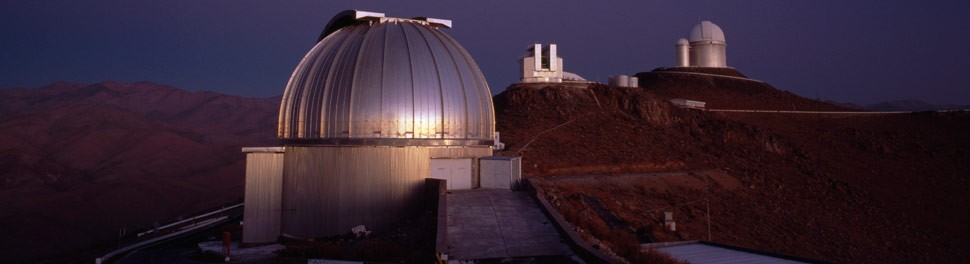
The original European Space Agency (ESA) press release noted that an invisible object has two companion stars, one of which orbits the unseen object every 40 days. The data for this finding used the MPG/ESO 2.2-metre telescope at ESO’s La Silla Observatory in Chile.
Well, you can relax. The ESA announced last week that HR 6819 is not a black hole based on new data from ESO’s Very Large Telescope (VLT) and Very Large Telescope Interferometer (VLTI):
Our best interpretation so far is that we caught this binary system in a moment shortly after one of the stars had sucked the atmosphere off its companion star. This is a common phenomenon in close binary systems, sometimes referred to as “stellar vampirism” in the press,” explains Bodensteiner, now a fellow at ESO in Germany and an author on the new study. “While the donor star was stripped of some of its material, the recipient star began to spin more rapidly.
So, mystery solved. Now we need to talk about local vampires!
Yesterday, the European Space Agency (ESA) announced that another space program has been impacted by the Russia’s invasion of Ukraine:
Regarding the ExoMars programme continuation, the sanctions and the wider context make a launch in 2022 very unlikely. ESA’s Director General will analyse all the options and prepare a formal decision on the way forward by ESA Member States.
The ESA website on the Exomars program notes that it is a two part mission searching for life on Mars: the Trace Gas Orbiter launched in 2016 and the Exomars rover and surface platform planned for launch in 2022. NASA also contributed to this latest mission:
NASA’s participation in the 2022 ExoMars Rover mission includes providing critical elements to the premier astrobiology instrument on the rover, the Mars Organic Molecule Analyzer (MOMA). By studying organic molecules, the chemical building blocks of life, MOMA is designed to help answer questions about whether life ever existed on Mars, along with its potential origin, evolution and distribution on the Red Planet.
The list of impacted space missions will only grow.



 Our Awesome Universe