With all of the current chaos related to NASA funding, one might think America has moved away from its previous support for space missions. However, a poll reported last month by CBS News tells a different story.
As shown in the image above, 67 percent of Americans polled by CBS News and YouGov are in favor or NASA returning astronauts to the Moon, and 65 percent feel the same way about a trip to Mars.
This is encouraging yet may not be enough to save NASA as it faces severe budget cuts and the loss of thousands of employees.
Some might say that the cuts are unrelated to the Moon and Mars missions, which are still being funded by the White House. However, that does not matter. NASA is losing expertise in all areas while its employees feel harassed and unappreciated. It is hard to build a successful space program on top of this disarray.
If so many Americans believe we should be back on the Moon and travel to Mars, how will they feel should China beat us to one or both? How will the current White House be viewed?
Maybe that is what should keep the White House and others proposing these drastic cuts up at night.
The above image is one of 24 winning posters designed by students at the School of Visual Arts (SVA) in New York City. The contest, sponsored by SVA and NASA, is called The Artemis II/Earthrise Poster Project.
All of the posters will be on display next month at the SVA Gramercy Gallery located at 209 East 23rd Street, 1st floor, New York, NY 10010.
You can learn more about the event and view more of these creative posters at this link.
Image (Credit): International partners empowering NASA’s mission on Mars. (US Embassy & Consulates in Italy)
While spreading out the manned missions to the International Space Station (ISS) among various private sector partners sounded like a great idea, it has proven less than perfect. First we had to worry about the emotional stability of SpaceX’s CEO, and now we need to worry about the financial viability of Boeing, the only other company on a path to bring astronauts to the ISS.
…faced challenges including labor actions, production delays, quality control problems, and financial losses on government contracts. Given Boeing’s importance to the defense industrial base, Congress may assess whether or not these developments have implications for U.S. national security…Some analysts have speculated that Boeing could declare bankruptcy or seek to sell elements of its space or defense business.
One of the author’s suggestions is for the US government to expand its contracting efforts with “trusted international companies.” While the article is focused on the defense realm, it sounds like a good idea for the space realm as well.
The major US space goals already include our trusted international partners, such as the ISS, Artemis and Mars programs, so none of this much of a stretch. Maybe it just needs to be more of the focus as the current US firms show their vulnerabilities when poorly managed. I would add to this list the need to offer greater support to other, newer US-based space companies to further diversity the workload.
This may not be a time to call for greater international coordination led by NASA when the agency is also showing its vulnerabilities when poorly managed, yet we need to plan for future days when the craziness dies down. In the meantime, as Europe prepares for NASA cuts to joint programs, we have a lot of convincing to do if we want a deeper international space industry.
A new administrator for NASA may help, as well as a Congress that does its job and protects the future of our space programs.
I don’t care if you call it “Make the Moon the Goal Again.” Just get started.
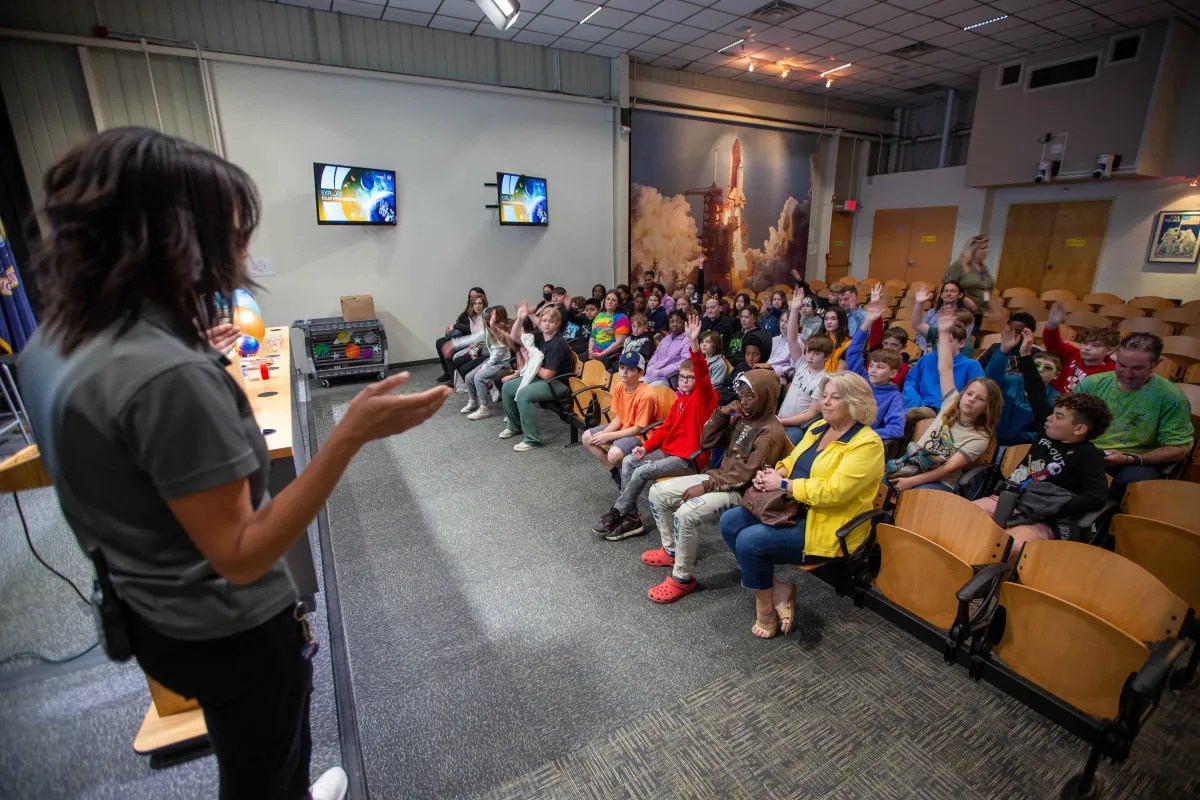
Image (Credit): Presentation to students at the Wallops Flight Facility Visitor Center. (Wallops Flight Facility Visitor Center).
“This is an unacceptable and drastic step that will have a significant impact on local employees, residents, and visitors…My staff and I are in contact with NASA to better understand the reasoning behind this reported decision as it is contradictory to the proposed House budget. Wallops has long been a vital part of our community, and we will do everything we can to support the work that’s done there and the people who work there.”
-Statement by Congresswoman Jen Kiggans (R-VA), as quoted in The Virginian-Pilot, after NASA announced plans to close the visitor center at the Wallops Flight Facility on the Virginia coast. The visitor center has a NASA museum visited by students on field trips as well as the general public. It also acts as a viewing location for rocket launches from the site, which includes unmanned cargo missions to the International Space Station. Surprisingly, the White House did not bother keeping even the Republican congressional members in the loop on these cuts. Cutting back on public outreach is a sure way to undermine support for US space missions.
A team of astronomers has found evidence of a candidate gas giant planet orbiting Alpha Centauri A, a Sun-like star in the closest stellar system to our own. Initial observations hinting at the planet’s existence were made in August 2024 using data from the James Webb Space Telescope (JWST). The Alpha Centauri system is located just 4 light-years from Earth. The findings, detailed in twopapers accepted for publication in The Astrophysical Journal Letters, could represent a major milestone. As Charles Beichman of NASA’s Jet Propulsion Laboratory noted in a JWST news release, “With this system being so close to us, any exoplanets found would offer our best opportunity to collect data on planetary systems other than our own.”
Pope Leo XIV has appointed a new head astronomer to run the Vatican Observatory, one of the oldest scientific observatories in the world. Rev. Richard D’Souza, 47, will succeed Guy Consolmagno, an American physicist who was known as the “pope’s astronomer” for ten years. Both men are members of the Jesuit Order.
After nearly six months onboard the International Space Station (ISS), the four astronauts of NASA’s SpaceX Crew-10 mission have safely returned to Earth. This weekend’s splashdown off the coast of California concludes a long-duration science expedition that supported dozens of investigations sponsored by the ISS National Laboratory. NASA astronauts Anne McClain and Nichole Ayers, Japan Aerospace Exploration Agency (JAXA) astronaut Takuya Onishi, and Roscosmos cosmonaut Kirill Peskov played a vital role in advancing science in space, contributing to biomedical research, physical and materials sciences, technology demonstrations, and student-led experiments. Their work helped push the boundaries of discovery in low Earth orbit (LEO) The orbit around the Earth that extends up to an altitude of 2,000 km (1,200 miles) from Earth’s surface. The ISS’s orbit is in LEO, at an altitude of approximately 250 miles. to benefit life on Earth and support a sustainable and robust space economy.





 Our Awesome Universe