“NASA has received hundreds of thousands of letter from the space-oriented “Star Trek” group asking that the name “Enterprise” be given to the craft. This group comprises millions of individuals who are deeply interested in our space program.”
-Statement in a September 3, 1976 letter to President Richard Nixon from the Deputy Assistant to the President for Economic Affairs regarding the naming of the nation’s first space shuttle. If they space shuttle had been delayed until after 1977, maybe the “Millennium Falcon” would have been on the list of top names as well.
A new paper looks at another way we might be able to detect advanced civilizations, and at its center is the need for energy. The more advanced a civilization becomes, the greater their need for energy and one of the most efficient ways, according to current theories, is to harness the energy from an actively feeding black hole. The paper suggests a civilization feeding matter into a black hole could harvest energy from it; more excitingly perhaps, the process could be detectable within 17,000 light years.
Officials said they are making progress in protecting two key institutions from the Eaton fire. Don Fregulia, an operations section chief for the California Department of Forestry and Fire Protection, which has joined in the Eaton fire response, said that efforts to protect Mt. Wilson had proved successful and he expected that to remain the case. “We’re actively engaged there, and so far, no loss to any values at risk at Mt. Wilson,” Fregulia said. “We’re feeling good about what we have to do up there tonight to keep that site secure.” He said the fire had also spread close to NASA’s Jet Propulsion Laboratory, but he said that’s a priority and crews were “making good progress there as well.”
To maximize chances of successfully bringing the first Martian rock and sediment samples to Earth for the benefit of humanity, NASA announced Tuesday a new approach to its Mars Sample Return Program. The agency will simultaneously pursue two landing architectures, or strategic plans, during formulation, encouraging competition and innovation, as well as cost and schedule savings. NASA plans to later select a single path forward for the program, which aims to better understand the mysteries of the universe, and to help determine whether the Red Planet ever hosted life. NASA is expected to confirm the program – and its design – in the second half of 2026.
Image (Credit): Volcanic fissure in Iceland. (NASA Earth Observatory images by Michala Garrison)
This week’s image comes from NASA’s Earth Observatory. It is an image from last November showing a volcanic fissure on Iceland’s Reykjanes peninsula not far from the country’s capital, Reykjavík
The image…shows lava coming from an eruptive fissure near Stóra Skógfell peak, along the Sundhnúkur crater row—a similar location to the February 2024 eruption. This natural color scene, acquired by the OLI-2 (Operational Land Imager-2) on Landsat 9 on November 24, is overlaid with an infrared signal to help distinguish the lava’s heat signature. A plume of gas, consisting primarily of sulfur dioxide, streamed from the lava, although the eruption did not affect flights to and from Iceland.
The lava flowed east and west from the fissure, rather than toward the town of Grindavík. The Icelandic National Broadcasting Service reported that the latest event forced the evacuation of some of the town’s residents and the Blue Lagoon resort, a geothermal spa. A tongue of lava flowed over the car park of the spa, enveloping a small service building located there.
The Reykjanes peninsula eruption is the seventh in a series of events that began in December 2023. As of November 26, 2024, the Blue Lagoon was closed to the public, but lava movement toward the spa had slowed.
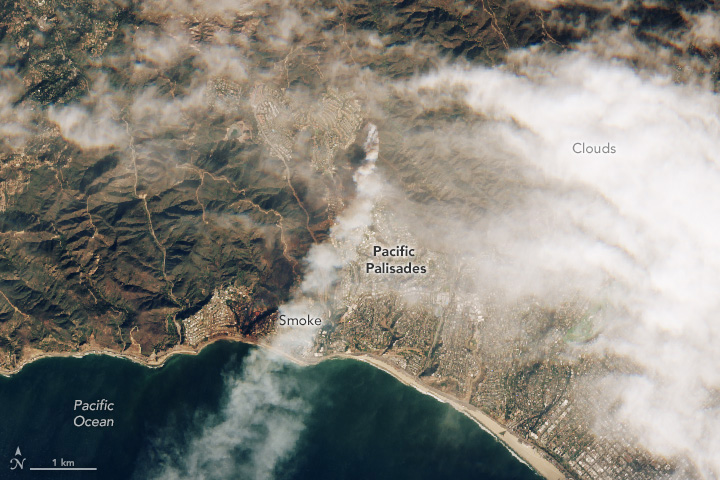
Note: Another image from NASA’s Earth Observatory is also very relevant this week. The image below shows the Los Angeles fires that are still burning. This particular image shows the Eaton fire, which erupted on the evening of January 7 in Altadena, located north of downtown Los Angeles.
Image (Credit): The Eaton Fire on January 7, 2024. (NASA Earth Observatory images by Wanmei Liang, using MODIS data from NASA EOSDIS LANCE and GIBS/Worldview and modified Copernicus Sentinel data (2025) processed by the European Space Agency)
This is not the same as invading Greenland or renaming the Gulf of Mexico, but one more Republican proposal is on the table. This one, from Florida’s Governor DeSantis, calls for NASA to move its headquarters from Washington, DC to Florida’s Kennedy Space Center.
They have this massive building in Washington, D.C., and like nobody goes to it. So why not just shutter it and move everybody down here? I think they’re planning on spending like a half a billion to build a new building up in D.C. that no one will ever go to, either.
Maybe the governor does not understand that NASA has a lot of work to do in the nation’s capital, such as keeping 535 members of Congress happy with the program. In addition, NASA is already spread out across the country, which was by design to keep many politicians happy over the years. For example, the NASA facility in Houston, TX was a political move to keep the chairman of the House Appropriations subcommittee happy. Governor DeSantis does not have the clout of a House chairman, whatever else he may believe about himself.
Besides, Florida already has quite a few of NASA’s assets. NASA knows it needs to spread the wealth.
By the way, we may need to keep some assets in reserve should we require a new NASA facility in Greenland.
You can hear host Casey Dreier, who is Chief of Space Policy for The Planetary Society, talk with Marcia Smith, the Founder and Editor for Space Policy Online. It is a candid conversation that spares no punches at NASA management for its secrecy related to delays with the Artemis program.
A few issues that stayed with me include:
Why all the criticism of the Space Launch System (SLS), as well as the accolades for the still unproven Starship, when the Starship was barely an idea at the time the SLS was being designed and built?
Elon Musk represents a “single point of failure” in the US space program.
The incentives of the space billionaires, which is generally curiosity and self-aggrandizing similar to climbing Mount Everest, cannot replace the dedication to national (and even international, in the case of Artemis) interests represented by the US astronauts.
I am sure you will have your own takeaways. It is a good way to spend an hour of your time.






 Our Awesome Universe