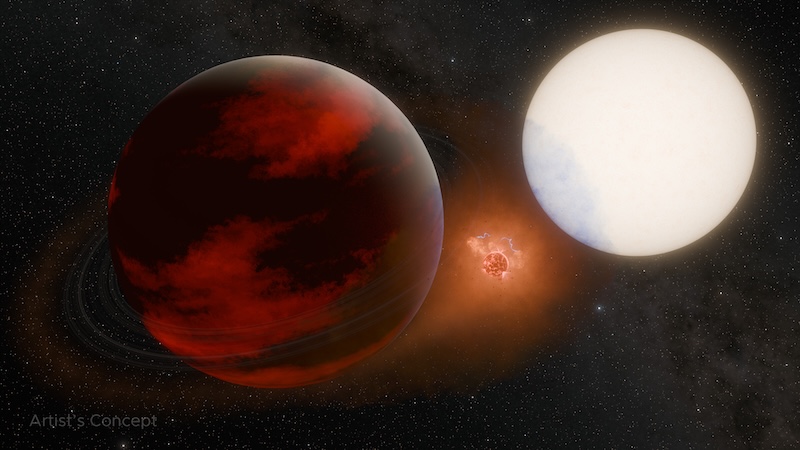
Image (Credit): An artist’s rendering of a volcanic moon orbiting WASP-49 b. (NASA/ JPL-Caltech)
The search for new exoplanets in our galaxy continues, but now it may include the first exomoon. This was something that was expected to occur at some point as the detection methods became better over time.
The exomoon in question is believed to be a volcanic moon orbiting a giant planet about 635 light-years away. Detected using the European Southern Observatory’s Very Large Telescope in Chile, the exomoon is discussed in a paper written by researchers with NASA’s Jet Propulsion Laboratory and Caltech in California. The clue was a cloud of sodium that did not appear to come from the host exoplanet.
The new discovery is being compared to Jupiter’s volcanic moon Io, which is the most volcanically active world in the solar system.
If you want to learn more about exomoons, I recommend a Cool Worlds video narrated by Assistant Professor of Astronomy David Kipping who provides five reasons that the study of exomoons is so important.
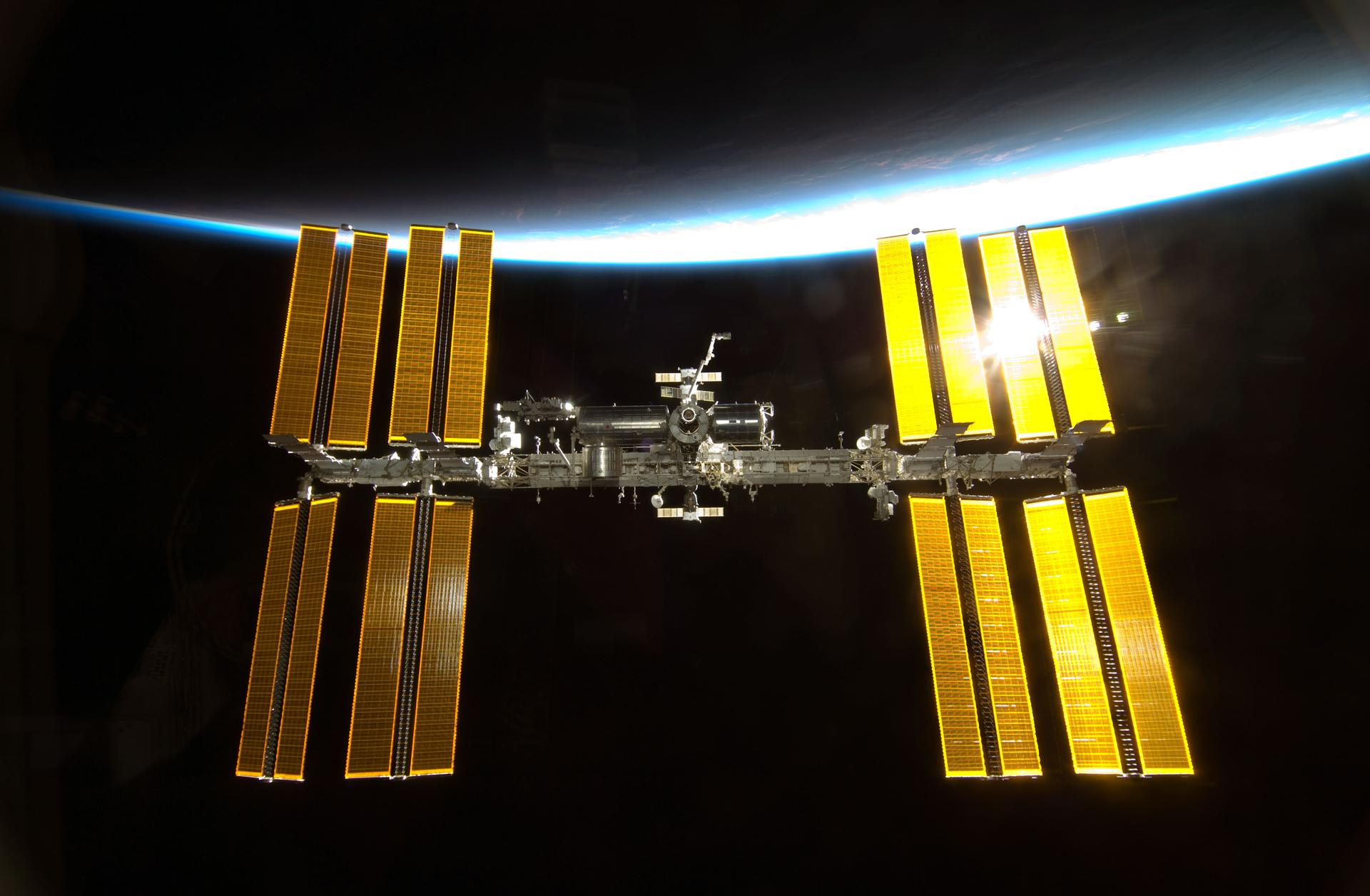
NASA will use SpaceX’s Crew Dragon for its two crew rotation missions to the International Space Station in 2025 as it continues to evaluate if it will require Boeing to perform another test flight of its Starliner spacecraft. In an Oct. 15 statement, NASA said it will use Crew Dragon for both the Crew-10 mission to the ISS, scheduled for no earlier than February 2025, and the Crew-11 mission scheduled for no earlier than July. Crew-10 will fly NASA astronauts Anne McClain and Nichole Ayers along with astronaut Takuya Onishi from the Japanese space agency JAXA and Roscosmos cosmonaut Kirill Peskov. NASA has not yet announced the crew for the Crew-11 mission.
There are government boondoggles, and then there’s NASA’s Artemis program. More than a half century after Neil Armstrong’s giant leap for mankind, Artemis was intended to land astronauts back on the moon. It has so far spent nearly $100 billion without anyone getting off the ground, yet its complexity and outrageous waste are still spiraling upward. The next US president should rethink the program in its entirety.
An international team led by three researchers from the CNRS1 , the European Southern Observatory (ESO, Europe), and Charles University (Czech Republic) has successfully demonstrated that 70% of all known meteorite falls originate from just three young asteroid families. These families were produced by three recent collisions that occurred in the main asteroid belt 5.8, 7.5, and about 40 million years ago. The team also revealed the sources of other types of meteorites; with this research, the origin of more than 90% of meteorites has now been identified. This discovery is detailed in three papers, a first published on 13 September 2024 in the journal Astronomy and Astrophysics, and two new papers published on 16 October 2024 in Nature.
If you are looking for a colorful calendar or simply some amazing images and art, you cannot go wrong downloading NASA’s 2025 calendar. For example, the graphics shown above and below are just two examples of the pages you can find in this 32-page calendar. It shows the number of NASA-led or supported space missions throughout our solar system. It is a numbing number of missions.
Have you heard of ESCAPADE mission, which stands for the Escape and Plasma Acceleration and Dynamics Explorers? Checking the NASA site, I learned that this mission was a dual-spacecraft mission to study ion and sputtered escape from Mars, and it was supposed to be launched this week but it was put back on the shelf. Here is more on the mission:
The planned launch on the Blue Origin New Glenn booster from Cape Canaveral, originally scheduled for October 13, 2024, has been delayed indefinitely. The science goals of the mission are to: understand the processes controlling the structure of Mars’ hybrid magnetosphere and how it guides ion flows; understand how energy and momentum are transported from the solar wind through Mars’ magnetosphere; and understand the processes controlling the flow of energy and matter into and out of the collisional atmosphere. EscaPADE is part of the NASA Small Innovative Missions for Planetary Exploration (SIMPLEx) program.
I am learning about it just in time to find out it is going nowhere for the moment.
Of course, there are many more on the list that you can look up for yourself. For instance, Google the European Space Agency’s BepiColombo.
Image (Credit): Second part of the Science Fleet – Operating & Future Missions. (NASA)
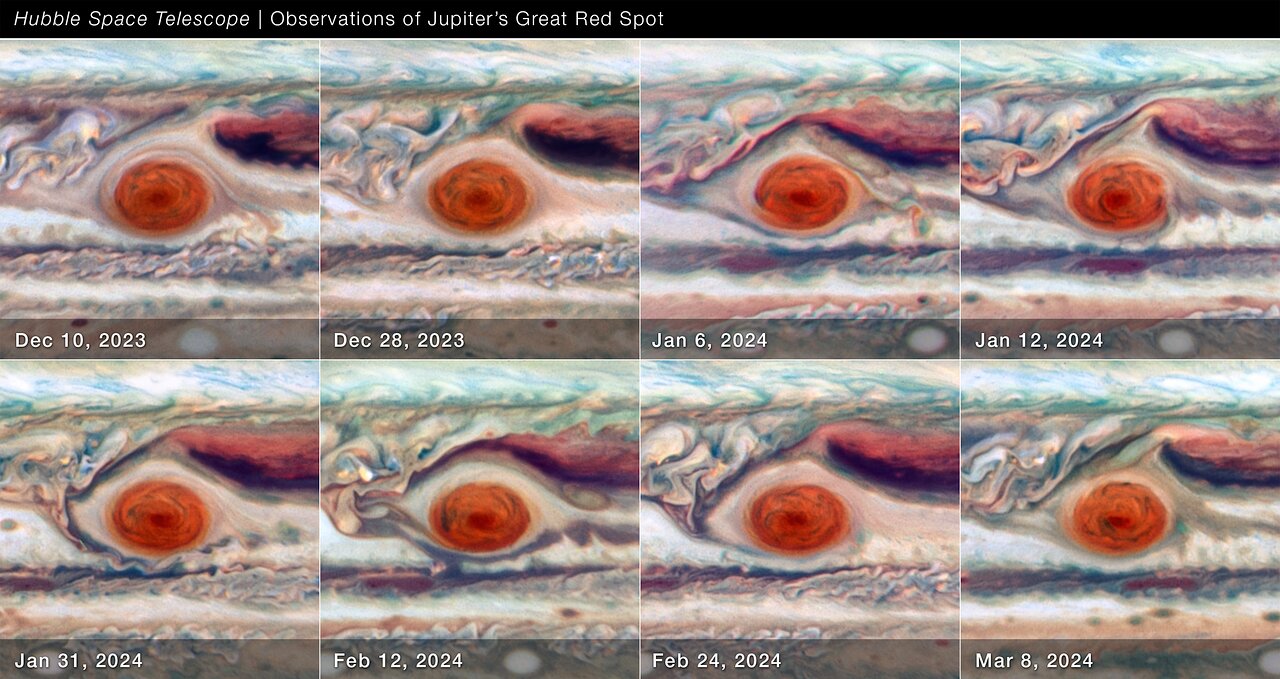
Image (Credit): Jupiter’s Great Red Spot captured by the Hubble Space Telescope over a 90 day period. (NASA, ESA, A. Simon (GSFC))
This week’s image is from the NASA/European Space Agency (ESA) Hubble Space Telescope. It captures one of the most identifiable objects in our solar system – Jupiter’s Great Red Spot.
Using Hubble Space Telescope data spanning approximately 90 days (between December 2023 and March 2024) when the giant planet Jupiter was approximately 630 million to 820 million kilometres from the Sun, astronomers measured the Great Red Spot’s size, shape, brightness, colour, and vorticity over one full oscillation cycle. The data reveal that the Great Red Spot is not as stable as it might look. It was observed going through an oscillation in its elliptical shape, jiggling like a bowl of gelatin. The cause of the 90-day oscillation is unknown.
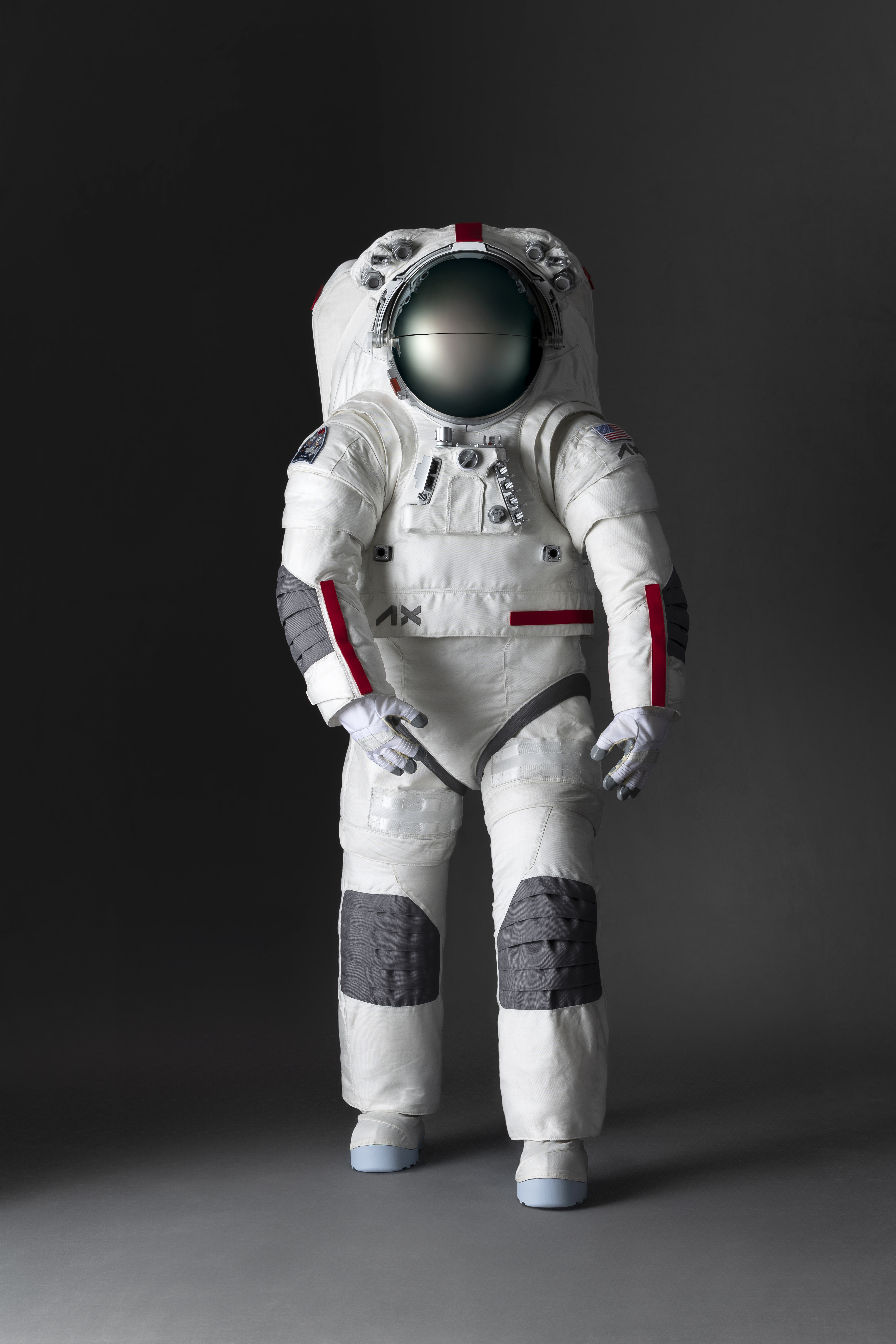
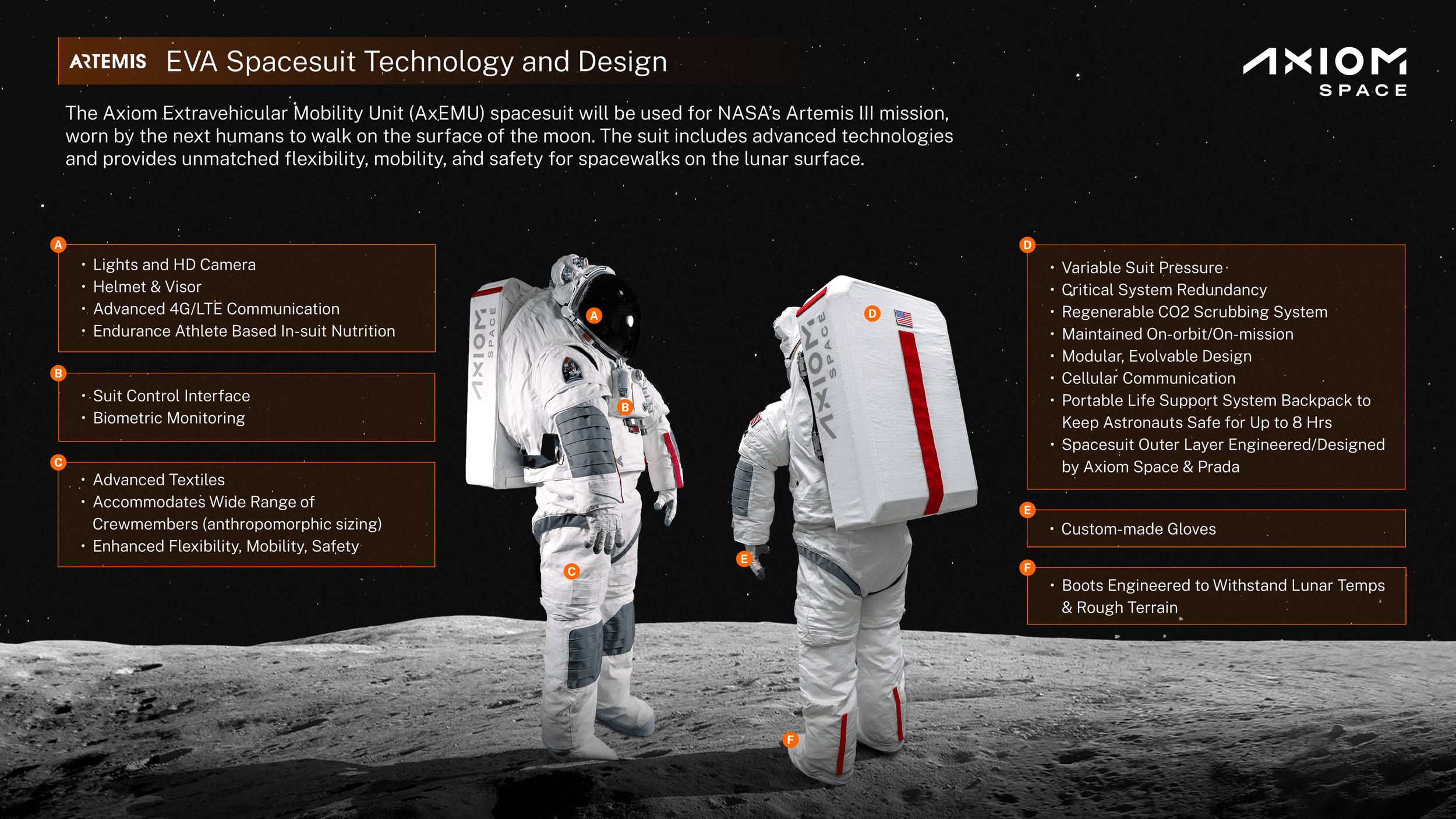
Image (Credit): The AxEMU spacesuit. (Axiom Space)
“At the International Astronautical Congress in Milan, Italy, Axiom Space and Prada revealed for the first time today the flight design of the Axiom Extravehicular Mobility Unit (AxEMU) spacesuit that will be used for NASA’s Artemis III mission…The AxEMU suit is nearing the final development stage. It completed a successful pressurized simulation with Artemis III partners – NASA, SpaceX, and Axiom Space – marking the first test of its kind since the Apollo era. It will continue to undergo testing including crewed underwater tests at the NBL facility, integrated tests with the Artemis Lunar Terrain Vehicle prototypes, and will enter the critical design review phase in 2025.“
-Statement from an Axiom Space press release. Specifics about the new space suit can be found in the graphic below. Now it is a matter of getting the other pieces together in time for the Artemis III mission, which will entail sending astronauts to explore the Moon’s South Pole.



 Our Awesome Universe