Image (Credit): The launch earlier today of a SpaceX Falcon 9 rocket carrying tNASA’s SpaceX Crew-9 mission to the ISS. (NASA/Keegan Barber)
Earlier today, NASA contractor SpaceX successfully launched the Crew-9 mission towards the International Space Station aboard a Falcon 9 rocket. The two crew members should be aboard the station tomorrow to join the rest of the Expedition 72 crew, who arrived at the station as part of two earlier launches.
While some are calling this a “rescue mission,” it is really a planned mission with a truncated crew roster to accommodate the two Boeing Starliner astronauts on the return back to Earth. Nothing to see here folks.
NASA Administrator Bill Nelson said it best:
This mission required a lot of operational and planning flexibility. I congratulate the entire team on a successful launch today, and godspeed to Nick and Aleksandr as they make their way to the space station…Our NASA wizards and our commercial and international partners have shown once again the success that comes from working together and adapting to changing circumstances without sacrificing the safe and professional operations of the International Space Station.
NASA has become quite flexible this year as it works with its commercial partners.
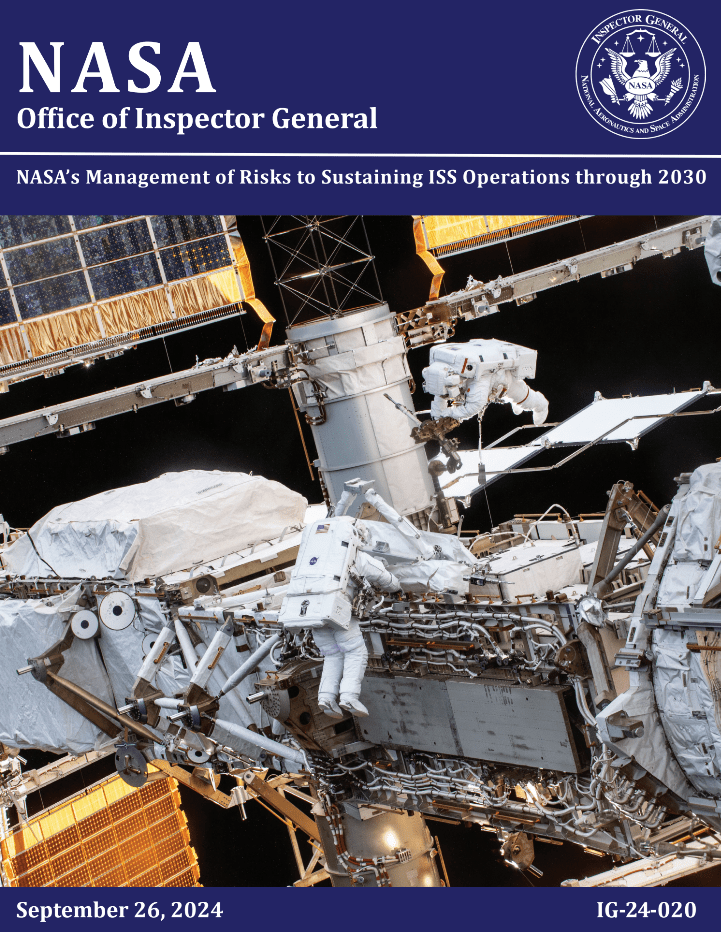
NASA’s Office of Inspect General (OIG) issued an audit report this week, NASA’s Management of Risks to Sustaining ISS Operations through 2030 (IG-24-020), that highlighted the ongoing issues NASA faces to keep the International Space Station (ISS) in orbit as well as plan its decommissioning.
The OIG auditors specifically noted concerns regarding (1) repairing and maintaining the integrity of the station, (2) too little redundancy in the commercial partners carrying crews and supplies to the station, (3) continued risk of micro meteoroids and debris damaging the station, (4) lack of ready-to-use capsules to escape the station in an emergency, and (5) lack of Russian commitment to de-orbiting the station at the end of its life.
That’s a long list of concerns, none of which are surprising given the complexity of the space station and the ongoing environmental issue, be it commercial partners, exterior space, or Russian commitment. It is amazing that the station has had so few major issues to date.
These issues need to be resolved for the current station and be considered as part of any new stations (government-run or commercial), whether they are orbiting the Earth, the Moon, or even Mars.
Image (Credit): Tropical Storm Helene on Sept. 24, 2024 as captured by the NASA/NOAA Suomi NPP satellite. (NASA Worldview)
SpaceX was scheduled to send astronauts to the International Space Station (ISS) tomorrow, but the approaching Hurricane Helene has delayed the launch until Saturday, September 28.
The Crew-9 mission is down to two crew members – NASA astronaut Nick Hague and Roscosmos cosmonaut Aleksandr Gorbunov – as a result of the two Boeing astronauts stuck on the ISS being added to the Crew-9 mission. The new combined crew will stay on the station until February 2025 and then return to Earth together.
NASA is in the process of locking down its Florida launch sites until the hurricane passes.
Patience is always needed with launches this time of year, and NASA seems to need a lot of patience these days for reasons beyond the weather.
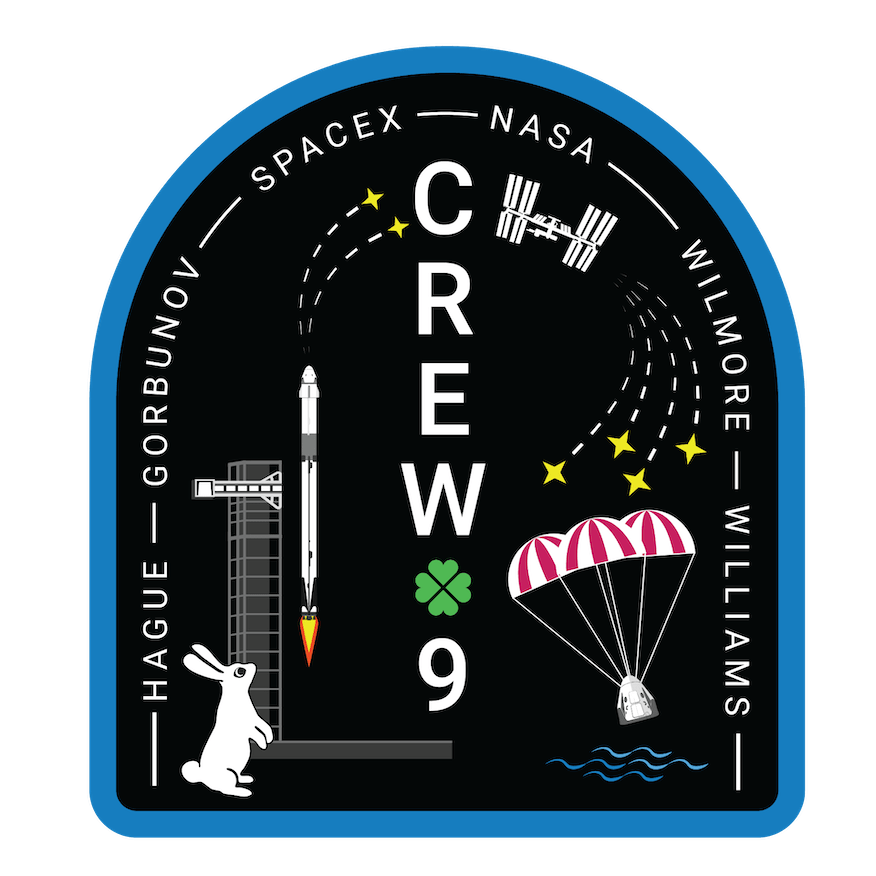
Image (Credit): Crew-9 mission patch designed by SpaceX. (SpaceX)
A decade ago, on Sept. 21, 2014, NASA’s MAVEN (Mars Atmospheric and Volatile EvolutioN) spacecraft entered orbit around Mars, beginning its ongoing exploration of the Red Planet’s upper atmosphere. The mission has produced a wealth of data about how Mars’ atmosphere responds to the Sun and solar wind, and how these interactions can explain the loss of the Martian atmosphere to space.Today, MAVEN continues to make exciting new discoveries about the Red Planet that increase our understanding of how atmospheric evolution affected Mars’ climate and the previous presence of liquid water on its surface, potentially determining its prior habitability.
A new algorithm tested on NASA’s Perseverance Rover on Mars may lead to better forecasting of hurricanes, wildfires, and other extreme weather events that impact millions globally. Georgia Tech Ph.D. student Austin P. Wright is first author of a paper that introduces Nested Fusion. The new algorithm improves scientists’ ability to search for past signs of life on the Martian surface. This innovation supports NASA’s Mars 2020 mission. In addition, scientists from other fields working with large, overlapping datasets can use Nested Fusion’s methods for their studies. Wright presented Nested Fusion at the 2024 International Conference on Knowledge Discovery and Data Mining (KDD 2024) where it was a runner-up for the best paper award. KDD is widely considered the most prestigious conference for knowledge discovery and data mining research.
Astronomers have made a breathtaking revelation: The most massive discovered black hole jets, extending on to incredibly 23 million light-years. To look at it through that lens, that’s approximately the length of 140 Milky Way galaxies positioned in a straight line. The immense jets, named ‘Porphyrion’ after a Greek giant, emerge from a supermassive black hole at the center of a faraway galaxy that was in existence when the universe was only 6.3 billion years old – – close to half its existing age of 13.8 billion years.
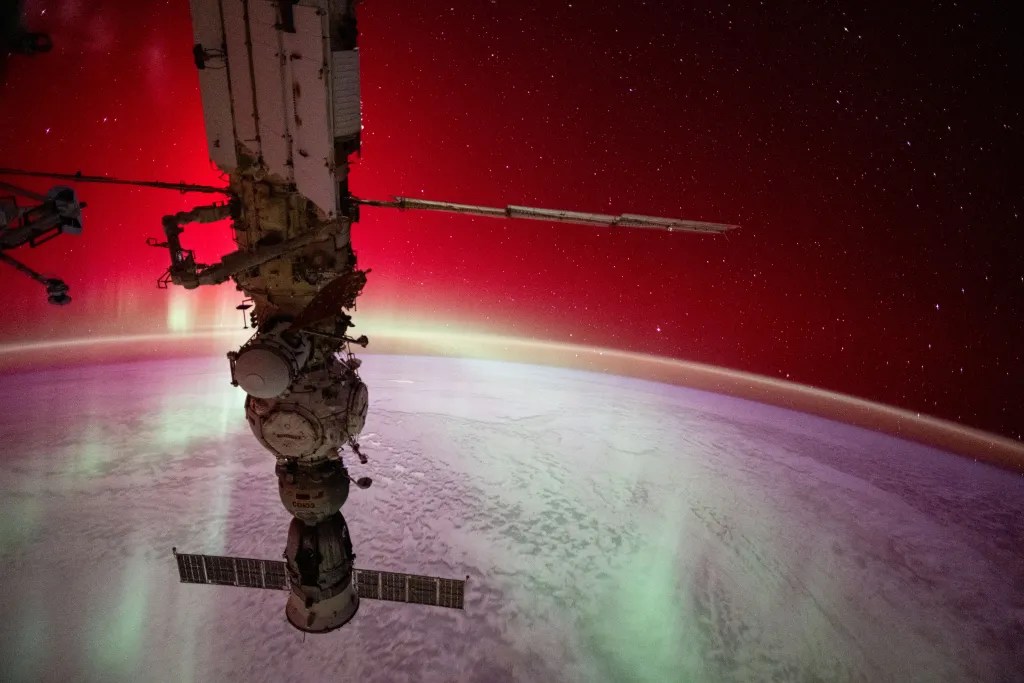
Image (Credit): The Soyuz MS-25 crew ship attached to the ISS as an aurora radiates brightly above the Indian Ocean. (NASA)
Astronaut Tracy C. Dyson is now safely back on Earth thanks to the Russian Soyuz MS-25 spacecraft, which also returned cosmonauts Oleg Kononenko and Nikolai Chub. The no drama return from the International Space Station (ISS) was very different from the recent Boeing Starliner return. The press barely paid attention, which is a good thing.
NASA highlighted Dyson’s six-month tour in this way:
Spanning 184 days in space, Dyson’s third spaceflight covered 2,944 orbits of the Earth and a journey of 78 million miles as an Expedition 70/71 flight engineer. Dyson also conducted one spacewalk of 31 minutes, bringing her career total to 23 hours, 20 minutes on four spacewalks.
I just hope that future Starliner’s can intentionally place astronauts in space for six-months or longer and then return to Earth with little attention. That type of clockwork will be success.




 Our Awesome Universe