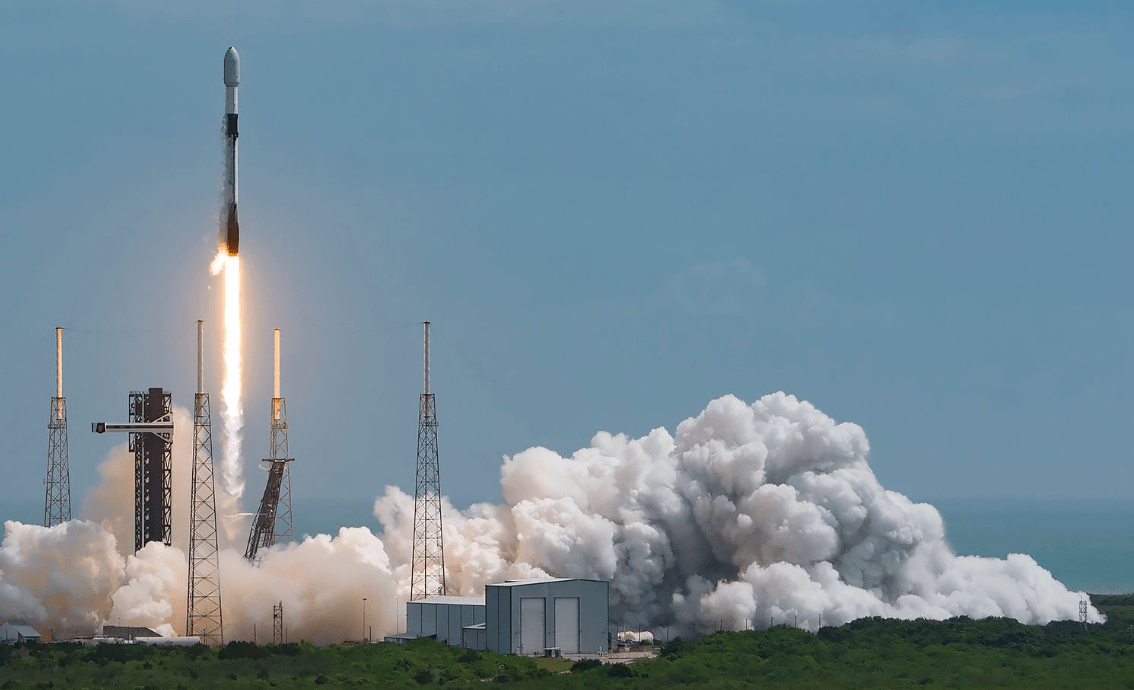
Image (Credit): Successful launch of a SpaceX Falcon 9 on August 4, 2024 sending supplies to the ISS. (SpaceX)
The weather cleared enough in Florida on Sunday for the SpaceX launch to take place, sending the Northrop Grumman Cygnus cargo spacecraft towards the International Space Station (ISS) after some earlier delays.
At 11:02 am ET, SpaceX’s Falcon 9 launched Northrop Grumman’s 21st Commercial Resupply Services mission (NG-21) to the ISS from Space Complex 40 (SLC-40) at Cape Canaveral Space Force Station in Florida.
The spacecraft will intercept the ISS on Tuesday, August 6. With the extra Starliner astronauts on board awaiting permission from Boeing to return to Earth, it is likely that the supplies will be very welcome.
Another three astronauts will be launched to the ISS on August 18 as part of the normal crew rotation. Hence, it will get even more crowded at the station by mid-August.
Update: The next crewed mission to the ISS was moved to “no earlier than” September 24 to give the Starliner more time to return to Earth.
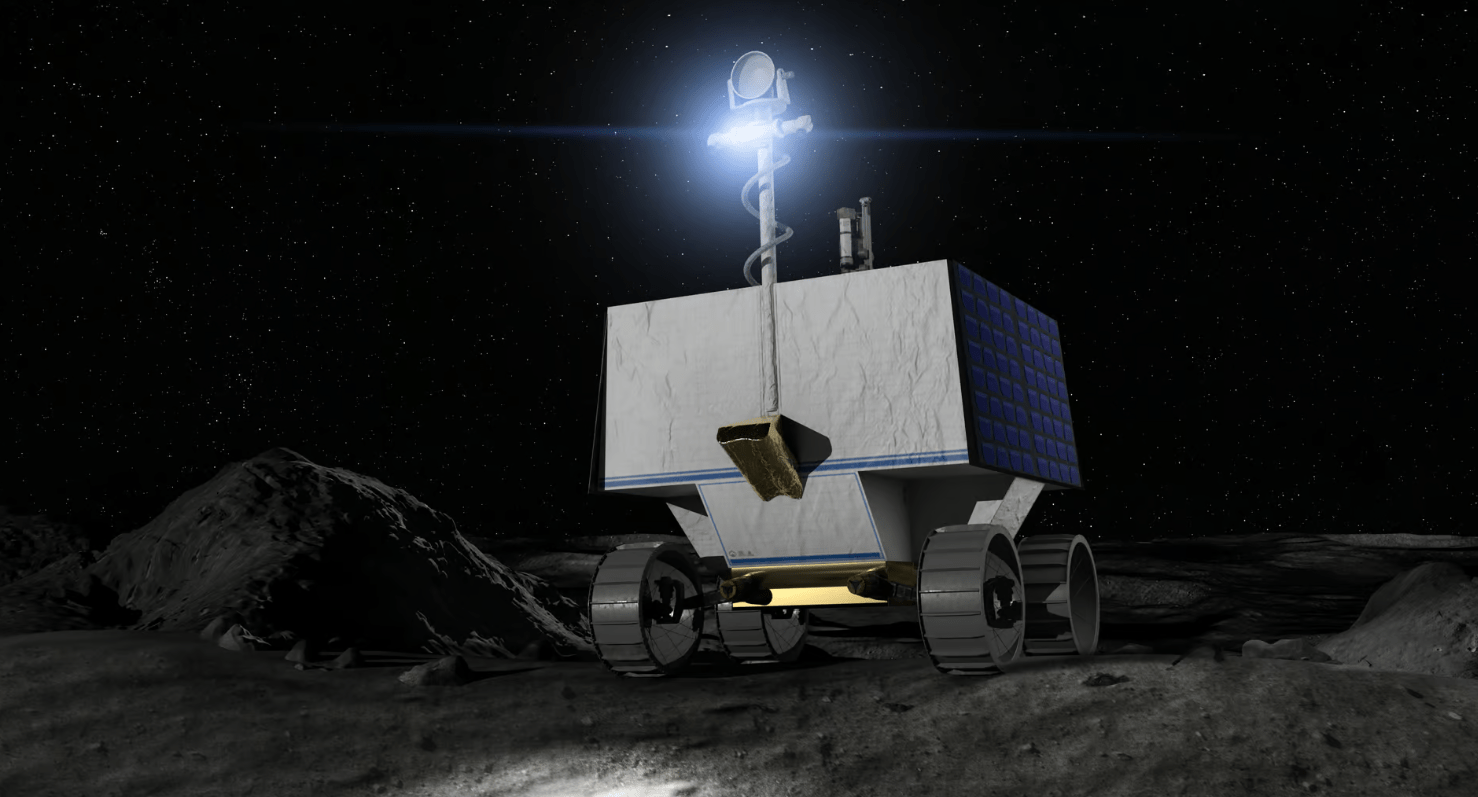
Image (Credit): Artist’s rendering of NASA’s Volatiles Investigating Polar Exploration Rover (VIPER) on the lunar surface. (NASA)
“I’m very disappointed in the recent NASA decision to cancel the VIPER rover…Please work with me as the bill moves forward to look for ways to repurpose the lander portion of this mission to advance moon-to-Mars objectives. The mission directly supports a national imperative for continued US leadership in science and exploration in the face of urgent geopolitical competition.”
-Statement by Senator Shelley Moore Capito (R-WV) at a July 25, 2024 budget hearing, as quoted by CNN. The CNN story highlights efforts by The Planetary Society to encourage the continuation of the mission as well as NASA’s efforts to solicit U.S. industry and international partners’ “expressions of interest” by August 1, 2024 for ways to use “the existing VIPER rover system at no cost to the government.”
Image (Credit): Northrop Grumman’s Cygnus cargo spacecraft as seen from the ISS. (Northrop Grumman)
The weather in Florida has delayed today’s Northrop Grumman resupply mission to the International Space Station (ISS). In fact, SpaceX is launching the payload for Grumman from the Cape Canaveral Space Force Station rather than the typical launch facility in Virginia. The Northrop Grumman Cygnus cargo spacecraft with its 8,200 pounds of supplies will probably need to sit on the launch pad for a few more days until the weather clears.
Why is SpaceX launching a Grumman resupply mission, you might ask? Doesn’t Grumman have its own rocket? Yes, and no. It has launches most of its resupply missions on its own Antares rocket, but the newest version of the rocket, the Antares 330, is still being finalized and is not expected to be ready until next year. As a result, Grumman procured three flights from SpaceX.
The ability of the commercial parties to support one another’s missions is encouraging, just as the European Space Agency dependied on SpaceX while it developed a new generation of its Ariane rocket.
SpaceX is always there to help (at a cost, of course) as other rocket companies prepare for the challenges ahead. In the case of Northrop Grumman, it needed to move away from its reliance on Ukrainian/Russian rockets and create a more reliable supply chain.
Image (Credit): The Crab Nebula captured by the Chandra X-ray Observatory. (X-ray: (Chandra) NASA/CXC/SAO, (IXPE) NASA/MSFC; Optical: NASA/ESA/STScI; Image Processing: NASA/CXC/SAO/J. Schmidt, K. Arcand, and L. Frattare)
The images released to celebrate the 25th anniversary of the Chandra X-ray Observatory are too beautiful to be visited only once. Above is another amazing image from the collection showing the Crab Nebula.
This composite image features the remnant of a supernova explosion, which resembles a neon purple mushroom at the heart of a colorful web of veins and filaments. Known as the Crab Nebula, the heavily veined blue and red cloud of gas is set against the blackness of space. At the core of the nebula is a pulsar, a rotating neutron star emitting electromagnetic radiation. Here, the pulsar appears as a bright white dot sitting in a neon purple cloud. Surrounding the dot are white rings. These are created by particles driven away from the pulsar and colliding with gas in the nebula to produce X-rays. From this angle, the rings and purple cloud combine to resemble a mushroom cap. Completing the look of a mushroom is a thin mushroom stem emerging from the white dot. This is a narrow beam of particles blasting away from the pulsar.
This composite image features a double star cluster, a blue-tinted cloud, and several neon purple dots. This double cluster is part of the Large Magellanic Cloud, a companion galaxy to the Milky Way. The bright, golden stars in the larger cluster fill the upper center of the image. The other cluster is much smaller and coincides with one of the neon purple circles located slightly above and to the right of the image’s center. This and the other purple circles are X-ray sources detected with Chandra. To our left of the combined cluster is a vertical streak of blue-tinted cloud. Extending beyond the upper and lower edges of the image, this section of cloud resembles wafting smoke from a cigarette.
Image (Credit): NGC 1850 captured by the Chandra X-ray Observatory. (X-ray: NASA/CXC/SAO; Optical: NASA/ESA/STScI; Infrared: NASA/JPL/CalTech/Spitzer; Image Processing: NASA/CXC/SAO/J. Major, K. Arcand)
Image (Credit): NASA’s Perseverance Mars Rover. (NASA)
“Cheyava Falls is the most puzzling, complex, and potentially important rock yet investigated by Perseverance…On the one hand, we have our first compelling detection of organic material, distinctive colorful spots indicative of chemical reactions that microbial life could use as an energy source, and clear evidence that water — necessary for life — once passed through the rock. On the other hand, we have been unable to determine exactly how the rock formed and to what extent nearby rocks may have heated Cheyava Falls and contributed to these features.”
–Statement by Ken Farley, Perseverance project scientist of Caltech in Pasadena, regarding a recent finding by the Perseverance rover on Mars. The rock, labeled “Cheyava Falls,” may answer whether Mars was home to microscopic life in the distant past.





 Our Awesome Universe