
Space Stories: Launch of GOES-U Satellite, Jupiter’s Surprising Atmosphere, and the Role of Black Holes in Dark Matter

Image (Credit): June 25, 2024 launch of NASA’s GOES-U satellite. (SpaceX)

Here are some recent stories of interest.

America Space: Falcon Heavy Launches, GOES-U Heads for Geostationary Orbit

SpaceX successfully launched its first Falcon Heavy of the year on Wednesday evening, the triple-barreled booster lifting the 11,000-pound (5,000-kilogram) Geostationary Operational Environmental Satellite (GOES-U) almost to Geostationary Earth Orbit (GEO) on behalf of the National Oceanic and Atmospheric Administration (NOAA). The Heavy—flying for the first time since November 2022 with a brand-new center core and pair of side-mounted strap-on boosters—went airborne from historic Pad 39A at Florida’s Kennedy Space Center (KSC) at 5:26 p.m. EDT, ten minutes after the opening of a two-hour “launch window”.

European Space Agency: Jupiter’s Upper Atmosphere Surprises Astronomers

The Great Red Spot of Jupiter was observed by Webb’s Near-InfraRed Spectrograph (NIRSpec) in July 2022, using the instrument’s Integral Field Unit capabilities. The team’s Early Release Science observations sought to investigate if this region was in fact dull, and the region above the iconic Great Red Spot was targeted for Webb’s observations. The team was surprised to discover that the upper atmosphere hosts a variety of intricate structures, including dark arcs and bright spots, across the entire field of view. “We thought this region, perhaps naively, would be really boring,” shared team leader Henrik Melin of the University of Leicester in the United Kingdom. “It is in fact just as interesting as the northern lights, if not more so. Jupiter never ceases to surprise.”

University of Warsaw: Is Dark Matter Made of Black Holes?

Gravitational wave detectors, LIGO and Virgo, have detected a population of massive black holes whose origin is one of the biggest mysteries in modern astronomy. According to one hypothesis, these objects may have formed in the very early Universe and may compose dark matter, a mysterious substance filling the Universe. A team of scientists from the OGLE (Optical Gravitational Lensing Experiment) survey from the Astronomical Observatory of the University of Warsaw have announced the results of nearly 20-year-long observations indicating that such massive black holes may comprise at most a few percent of dark matter. Another explanation, therefore, is needed for gravitational wave sources. The results of the study were published in two articles, in Nature and the Astrophysical Journal Supplement Series.

Space Quote: The Starliner Delayed Return Continues

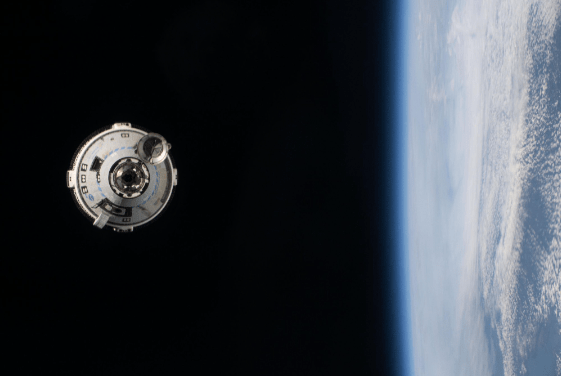
Image (Credit): The Boeing Starliner approaching the International Space Station. (NASA)

“We are strategically using the extra time to clear a path for some critical station activities while completing readiness for Butch and Suni’s return on Starliner, and gaining valuable insight into the system upgrades we will want to make for post-certification missions.”

Statement by Steve Stich, manager of NASA’s Commercial Crew Program, regarding delays in the return of Boeing’s Starliner capsule. The language is becoming as flowery as SpaceX’s language when something goes wrong. NASA has already nixed the June 26 return date and has yet to provide a new date.

What to do When an Asteroid is Heading for Earth

Back in early April, officials from NASA, FEMA, other domestic and foreign government agencies, and private think tanks conducted an exercise – Planetary Defense Interagency Tabletop Exercise 5 – to devise ways to deal with an incoming asteroid that threatened the planet. You can see the presentation components and results in the May 13th NASA report.

Here is the scenario:

  • 72% chance than an asteroid may hit Earth in 14 years.
  • Requirements for preventing its impact are unknown.
  • Models indicate the asteroid could devastate a regional- to country-scale area, if it should impact.

And the objective:

Awareness raising; space mission options; disaster preparedness; information sharing and public messaging.

Some of the takeaways were as follows:

  • Many stakeholders expressed that they would want as much information about the asteroid as soon as possible but expressed skepticism that funding would be forthcoming to obtain such information without more definitive knowledge of the risk.
  • Misinformation and disinformation would have to be dealt with.
  • Although specific disaster management plans for an [Near Earth Object] impact threat do not currently exist, plans for response to other catastrophes may be a suitable starting point.

You can read all about the results in the report itself, but it is clear we are not ready for such an event.

Maybe we would do better with a NASA tabletop exercise covering an alien invasion 400 years in the future, giving us plenty of time to plan it out. Of course, this scenario is already being played out on television (as well as the book that started it all).

Voyager 1 is Communicating Again

Image (Credit): Artist’s rendering of the Voyager 1 spacecraft. (NASA)

The Voyager 1 spacecraft is communicating properly again after having issues since November 2023. NASA was able to fix the spacecraft that is currently more than 15 billion miles from Earth, which is a pretty impressive feat.

Late last week, NASA noted:

The team partially resolved the issue in April when they prompted the spacecraft to begin returning engineering data, which includes information about the health and status of the spacecraft. On May 19, the mission team executed the second step of that repair process and beamed a command to the spacecraft to begin returning science data. Two of the four science instruments returned to their normal operating modes immediately. Two other instruments required some additional work, but now, all four are returning usable science data.

Launched back in 1977, the Voyager 1 and Voyager 2 spacecraft explored the solar system before starting a journey to the great unknown. Both are now the only spacecraft outside the heliosphere.

You can read more about the Voyager spacecraft and mission here.

Podcast: A Mixed Week for Musk

Image (Credit): Scene from a Tesla crash. (fox2detroit.com)

While things appear to be going Elon Musk’s way with his ridiculous Tesla pay package, The Wall Street Journal had another story this week that discussed his self-serving management style that should not merit reward. The article, “Elon Musk’s Boundary-Blurring Relationships With Women at SpaceX,” highlights some pretty horrible behavior for a man that then and now believes he is above the law (and all codes of decency).

If you cannot read the Journal article, you can find summaries of the story elsewhere or listen to the Wall Street Journal podcast called The Journal. The podcast is titled “Elon Musk’s Unusual Relationships With Women at SpaceX.”

It is scary that the US space program is so dependent on the behavior of this man, who has already been part of prior Wall Street Journal articles about his drug use.

We need to build greater depth in our space program, be it Blue Origin, Boeing, Northrop Grumman, Rocket Lab, or others. The dream of a stronger space program could die if we tie too much to one man.