Image (Credit): The approach of the Soyuz MS-25 spacecraft as seen from the ISS. (NASA TV)
Earlier today, the two cosmonauts and one astronaut that launched on the Russian Soyuz MS-25 mission over the weekend safely attached themselves to the International Space Station. The station is now hosting a crew of 10.
Both cosmonauts Oleg Novitskiy and cosmonaut Marina Vasilevskaya (of Belarus) from this latest mission will return to Earth in the Soyuz MS-24 capsule in about 12 days along with NASA astronauts Loral O’Hara, who will have spent a total of 204 days on the station.
It’s a game of musical spacecraft, but it seems the routine is working and, other than the occasional leak, all is well with the station and its crew.
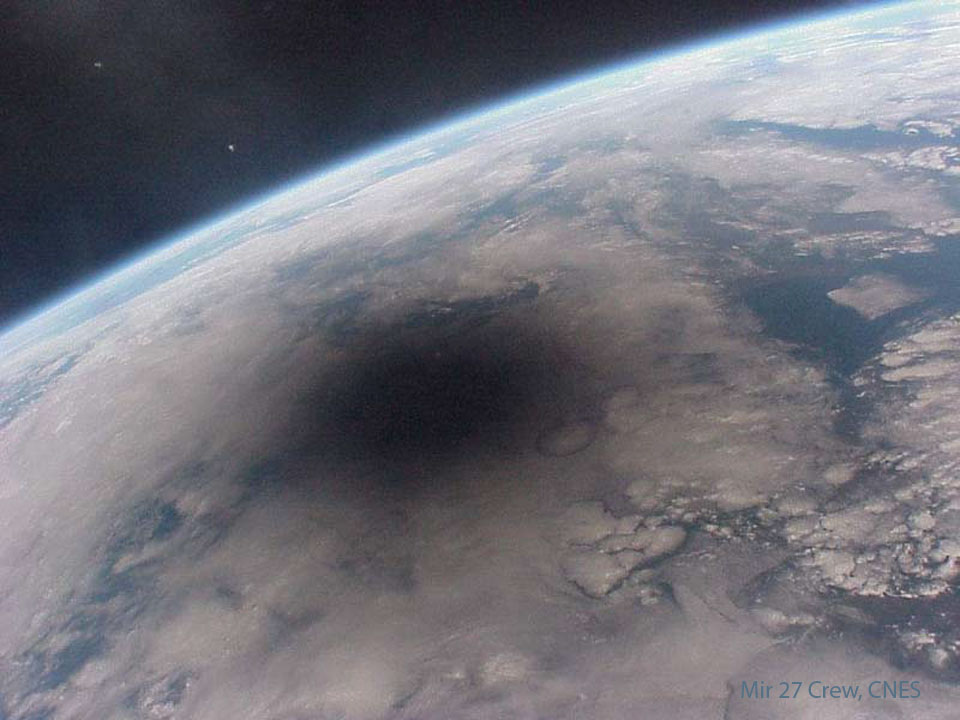
Image (Credit): A view of the Moon’s shadow on Earth during the solar eclipse on August 11, 1999. The image was captured by Russia’s Mir space station. (Mir 27 Crew)
On April 8, should you be outside staring at the Total Solar Eclipse, you may want to take a few precautions so that you can witness future eclipses as well. In other words, protect your eyes!
NASA has provided a few tips related to photographing the eclipse. Please keep all of this in mind.
For instance, NASA notes:
Looking directly at the Sun is dangerous to your eyes and your camera. To take images when the Sun is partially eclipsed, you’ll need to use a special solar filter to protect your camera, just as you’ll need a pair of solar viewing glasses (also called eclipse glasses) to protect your eyes. However, at totality, when the Moon completely blocks the Sun, make sure to remove the filter so you can see the Sun’s outer atmosphere – the corona.
Image (Credit): Members of the Soyuz MS-25 crew – commander Oleg Novitskiy (bottom), NASA astronaut Tracy Dyson (middle), and Belarus guest cosmonaut Marina Vasilevskaya (top). (NASA/Bill Ingalls)
Earlier today, a Russian Soyuz rocket launched into space to bring three new crew members to the International Space Station (ISS).
The passengers on today’s delayed flight are cosmonauts Oleg Novitskiy and Marina Vasilevskaya as well as NASA astronaut Tracy Dyson. They are expected to board the ISS on Monday.
Astronaut Dyson, who plans to stay on the station for six months, will assist her fellow astronauts on the ISS with a variety of experiments, including “…[s]tudies of neurological organoids, plant growth, and shifts in body fluids,”
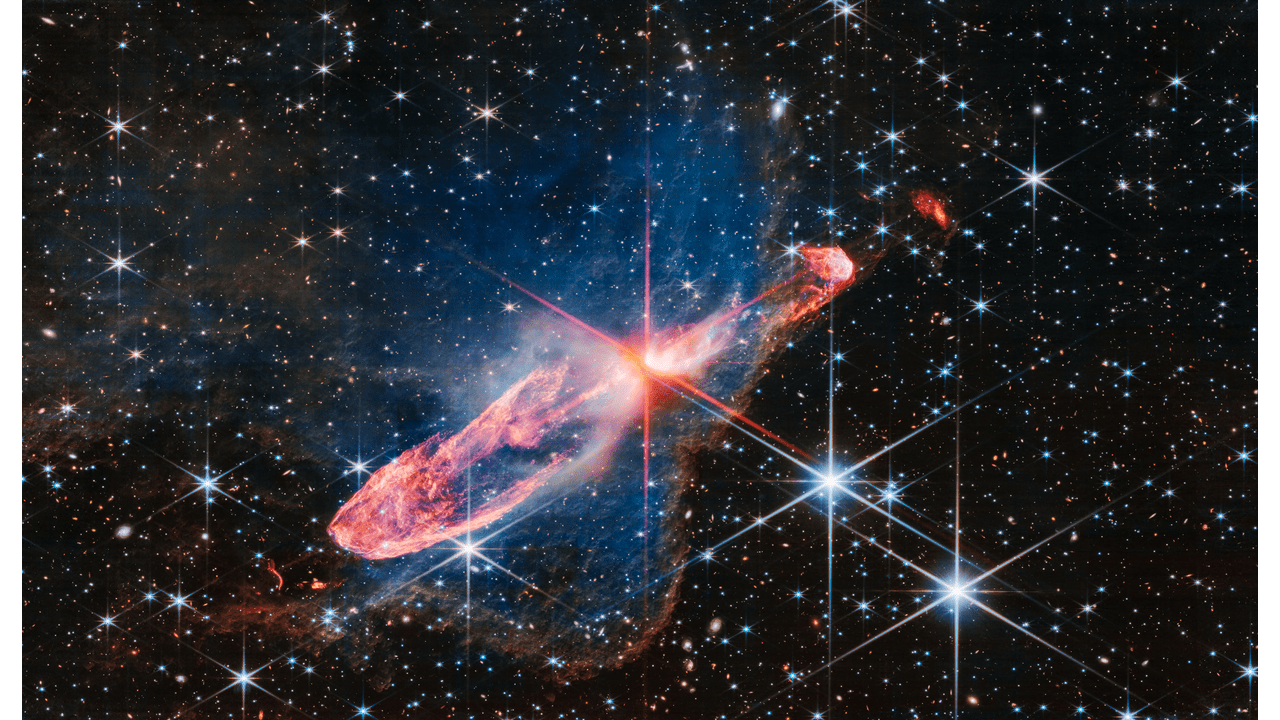
NASA’s James Webb Space Telescope has captured a tightly bound pair of actively forming stars, known as Herbig-Haro 46/47, in high-resolution near-infrared light. Look for them at the center of the red diffraction spikes. The stars are buried deeply, appearing as an orange-white splotch. They are surrounded by a disk of gas and dust that continues to add to their mass.
Herbig-Haro 46/47 is an important object to study because it is relatively young – only a few thousand years old. Stars take millions of years to fully form. Targets like this also give researchers insight into how stars gather mass over time, potentially allowing them to model how our own Sun, a low-mass star, formed.
The two-sided orange lobes were created by earlier ejections from these stars. The stars’ more recent ejections appear in a thread-like blue, running along the angled diffraction spike that covers the orange lobes.
Actively forming stars ingest the gas and dust that immediately surrounds them in a disk (imagine an edge-on circle encasing them). When the stars “eat” too much material in too short a time, they respond by sending out two-sided jets along the opposite axis, settling down the star’s spin, and removing mass from the area. Over millennia, these ejections regulate how much mass the stars retain.
Don’t miss the delicate, semi-transparent blue cloud. This is a region of dense dust and gas, known as a nebula. Webb’s crisp near-infrared image lets us see through its gauzy layers, showing off a lot more of Herbig-Haro 46/47, while also revealing a deep range of stars and galaxies that lie far beyond it. The nebula’s edges transform into a soft orange outline, like a backward L along the right and bottom.
The blue nebula influences the shapes of the orange jets shot out by the central stars. As ejected material rams into the nebula on the lower left, it takes on wider shapes, because there is more opportunity for the jets to interact with molecules within the nebula. Its material also causes the stars’ ejections to light up.
Over millions of years, the stars in Herbig-Haro 46/47 will fully form – clearing the scene.




 Our Awesome Universe