An Interesting Message for Europa

Image (Credit): One side of the panel attached to the Europa Clipper showing “water” ” in 103 languages (explained below). (NASA/JPL-Caltech)

In past NASA missions to the outer planets of our solar system, we attached messages for any distant civilization that might be out there. Both the Pioneer and Voyager missions contained such messages.

So what about NASA’s Europa Clipper mission to Jupiter’s moon set to launch in October? It too will have some messages, but these appear to be for the inhabitants of the moon rather than some distant civilization.

A triangular 7″ x 11″ metal plate attached to the spacecraft destined for Europa will carry messages on both sides. The image above shows one of these sides containing features waveforms that are visual representations of the sound waves formed by the word “water” in 103 languages.

The other side of the plate (shown below) contains a variety of messages:

  • the Drake Equation, which estimate the possibility of finding advanced civilizations beyond Earth;
  • U.S. Poet Laureate Ada Limón’s handwritten “In Praise of Mystery: A Poem for Europa”;
  • a reference to the radio frequencies considered plausible for interstellar communication; and
  • a portrait Ron Greeley, whose early efforts laid the foundation for Europa Clipper.

The spacecraft will also carry a silicon microchip containing more than 2.6 million names that were submitted by the public as part of NASA’s “Message in a Bottle” campaign.

This is all interesting in itself, but not really a message to others. I expect it is not intended for anyone else but ourselves because the Europa Clipper is not expected to leave the solar system but instead crash into another of Jupiter’s moons – Ganymede.

Note: You may wonder about the message on the New Horizons spacecraft that is also travelling to the edges of our solar system. That message is somewhat controversial. I will let you read about that one in this Slate article, “Ashes and Small Change.”

Image (Credit): One side of the panel attached to the Europa Clipper showing a poem, portrait, and more (explained above). (NASA/JPL-Caltech)

In Case You Missed It/Video: The Stakes Are High with Our Return to the Moon

Image (Credit): Moving the Artemis I mission into place. (NASA)

With the recent glitches related to the two commercial Moon missions, an earlier NASA video on the Artemis program became all too relevant. In the video, “Farther and Faster: NASA’s Journey to the Moon with Artemis,” we hear that the stakes are high as we attempt to return to the Moon, and how we could be the generation that loses the Moon if we don’t get it right.

In addition to the risks, the video also highlights the great successes already with the Artemis I mission, as you may recall from back in 2022:

Over the course of 25.5 days, Orion performed two lunar flybys, coming within 80 miles (129 kilometers) of the lunar surface. At its farthest distance during the mission, Orion traveled nearly 270,000 miles (435,000 kilometers) from our home planet. On Dec. 11, 2022, NASA’s Orion spacecraft successfully completed a parachute-assisted splashdown in the Pacific Ocean at 9:40 a.m. PST (12:40 p.m. EST) as the final major milestone of the Artemis I mission.

Artemis I set new performance records, exceeded efficiency expectations, and established new safety baselines for humans in deep space. This is a prelude to what comes next—following the success of Artemis I, human beings will fly around the Moon on Artemis II.

It is worth pondering what we have ahead of us. NASA may be having a few issues with its commercial partners, but the main mission has done well. We cannot be discouraged with a few delays as long as we keep the course. We have done it before and there is no reason we cannot do it again. I say slow and steady.

Mars is the goal, but we need to prove ourselves with the Moon. Check out the video and determine for yourself if we have already made a fair amount of progress.

Pic of the Week: Spiral galaxy NGC 1300

Image (Credit): JWST’s view of spiral galaxy NGC 1300. (NASA, ESA, CSA, STScI, Janice Lee (STScI), Thomas Williams (Oxford), and the PHANGS team)

This week’s image is from the James Webb Space Telescope (JWST). It shows a face-on view of spiral galaxy NGC 1300, which is 69 million light-years away.

Here is more about the image from NASA:

Webb’s image of NGC 1300 shows a face-on barred spiral galaxy anchored by its central region, which is circular and shows a bright white point at the center with a light yellow circle around it. The central core is tiny compared to the rest of the galaxy. The core extends into the galaxy’s prominent diagonal bar structure, which is filled with a blue haze of stars. Orange dust filaments cross the bar, extending diagonally to the top and bottom, connecting the yellow circle in the central core to the galaxy’s spiral arms. There are two distinct orange spiral arms made of stars, gas, and dust that start at the edges of the bar and rotate counterclockwise. Together, the arm and bars form a backward S shape. The spiral arms are largely orange, ranging from dark to bright orange. Scattered across the packed scene are very few bright blue pinpoints of light. There are vast areas between where the orange spiral arms wrap that appear black. The top left and bottom right edges are dark black and there are some larger red and blue points of light, some that appear like disks seen from the side.

Another Crew Departing for the ISS

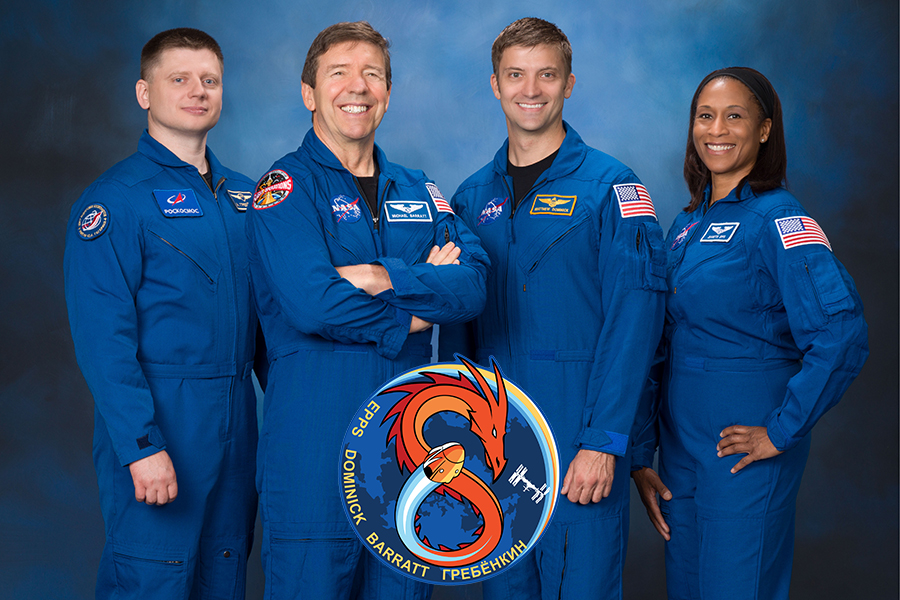
Image (Credit): The SpaceX Crew-8 (identified below) expected to depart later today. (NASA)

Later today, a SpaceX rocket with carry another crew to the International Space Station (ISS) after a few delays. The crew, shown above, consists of Alexander Grebenkin (Roscosmos), Michael Barratt (NASA), Matthew Dominick (NASA), Jeanette Epps (NASA).

The new crew will be approaching a space station already containing seven crew members as well as a module in need of repair. The Russian components of the space station have sprung a number of leaks over the past several years. The most recent appears to be a recurring oxygen leak.

To date, NASA is playing it cool, though I expect everyone on board would be happy to experience at leakless station as soon as possible. We know the ISS will not last forever, but until the day it is decommissioned it should be a safe vessel for the astronauts and cosmonauts aboard.

Update: The SpaceX launch went off without a hitch Sunday evening. The new crew on the Dragon spacecraft is expected to reach the ISS Tuesday morning.

Space Quote: The End of NASA’s OSAM-1 Project

Image (Credit): Artist’s rendering of the OSAM-1 project in action. (NASA)

“Following an in-depth, independent project review, NASA has decided to discontinue the On-orbit Servicing, Assembly, and Manufacturing 1 (OSAM-1) project due to continued technical, cost, and schedule challenges, and a broader community evolution away from refueling unprepared spacecraft, which has led to a lack of a committed partner. Following Congressional notification processes, project management plans to complete an orderly shutdown, including the disposition of sensitive hardware, pursuing potential partnerships or alternative hardware uses, and licensing of applicable technological developments. NASA leadership also is reviewing how to mitigate the impact of the cancellation on the workforce at NASA’s Goddard Space Flight Center in Greenbelt, Maryland.”

-Statement by NASA in recent communications. The project has been in development since 2015. About 450 NASA employees and contractors working on the OSAM-1 project. In an earlier report by the Government Accountability Office, the auditors noted, “OSAM-1 cost growth and schedule delays are exacerbated by poor contractor performance and continued technical challenges.”