All Eyes on the Next Moon Mission

Image (Credit): Intuitive Machines IM-1 mission on the launch pad at NASA’s Kennedy Space Center in Florida. (SpaceX)

The second NASA-related commercial Moon mission was set to launch earlier today, but SpaceX called it off at the last moment due to a methane issue with its Falcon 9 rocket. SpaceX is expected to try the launch tomorrow.

The launch of the Intuitive Machines IM-1 mission is related to NASA’s Commercial Lunar Payload Services (CLPS) initiative, and will serve as one of the first lunar-based pieces of the Artemis program.

In terms of the main mission, NASA noted:

Intuitive Machines’ Nova-C lander is expected to land on the Moon Thursday, Feb. 22. Among the items on its lander, the IM-1 mission will carry NASA science and technology instruments focusing on plume-surface interactions, space weather/lunar surface interactions, radio astronomy, precision landing technologies, and a communication and navigation node for future autonomous navigation technologies.

The Moon mission that failed last month was also part of NASA’s CLPS initiative. This program is off to a slow start, but hopefully it can be relied on to be a key component of the lunar space program going forward.

If you are looking for some good news, I can report that Russia’s Progress MS-26 International Space Station resupply mission successfully launched earlier today.

Space Stories: A Test of Space Suits, Water Detected on Asteroids, and China’s Growing Space Program

Image (Credit): Recent test of the space suit being built by Collins Aerospace. (Collins Aerospace)

Here are some recent stories of interest.

The Verge: One of NASA’s New Spacesuits Passes Microgravity Test

Collins Aerospace, a private company hired to create spacesuits for use outside the International Space Station (ISS), has tested its suit aboard a commercial microgravity flight, passing a milestone that lets engineers move forward toward critical design review…During the test, the plane executed “roller-coaster-like maneuvers” to induce weightlessness and allow someone wearing a prototype to see if it actually lets someone move around in it under those conditions.

Newsweek: NASA Data Detects Water on Asteroids for the First Time Ever

Water has been found on the surface of two asteroids for the first time, scientists said in a new paper. Two silicate-rich asteroids were detected by the retired Stratospheric Observatory for Infrared Astronomy (SOFIA) that were giving off a specific wavelength of light that indicated the presence of molecules of water, according to research published in The Planetary Science Journal. The discovery may have major implications for theories about how water initially made its way to our own planet. It could have been delivered via asteroid impact.

Astronomy.com: China is Embarking on a Science and Exploration Program of Staggering Scale

When China’s first lunar lander, Chang’e 3, touched down in Mare Imbrium on the Moon in 2013, it was the pinnacle of the country’s space endeavors. The robotic lander and its small Yutu rover companion were the first spacecraft to operate on the Moon since the 1970s, and provided new insights into our planet’s natural satellite…Since then, China’s space activities have exploded in range, frequency, and ambition. The country now rivals the U.S. for the most launches per year, with around 80 missions having been planned for 2023. The nation has its own modular space station, named Tiangong, which is expected to be continuously occupied by a rotating crew of three astronauts for at least a decade.

The Goldilocks Zone Turned Awfully Cold for Earth

Image (Credit): Artist’s rendering of a “Snowball Earth.” (NASA)

We point of telescopes at distant solar systems searching for exoplanets in the “Goldilocks Zone,” it being defined as the habitable zone around a star where water can remain in liquid form. But that was not always the case for planet Earth, even if we are the model for this zone.

A recent New York Times article, “How Earth Might Have Turned Into a Snowball,” discusses how the Earth became a frozen ball about 717 million years ago. And it remained in this deep freeze for approximately 56 million years.

While the article goes on to discuss the reasons for this freeze, I am more interested in the idea of what this may mean for our own plans to someday travel to a distant star.

If a civilization on another planet was viewing our solar system from afar 750 million years ago, they too may have mistaken our Earth as a perfectly place planet to support life on its surface. However, they would have needed to wait another 23 million years for our planet to revert back to having a liquid surface.

It appears timing is everything, and the inner workings of a planet can be just as important as its placement in the solar system. I expect our telescopes will be able to tease our more information about each exoplanet in the future, though it also makes sense to send robotic probes before ever attempting to send a human that far.

In the meantime, we have a few moons here in our own solar system with frozen oceans. We can start to learn more about the potential for life in such places and our ability to survive in such climates. NASA’s Europa Clipper, set to launch later this year, is part of that learning process.

Pic of the Week: Launch of the PACE Mission

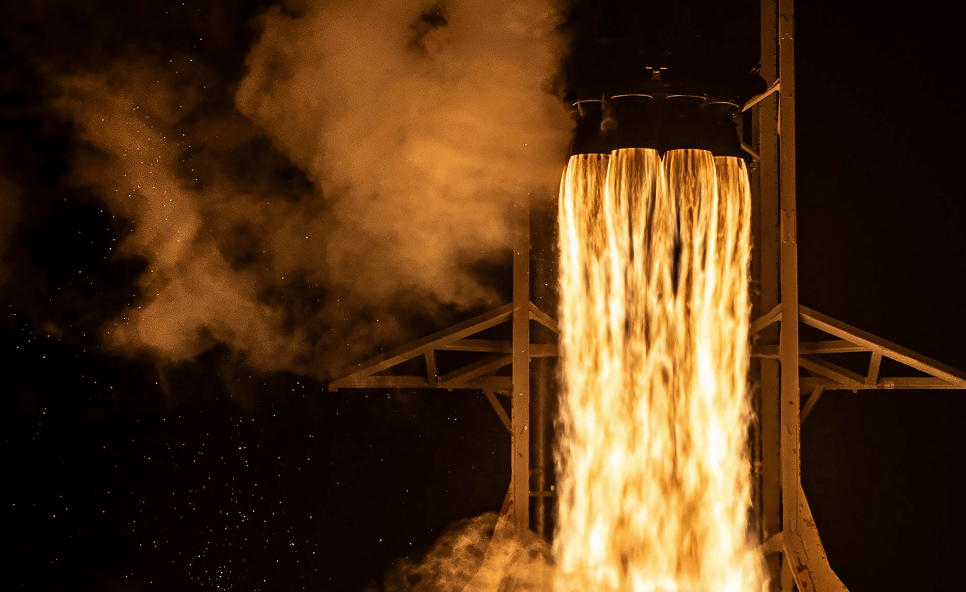
Image (Credit): Engines of the SpaceX rocket carrying the PACE spacecraft into orbit. (SpaceX)

This week’s image is from SpaceX, which launched NASA’s Plankton, Aerosol, Cloud, ocean Ecosystem (PACE) mission into orbit earlier today (the Falcon 9 rocket engines are shown above). 

The spacecraft is designed to monitor the Earth from orbit. NASA explains the mission is this way:

Information collected throughout PACE’s mission will benefit society in the areas of ocean health, harmful algal bloom monitoring, ecological forecasting, and air quality. PACE also will contribute new global measurements of ocean color, cloud properties, and aerosols, which will be essential to understanding the global carbon cycle and ocean ecosystem responses to a changing climate.

The PACE’s mission is designed to last at least three years, though the spacecraft is loaded with enough propellant to expand that timeline more than three times as long.

Bad News for NASA’s JPL and the Mars Sample Return

NASA has started to crack under budget uncertainty.

The Washington Post has reported that NASA’s Jet Propulsion Laboratory (JPL) is laying off 530 employees and another 40 contractors. Overall, this is an eight percent drop in JPL staffing, most of it related to the Mars Sample Return (MSR) efforts that have been facing cost overruns and questions from Congress.

JPL management explained the reduction in a memo to employees:

I am writing to share as much detail and clarity on our actions as I can, including reviewing the factors that have led to this decision, and our next steps. First, how we got here. Without an approved federal budget including final allocation for MSR FY24 funding levels, NASA previously directed JPL to plan for an MSR budget of $300M. This is consistent with the low end of congressional markups of NASA’s budget and a 63% decrease over the FY23 level. In response to this direction, and in an effort to protect our workforce, we implemented a hiring freeze, reduced MSR contracts, and implemented cuts to burden budgets across the Lab. Earlier this month, we further reduced spending by releasing some of our valued on-site contractors.

This may be a short layoff should NASA get more funding from Congress, but even then it is possible that some of the great talent associated with the program will head off into the sunset to find more secure employment.

Will we ever get a sample back from Mars? Can we get the information we need via other means for now until the budget situation improves (as well as more partner funding)? Will the Chinese or another party find the means to do something we cannot?

NASA has a lot of balls in the air and may lack the necessary funding to keep them all afloat, as was highlighted in an earlier post.

It appears one of the balls has dropped.