Starship Launch: A Few Legal Issues on the Ground

Image (Credit): The Starship rocket at the SpaceX facility located at Boca Chica, Texas. (SpaceX)

SpaceX and NASA are trying to get ready for the third launch of the Starship, a key component of the Artemis program. Yet some parties here are Earth are still steamed about the April 2023 Starship launch that spread debris at the Texas rocket site.

A group of organizations – the Center for Biological Diversity, American Bird Conservancy, Surfrider Foundation, Save RGV and the Carrizo/Comecrudo Nation of Texas, Inc. – have filed additional legal claims against the Federal Aviation Administration and U.S. Fish and Wildlife Service.

The group’s main concerns, outlined in a press release from the Center for Biological Diversity, are:

  • the agencies’ failure to fully analyze and mitigate environmental harms from the April 20 explosion of the SpaceX Starship/Super Heavy rocket and launchpad at Boca Chica in south Texas;
  • the Fish and Wildlife Service failed to address the harm from the April 20 explosion and efforts to recover thousands of chunks of concrete and metal from sensitive tidal flat habitat; and
  • the Service further failed to address excessive noise and vibrations from the first launch, including reports that noise levels greatly exceeded what was expected.

Mary Angela Branch, board member at Save RGV, stated;

Approving a massive rocket test launch facility only steps from our state park and national wildlife refuge is unconscionable…This failed launch shows the extent of damage, not just to our wildlife and sensitive eco-system, but to our residential, recreational and tourist communities. The noise, debris, vibrations and explosion proved far too extreme to not be given full environmental assessment by the FAA and Fish and Wildlife Service. Failure to do so is pure negligence and exhibits a blatant disregard for our community life.

This may further slow down efforts to get the Starship testing back on track.

Many have already noted how dumb the first launch was with no provisions for the rocket exhaust. It set a bad precedent that will hang over the Starship launches as long as they continue in Texas.

Space Quote: $5 Million for A Probe of Drug Use at SpaceX

Image (Credit): Mr. Musk smoking during an appearance on the Joe Rogan Experience show in September 2018. (Joe Rogan Experience/YouTube)

“It is essential for the integrity of the United States space program to ensure that the development and production of the space systems that will transport astronauts is conducted in a manner that prioritizes safety…The Safety and Health provision in the contract requires SpaceX to comply with standard industry practices, applicable laws, and other relevant provisions of the contract, such as the requirement to maintain a drug-free workplace.”

-Statement by NASA’s Associate Administrator William Gerstenmaier in a letter to SpaceX back in September 2018, as noted in a recent article in Business Insider. The reporter was not able the results of this expensive audit, but noted that Mr. Gerstenmaier later left NASA and joined SpaceX. Nothing to see here, folks.

Pic of the Week: Supernova Remnant Cassiopeia A

Image (Credit): Supernova Remnant Cassiopeia A. (NASA, ESA, CSA, STScI; D. Milisavljevic (Purdue University), T. Temim (Princeton University), I. De Looze (University of Gent))

This week’s image captured by the James Webb Space Telescope is both violent yet beautiful. It is also NASA’s Astronomy Picture of the Day for today.

Here are some details about the image from NASA:

Massive stars in our Milky Way Galaxy live spectacular lives. Collapsing from vast cosmic clouds, their nuclear furnaces ignite and create heavy elements in their cores. After only a few million years for the most massive stars, the enriched material is blasted back into interstellar space where star formation can begin anew. The expanding debris cloud known as Cassiopeia A is an example of this final phase of the stellar life cycle. Light from the supernova explosion that created this remnant would have been first seen in planet Earth’s sky about 350 years ago, although it took that light 11,000 years to reach us. This sharp NIRCam image from the James Webb Space Telescope shows the still hot filaments and knots in the supernova remnant. The whitish, smoke-like outer shell of the expanding blast wave is about 20 light-years across. Light echoes from the massive star’s cataclysmic explosion are also identified in Webb’s detailed image of supernova remnant Cassiopeia A.

Voyager I Not Communicating at the Moment

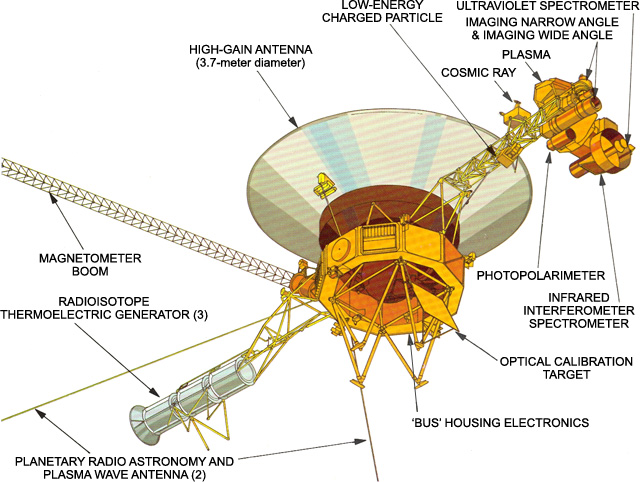
Image (Credit): The Voyager spacecraft. (NASA)

NASA is experiencing communication issues with the distant Voyager 1 spacecraft. As a result, NASA reports that no science or engineering data is being sent back to Earth.

Voyager 1 is about 15 billion miles from Earth, so its binary code signals take about 22.5 hours to reach Earth.

The communication issue with the spacecraft is expected to be resolved in the next few weeks. Of course, Voyager dates back to 1977. At some point we will need to say goodbye to our friend, but no one is ready for that.

NASA’s Voyager FAQ page states:

Engineers expect each spacecraft to continue operating at least one science instrument until around 2025. Even if science data won’t likely be collected after 2025, engineering data could continue to be returned for several more years. The two Voyager spacecraft could remain in the range of the Deep Space Network through about 2036, depending on how much power the spacecraft still have to transmit a signal back to Earth.

It would be great to have another 13 years of discussions with humanity’s most distant probes.

Space Stories: Tom Hanks Returns to the Moon, Exomoons are Questioned, and Our Moon Enters a New Phase

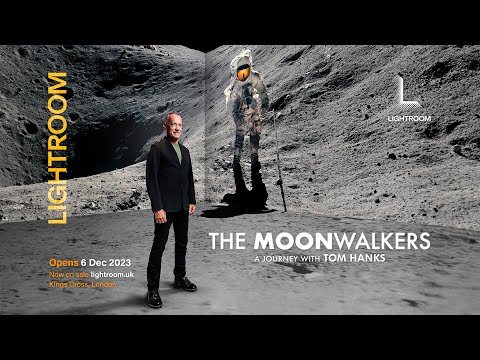
Image (Credit): Tom Hanks at the opening of his new show in London. (Apollo Remastered)

Here are some recent stories of interest.

Reuters: “Tom Hanks Brings Love of Space to New Immersive London Show

Archive footage of space rockets taking off beam across giant walls in a new immersive show in London, as Hollywood actor Tom Hanks narrates the story of human voyages to the moon. “The Moonwalkers: A Journey With Tom Hanks” looks at the first moon landings of the Apollo missions from 1969 to 1972 and their successor, NASA’s human spaceflight program, Artemis. The next mission – the Artemis II lunar flyby – is planned for next year and interviews with the four-member team are also projected on the walls at the Lightroom gallery space in London’s King Cross area.

Max Planck Institute for Solar System Research: “Giant Doubts About Giant Exomoons

Just as it can be assumed that the stars in our Milky Way are orbited by planets, moons around these exoplanets should not be uncommon. This makes it all the more difficult to detect them. So far, only two of the more than 5300 known exoplanets have been found to have moons. A new data analysis now demonstrates that scientific statements are rarely black or white, that behind every result there is a greater or lesser degree of uncertainty and that the path to a statement often resembles a thriller. In observations of the planets Kepler-1625b and Kepler-1708b from the Kepler and Hubble space telescopes, researchers had discovered traces of such moons for the first time. A new study now raises doubts about these previous claims. As scientists from the Max Planck Institute for Solar System Research and the Sonnenberg Observatory, both in Germany, report in the journal Nature Astronomy, “planet-only” interpretations of the observations are more conclusive.

The University of Kansas: “Scholars Say it’s Time to Declare a New Epoch on the Moon, The ‘Lunar Anthropocene’

Human beings first disturbed moon dust Sept. 13, 1959, when the USSR’s unmanned spacecraft Luna 2 alighted on the lunar surface. In the following decades, more than a hundred other spacecraft have touched the moon — both crewed and uncrewed, sometimes landing and sometimes crashing. The most famous of these were NASA’s Apollo Lunar Modules, which transported humans to the moon’s surface to the astonishment of humankind. In the coming years, missions and projects already planned will change the face of the moon in more extreme ways. Now, according to anthropologists and geologists at the University of Kansas, it’s time to acknowledge humans have become the dominant force shaping the moon’s environment by declaring a new geological epoch for the moon: the Lunar Anthropocene.