Audit Report: Artemis III May Not Be Possible Until 2027

The legislative branch’s audit arm, the Government Accountability Office (GAO), has some bad news regarding the Artemis mission to the moon – the landing on the Moon may need to wait until 2027.

Here is what the auditors said in their November 30 report, NASA Artemis Programs: Crewed Moon Landing Faces Multiple Challenges, about NASA’s delays:

As of September 2023, the Human Landing System program had delayed eight of 13 key events by at least 6 months. Two of these events have been delayed to 2025—the year the lander is planned to launch. The delays were caused in part by the Orbital Flight Test, which was intended to demonstrate certain features of the launch vehicle and lander configuration in flight. The test was delayed by 7 months to April 2023. It was then terminated early when the vehicle deviated from its expected trajectory and began to tumble. Subsequent tests rely on successful completion of a second Orbital Flight Test.

The Human Landing System was awarded to SpaceX, which has been having a few issues getting everything to work on schedule. Of course, this is just one of many issues that contribute to potential delays (such as the space suit), but I expect SpaceX does not want to be labeled as the drag on the program when we are trying to beat the Chinese to the Moon.

The audit report is comprehensive and serves as a warning that things are slipping and may continue to slip without sufficient attention.

Artemis represent an international effort to bring together the best parties from the government and private sector for something amazing. The Apollo missions to the Moon were run by one country as a central government program. This is a chance for everyone to shine using a whole new approach. We just need to keep up the momentum.

Gift Ideas: Books by Astronauts

Credit: Hachette Go

Are you looking for that perfect book for a space enthusiast? You may want to take a look at some of the books authored by NASA astronauts in the last few years. Be it inspiration or adventure you are seeking, you can find it with these authors. Below are three books to consider as gift ideas.

Moonshot by NASA astronaut Mike Massimino:

Mike Massimino achieved his dream of exploring space. Now he distills stories and insights from NASA into an actionable guide to accomplish your biggest goals. Mike reveals how to make possible the seemingly impossible—on Earth. Written with characteristic wit and a big heart, Mike identifies ten hard-earned lessons of spaceflight and his other life experiences, including:

  • One in a Million Is Not Zero: The odds are against you. Do it anyway.
  • The Thirty-Second Rule: You’re going to make mistakes. Learn how to deal with them.
  • Be Amazed: The universe is an incredible place. Stop what you’re doing and look around.
  • Know When to Pivot: Change is inevitable. Accept and embrace it.

We all have our own personal “moon shots” we’d like to take in life, but as mission control will tell you, doing one big thing really means getting a thousand little things right along the way. Moonshot is the book that will show you how to do just that, and help set you on the right path to achieve your own personal and professional dreams.

Back to Earth by NASA astronaut Nicole Stott:

Stott imparts essential lessons in problem-solving, survival, and crisis response that each of us can practice to make change. She knows we can overcome differences to address global issues, because she saw this every day on the International Space Station. Stott shares stories from her spaceflight and insights from scientists, activists, and changemakers working to solve our greatest environmental challenges. She learns about the complexities of Earth’s biodiversity from NASA engineers working to enable life in space and from scientists protecting life on Earth for future generations. Ultimately, Stott reveals how we each have the power to respect our planetary home and one another by living our lives like crewmates, not passengers, on an inspiring shared mission.

The Apollo Murders by astronaut Chris Hadfield:

NASA is about to launch Apollo 18. While the mission has been billed as a scientific one, flight controller Kazimieras “Kaz” Zemeckis knows there is a darker objective. Intelligence has discovered a secret Soviet space station spying on America, and Apollo 18 may be the only chance to stop it.

But even as Kaz races to keep the NASA crew one step ahead of their Russian rivals, a deadly accident reveals that not everyone involved is quite who they were thought to be. With political stakes stretched to the breaking point, the White House and the Kremlin can only watch as their astronauts collide on the lunar surface, far beyond the reach of law or rescue.

Credit: Seal Press
Credit: Mulholland Books

Pic of the Week: Odyssey Over Mars

Image (Credit): Martian horizon courtesy of NASA’s Mars Odyssey orbiter. (NASA/JPL-Caltech/ASU)

The image this week is what the International Space Station might see if it were traveling over Mars. Instead, this is the view of NASA’s Mars Odyssey orbiter.

You can learn more about this image by watching this video with Laura Kerber, deputy project scientist for NASA’s Mars Odyssey orbiter. You can also read more about the orbiter’s mission and the video of Phobos by visiting this NASA site.

Space Stories: Japan Bolsters it Space Investments, The Next Starship, and Russia’s Declining Space Program

Image (Credit): Artist’s rendering of JAXA’s proposed lunar rover with Toyota. (Toyota/JAXA)

Here are some recent stories of interest.

Forbes: “Modern Space Race: Japan Pledges $6.6 Billion For Developing Space Sector As U.S. And China Plan Historic Missions

The Japanese government has said it will establish a $6.6 billion (¥1 trillion) fund to develop the country’s space industry as programs in the U.S., Russia, China and India rush to put men on the moon, build lunar sites and plan for the future of the International Space Station in a renewed race for celestial supremacy...Nikkei, a Japanese newspaper, reported that funding will be given to companies developing technologies that could be used to support national security or those that could rival Elon Musk’s SpaceX by developing rockets and “satellite constellations”—groups of satellites that operate as one system.

PayloadSpace.com: “SpaceX Announces a Starship Version Two is in the Works

With just two Starship integrated test flights under its belt, SpaceX announced last week it is already working on a major overhaul of its second-stage Starship vehicle. The design changes will be significant enough to speciate the ship, giving it the title of Version 2. SpaceX plans to finish and launch four or five additional Starship V1 prototypes before transitioning to its V2 product line, Elon Musk said on X. Insights gained from the upcoming flights will be integrated into the next-gen rocket.

Center for European Policy Analysis: “Russia’s Earthly Aggression Cripples its Celestial Plans

When the US imposed sanctions to degrade Russia’s aerospace industry, including embargoes on semiconductors, lasers, sensors, and navigation equipment, Dmitry Rogozin, then chief of Russia’s space program, warned it might cause the International Space Station to fall on the US or Europe. These comments and others from a supposedly serious scientific organization did cause a crash — the decades-old US-Russia space partnership was effectively ended after decades of joint work, including the Soviet era, that had benefited science, détente, and humanity. The events of 2022-2023 have made it more likely Russia would step away from exploration and, with China, focus on military applications in space. 

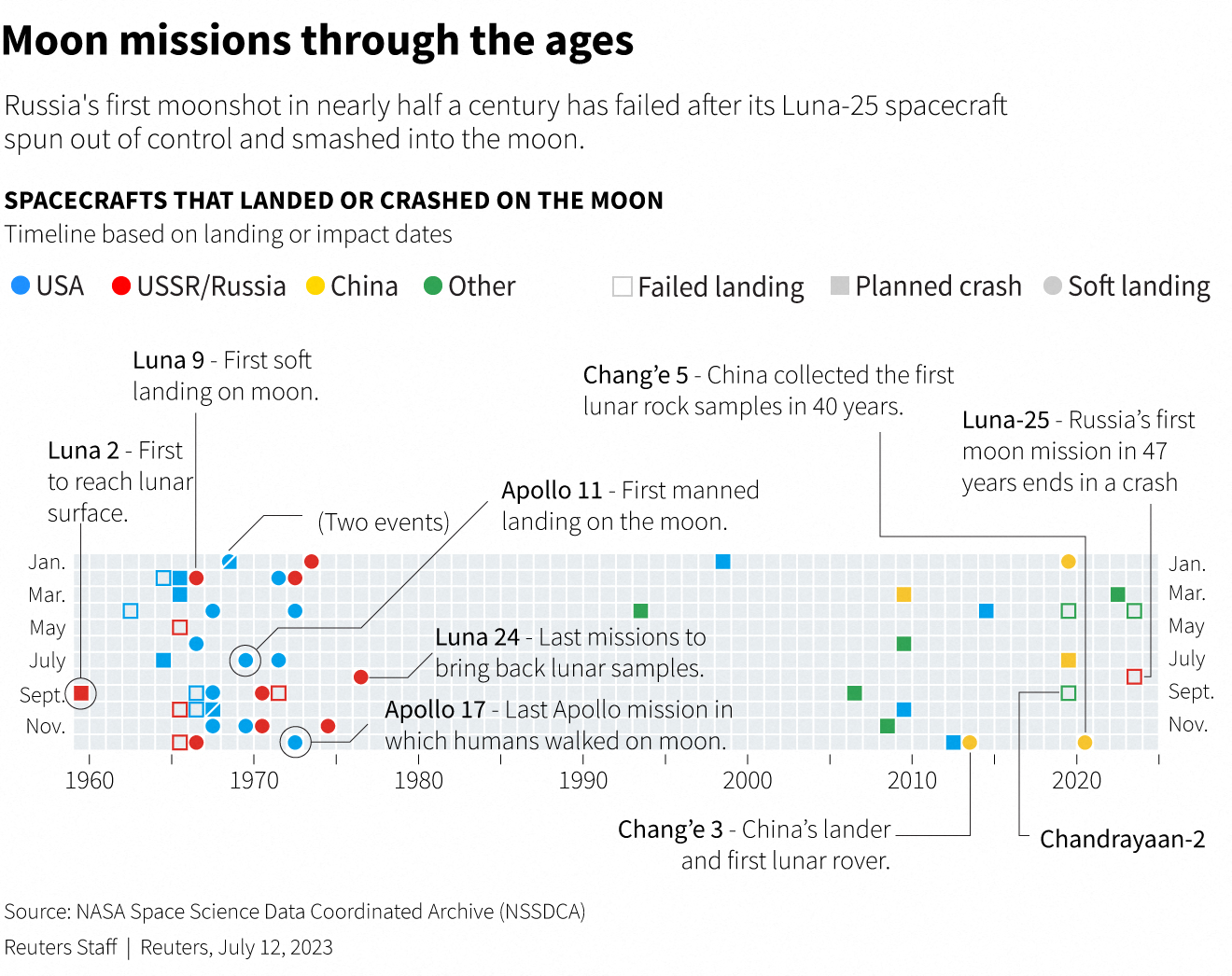
Note: The helpful graphic below is used in the Center for European Policy Analysis story.

A Day in Astronomy: Pioneer 10 Approaches Jupiter

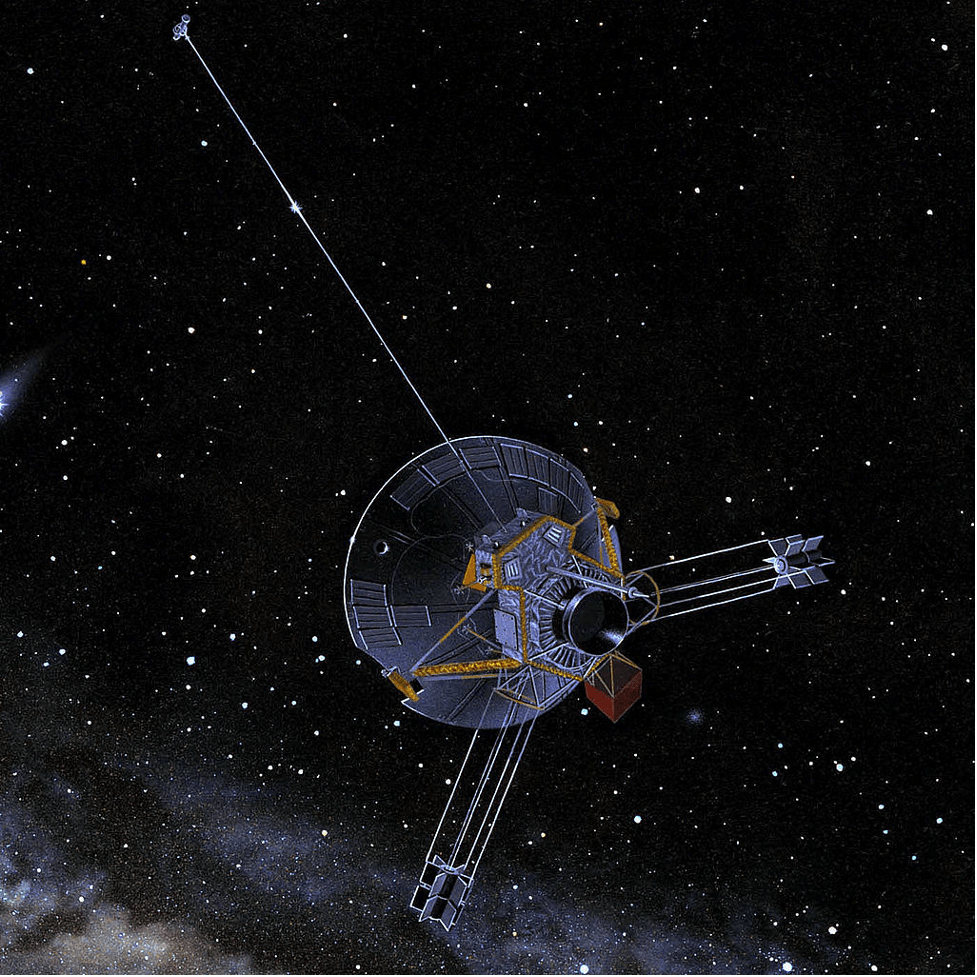
Image (Credit): Artist’s rendering of the Pioneer 10 spacecraft. (Don Davis for NASA)

We may have missed the date of the story in this piece (the anniversary was November 6), but this is an opportunity to share another site that brings astronomical history to life. The American Astronomical Society, which brings together professional astronomers, astronomy educators, and amateur astronomers, has its own blog on astronomical anniversaries that I wanted to highlight. It is called This Month in Astronomical History.

The November article is about the 50th anniversary of NASA’s Pioneer 10 mission as it came in contact with Jupiter. The article notes that the spacecraft first started imaging Jupiter on November 6, 1973 when it was still 16 million miles away from the planet. Overall, it sent back about 500 images of Jupiter and its moons.

You can read the article itself for information on the success of the mission. The author also noted the fate of the spacecraft:

Originally slated for 21 months of operation — sufficient to complete the Jupiter observations — its official science mission was ended on 31 March 1997. Its last signal was sent on 23 January 2003; from a distance of about 12.2 billion km (7.6 billion miles) from home, Pioneer’s swansong took over 11 hours to reach us.

The spacecraft was still communicating with us about 50 years after its Jupiter mission. That is impressive.