Image (Credit): NASA’s 3D billboard display by Blunt Action at Kennedy Space Center. (NASA)
If you want to see something that is both fun and educational, check out the 30-foot 3D billboard display outside the Kennedy Space Center Visitor Complex in Merritt Island, Florida.
Created by Blunt Action, the billboard plays out the history of NASA’s space program from its origins with the Mercury missions all the way to the Artemis missions.
You can go to an article by Designboom to watch the space story play out, though I expect it is better in person.
However you decide to watch it, it is worth viewing.
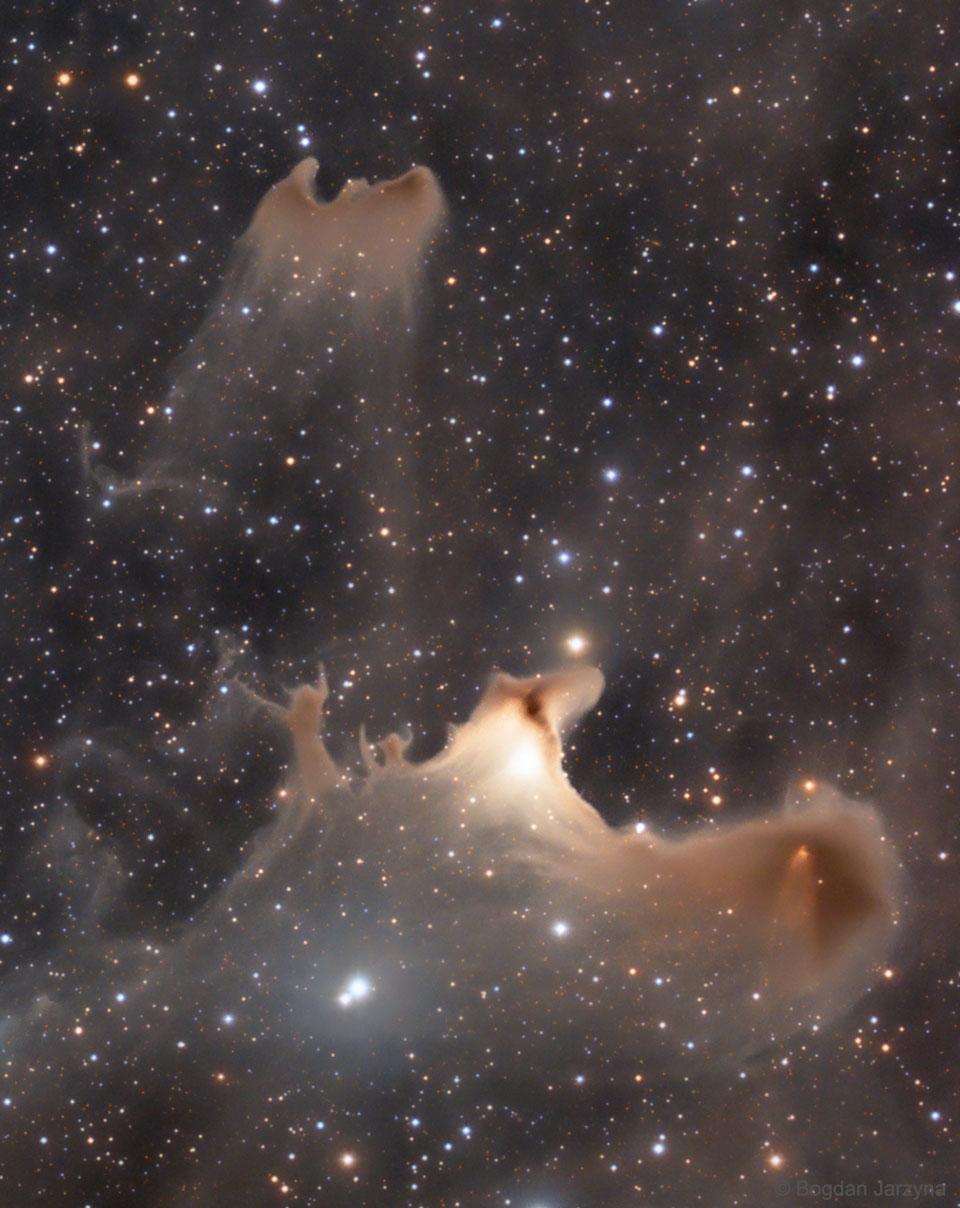
The jeweled expanse, filled with faint, starlight-reflecting clouds, drifts through the night in the royal constellation of Cepheus. Far from your own neighborhood on planet Earth, these ghostly apparitions lurk along the plane of the Milky Way at the edge of the Cepheus Flare molecular cloud complex some 1,200 light-years away. Over two light-years across and brighter than the other spooky chimeras, VdB 141 or Sh2-136 is also known as the Ghost Nebula, seen toward the bottom of the featured image. Within the reflection nebula are the telltale signs of dense cores collapsing in the early stages of star formation.
Fine dust from pulverized rock generated by the Chicxulub impact likely played a dominant role in global climate cooling and the disruption of photosynthesis following the event. This is suggested by a new study published in Nature Geoscience, in which researchers Cem Berk Cenel, Özgür Karatekin and Orkun Temel of the Royal Observatory of Belgium contributed.
A team of Spanish astronomers is leading the investigation into one of stargazing’s most perplexing mysteries. Three bright stars photographed in the night sky above southern California in 1952 vanished just an hour later. Generations of scientists have sought to explain the rare phenomenon over the past half-century, but nothing has yet convinced the community. Researchers at the Centre for Astrobiology (CAB) in Madrid tried to solve the riddle of the “triple transient” that has “remained absent from telescope exposures for 71 years” in a new paper published online.
A stable-frequency transmitter with relative radial acceleration to a receiver will show a change in received frequency over time, known as a ‘drift rate.’ For a transmission from an exoplanet, astronomers must account for multiple components of drift rate: the exoplanet’s orbit and rotation, the Earth’s orbit and rotation, and other contributions. Understanding the drift rate distribution produced by exoplanets relative to Earth, can help scientists constrain the range of drift rates to check in a Search for Extraterrestrial Intelligence (SETI) project to detect radio technosignatures, and help them decide validity of signals-of-interest, as they can compare drifting signals with expected drift rates from the target star. In a new study, University of California, Los Angeles astronomer Megan Grace Li and colleagues modeled the drift rate distribution for over 5,300 confirmed exoplanets, using parameters from the NASA Exoplanet Archive.
Image (Credit): Asteroid Gaspra as photographed by the Galileo spacecraft. (NASA)
On this day in 1991, NASA’s Galileo spacecraft conducted a flyby of asteroid Gaspra, an asteroid that orbits in the asteroid belt between Mars and Jupiter. The asteroid is about 10.5 miles long. Gaspra was discovered in 1916 by Russian astronomer G. N. Neujmin, who named it after a famous Russian spa retreat in Crimea.
The Galileo spacecraft’s primary mission was to visit Jupiter and its moons, but it also conducted other observations along the way, including flybys of asteroids Gaspra and Ida.
Here are a few facts about the Galileo mission from NASA:
Galileo was the first spacecraft to orbit an outer planet.
It was the first spacecraft to deploy an entry probe into an outer planet’s atmosphere.
It completed the first flyby and imaging of an asteroid (Gaspra, and later, Ida).
It made the first, and so far only, direct observation of a comet colliding with a planet’s atmosphere (Shoemaker-Levy 9).
It was the first spacecraft to operate in a giant planet magnetosphere long enough to identify its global structure and to investigate its dynamics.
Image (Credit): View of Jupiter taken by the NASA’s Juno mission. (NASA/JPL-Caltech/SwRI/MSSS, Vladimir Tarasov)
NASA has an image for all of us just in time for Halloween. The strange face you see above is a view of Jupiter taken on September 7, 2023 by NASA’s Juno spacecraft on its 54th close flyby of the planet.
NASA explains what you are seeing in this northern region of Jupiter:
The image shows turbulent clouds and storms along Jupiter’s terminator, the dividing line between the day and night sides of the planet. The low angle of sunlight highlights the complex topography of features in this region, which scientists have studied to better understand the processes playing out in Jupiter’s atmosphere.
Now I want to see the images from the first 53 flybys to understand what we might have missed.




 Our Awesome Universe