Space Stories: Crew Returns from ISS, Isaacman Nomination Advances, and Robotic Spacecraft to Save Space Telescope

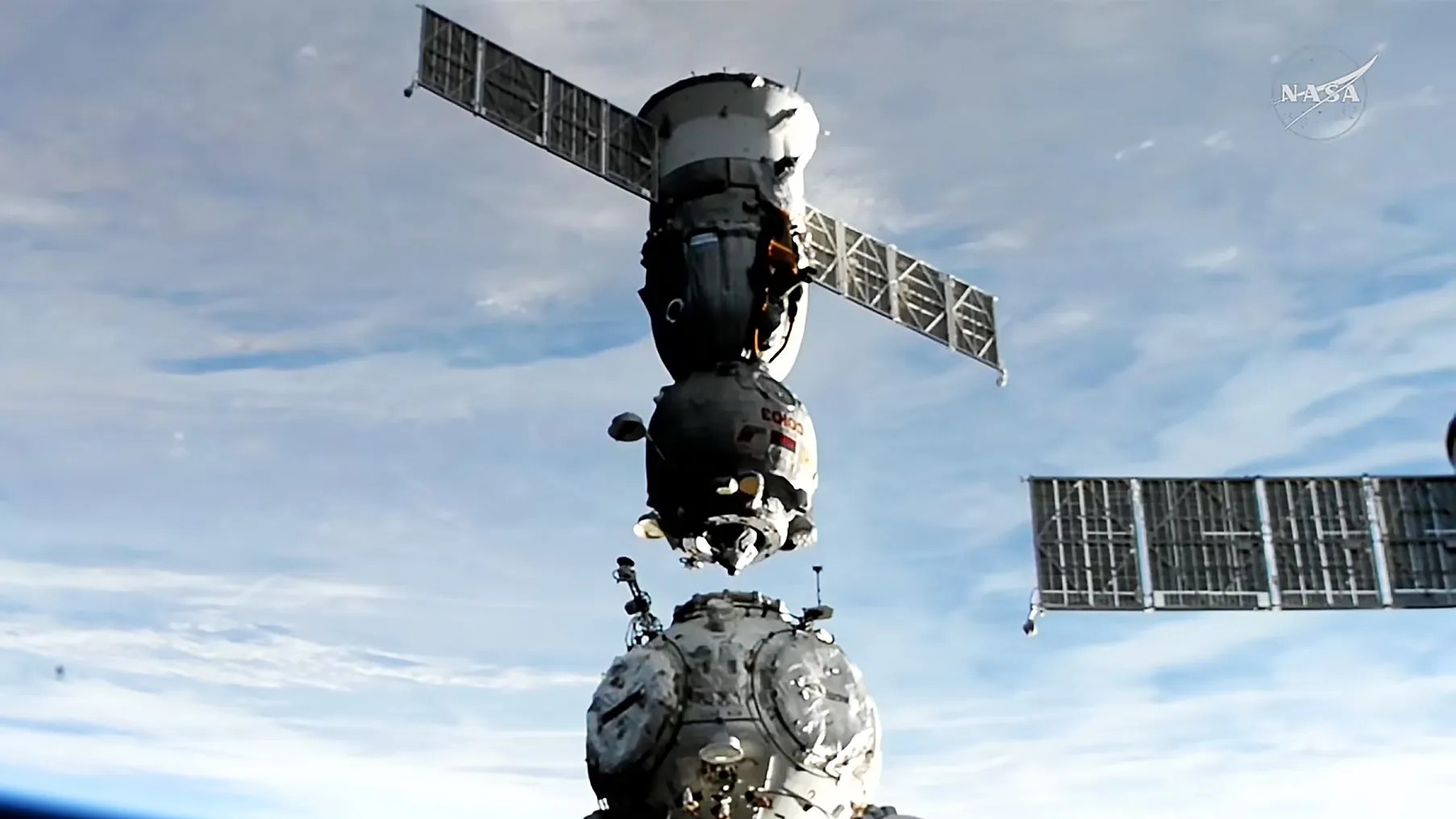
Image (Credit): The Soyuz MS-27 spacecraft undocking from the ISS earlier today. (NASA)

Here are some recent space-related stories of interest.

CBS News: 3-man Crew Undocks from International Space Station, Wrapping Up 8-month Stay

A NASA astronaut and two cosmonaut crewmates strapped into their Soyuz ferry ship and undocked from the International Space Station on Monday, heading for landing on the steppe of Kazakhstan to wrap up an eight-month mission…With Soyuz commander Sergey Ryzhikov strapped into the descent module’s center seat, flanked on his left by cosmonaut Alexey Zubritsky and on the right by NASA’s Jonny Kim, the Soyuz MS-27/73S spacecraft undocked from the lab at 8:41 p.m. ET.

Reuters: US Senate Committee Votes to Advance NASA Nominee Jared Isaacman

The U.S. Senate Commerce Committee voted late on Monday to advance the nomination of billionaire private astronaut Jared Isaacman to lead NASA...Senate Commerce Committee Chair Ted Cruz said: “You are as committed to American supremacy in the final frontier as is this committee and the entire Senate. My hope is that you will be confirmed and in this role before the end of this year.” He also won support of the panel’s top Democrat, Senator Maria Cantwell.

Indian Defence Review: A Rescue Mission Will Save NASA’s Space Telescope Using a Rocket Dropped from a Plane

Launched in 2004 to study gamma-ray bursts, Swift has been a crucial asset in understanding some of the most energetic events in the universe. However, over time, the spacecraft’s orbit has been decaying due to the drag from Earth’s atmosphere. As the orbit continues to degrade, the telescope is set to fall from its current 249-mile altitude unless action is taken. The problem is that Swift lacks onboard thrusters for orbit adjustments. With no replacement mission in the pipeline, NASA has turned to the private sector for a solution, and Katalyst is stepping in with a bold plan…For Neil Gehrels Swift Observatory, however, no astronauts will be involved. Instead, Katalyst will perform the rescue entirely remotely.


Study Findings: Not All Sub-Neptune Exoplanets Have Magma Oceans

Credit: Image by Enrique from Pixabay

The Astrophysical Journal Letters abstract of the study findings:

The evolution and structure of sub-Neptunes may be strongly influenced by interactions between the outer gaseous envelope of the planet and a surface magma ocean. However, given the wide variety of permissible interior structures of these planets, it is unclear whether conditions at the envelope–mantle boundary will always permit a molten silicate layer or whether some sub-Neptunes might instead host a solid silicate surface. In this work, we use internal structure modeling to perform an extensive exploration of surface conditions within the sub-Neptune population across a range of bulk and atmospheric parameters. We find that a significant portion of the population may lack present-day magma oceans. In particular, planets with a high atmospheric mean molecular weight and large envelope mass fraction are likely to instead have a solid silicate surface, since the pressure at the envelope–mantle boundary is high enough that the silicates will be in solid postperovskite phase. This result is particularly relevant given recent inferences of high-mean molecular weight atmospheres from JWST observations of several sub-Neptunes. We apply this approach to a number of sub-Neptunes with existing or upcoming JWST observations and find that in almost all cases, a range of solutions exist that do not possess a present-day magma ocean. Our analysis provides critical context for interpreting sub-Neptunes and their atmospheres.

Citation: Bodie Breza et al. Not all sub-Neptune exoplanets have magma oceans. ApJL 993 L46 (2025).

https://doi.org/10.3847/2041-8213/ae0c07

Study-related stories:

Universe Today – “It Looks Like All Mini-Neptunes Aren’t Magma Oceans After All”

University of Chicago – “New Study Revises Our Picture of the Most Common Planets in the Galaxy”

Space.com – “Is Our Dream of Finding Ocean-Covered Exoplanets Drying Up?”

Space Stories: Layoffs at NASA’s JPL, Rocky Giants in our Solar System, and New Findings from Apollo 17

Here are some recent space-related stories of interest.

NBC News: NASA’s Jet Propulsion Laboratory Lays Off 550 Workers

NASA’s Jet Propulsion Laboratory announced Monday that it will cut around 550 jobs — around 10% of its staff. In a statement posted online, the lab’s director, Dave Gallagher, said the layoffs are part of a broad “realignment of its workforce” and not a result of the government shutdown. The cuts will affect positions across the NASA center’s technical, business and support areas, he said.

Space.com: Uranus and Neptune May Not Be ‘Ice Giants’ After All, New Research Suggests

Astronomers have long called Uranus and Neptune the “ice giants” because models suggested that these outer planets’ interiors are largely made of mixtures of water, ammonia and other ices — compounds that freeze easily in deep space. But new research reveals that we actually know very little about what’s going on inside these planets, causing researchers to propose that Uranus and Neptune be called “rocky giants” instead.

Brown University: “With New Analysis, Apollo Samples Brought to Earth in 1972 Reveal Exotic Sulfur Hidden in Moon’s Mantle

In a study published in JGR: Planets, researchers report a sulfuric surprise in rock samples taken from the Moon’s Taurus Littrow region during Apollo 17. The analysis shows that volcanic material in the sample contains sulfur compounds that are highly depleted of sulfur-33 (or 33S), one of four radioactively stable sulfur isotopes. The depleted 33S samples contrast sharply with sulfur isotope ratios found on Earth, the researchers say.

Space Stories: More on Planet 9, A Collision with Pluto, and Explaining Free-Floating Planets

Here are some recent stories of interest.

IFLScience: Astronomers Find Evidence Of A Massive Object Beyond The Orbit Of Neptune

A team of researchers say they have found the “strongest statistical evidence yet that Planet 9 is really out there” in the solar system after studying a population of distant, unstable objects that cross Neptune’s orbit...In a new paper, the team looked at long-period objects that crossed the path of Neptune’s orbit, finding that their closest point of orbit to the sun was around 15-30 astronomical units (AU), with one AU being the distance between the sun and the Earth.

CNN: Pluto Gained a ‘Heart’ After Colliding with a Planetary Body

A huge heart-shaped feature on the surface of Pluto has intrigued astronomers since NASA’s New Horizons spacecraft captured it in a 2015 image. Now, researchers think they have solved the mystery of how the distinctive heart came to be — and it could reveal new clues about the dwarf planet’s origins…an international team of scientists has determined that a cataclysmic event created the heart. After an analysis involving numerical simulations, the researchers concluded a planetary body about 435 miles (700 kilometers) in diameter, or roughly twice the size of Switzerland from east to west, likely collided with Pluto early in the dwarf planet’s history.

University of Nevada: Astronomers Offer New Model for Formation of Recently Discovered ‘Free-floating’ Planets

The recent discovery of a potential new class of distant and mysterious “free-floating” planets has intrigued astronomers since stunning new images captured by the James Webb Space Telescope were shared late last year. These candidate planets, known as Jupiter-mass Binary Objects (JuMBOs), seem to orbit one another as they float freely in space unbound to any star—which counters prevailing theories of how planetary systems were thought to work. Now, a new study by a team of astrophysicists from UNLV and Stony Brook University, published April 19 in the journal Nature Astronomy, introduces a compelling model for how these JuMBOs may have formed.