Study Findings: A Resonant Sextuplet of Sub-Neptunes Transiting the Bright Star HD 110067

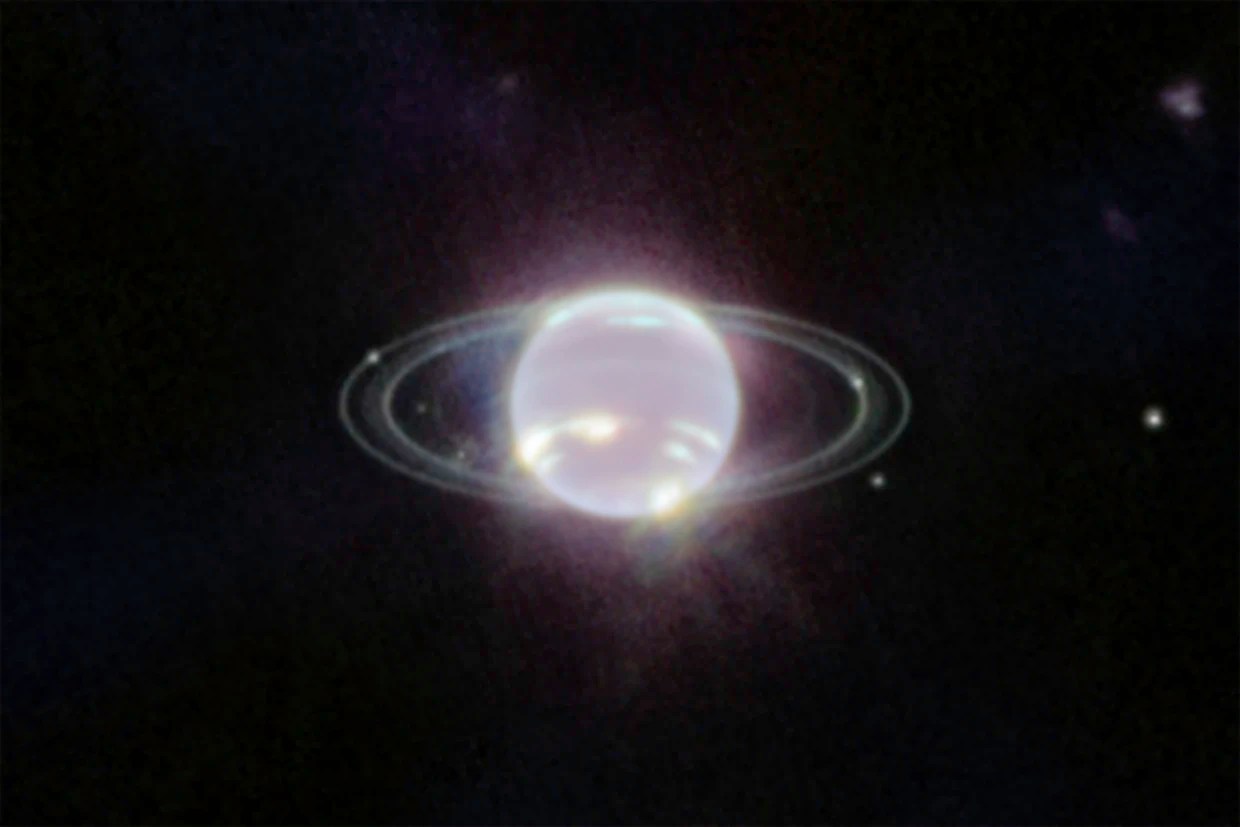
Image (Credit): Neptune as captured by the James Webb Space Telescope’s near-infrared camera. (NASA, ESA, CSA, and STScI)

Nature abstract of the study findings:

Planets with radii between that of the Earth and Neptune (hereafter referred to as ‘sub-Neptunes’) are found in close-in orbits around more than half of all Sun-like stars. However, their composition, formation and evolution remain poorly understood. The study of multiplanetary systems offers an opportunity to investigate the outcomes of planet formation and evolution while controlling for initial conditions and environment. Those in resonance (with their orbital periods related by a ratio of small integers) are particularly valuable because they imply a system architecture practically unchanged since its birth. Here we present the observations of six transiting planets around the bright nearby star HD 110067. We find that the planets follow a chain of resonant orbits. A dynamical study of the innermost planet triplet allowed the prediction and later confirmation of the orbits of the rest of the planets in the system. The six planets are found to be sub-Neptunes with radii ranging from 1.94R to 2.85R. Three of the planets have measured masses, yielding low bulk densities that suggest the presence of large hydrogen-dominated atmospheres.

Citation: Luque, R., Osborn, H.P., Leleu, A. et al. A resonant sextuplet of sub-Neptunes transiting the bright star HD 110067. Nature 623, 932–937 (2023).
https://doi.org/10.1038/s41586-023-06692-3

Study-related stories:

A Day in Autonomy: The Discovery of Neptune

Image (Credit): Neptune as captured by Voyager 2 on August 31,1989. (NASA/JPL-Caltech/Kevin M. Gill)

On this day in 1846, astronomer Johann Gottfried Galle discovered the ice giant Neptune, the eighth and most distant planet in the solar system. Two other astronomers are credited with coming up with the mathematical calculations related to the discovery – France’s Urbain Le Verrier and England’s John Couch Adams.

Here are some interesting facts about the planet:

  • It is more than 30 times as far from the Sun as Earth;
  • It takes 165 Earth years to orbit the sun, meaning it has only completed one full orbit since it was discovered;
  • It is about four times wider than Earth;
  • It has at least five main rings and four prominent ring arcs; and
  • It lacks a solid surface.

Space Stories: New Horizon Questions, A Dark Spot on Neptune, and Prioritizing Exoplanets

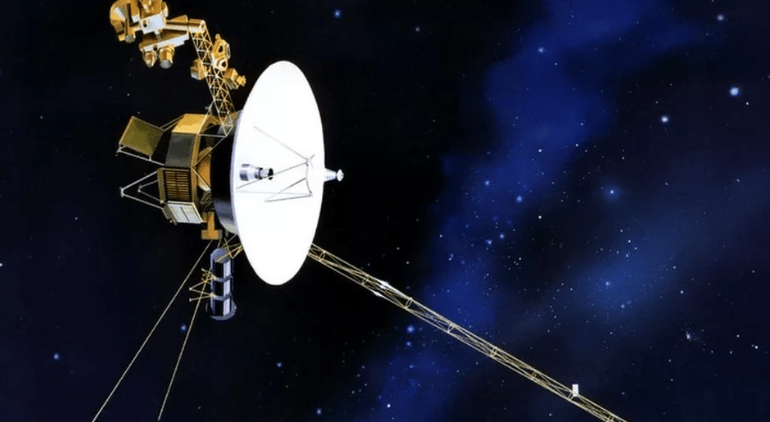
Image (Credit): NASA’s New Horizons spacecraft. (NASA/Johns Hopkins University Applied Physics Laboratory/Southwest Research Institute)

Here are some recent stories of interest.

Space.com : “NASA’s New Horizons Mission Faces an Uncertain Future (op-ed)

With its budget being trimmed for 2024, NASA is making some weighty decisions… and one includes drastically trimming New Horizons funds by replacing the current science staff with a new team in an effort to save about $3 million—a rounding error in terms of the planetary science budget...As it stands, New Horizons will exit the Kuiper Belt around 2028 and should continue operating until 2050.

ScienceDaily : “Mysterious Neptune Dark Spot Detected from Earth for the First Time

Using ESO’s Very Large Telescope (VLT), astronomers have observed a large dark spot in Neptune’s atmosphere, with an unexpected smaller bright spot adjacent to it. This is the first time a dark spot on the planet has ever been observed with a telescope on Earth. These occasional features in the blue background of Neptune’s atmosphere are a mystery to astronomers, and the new results provide further clues as to their nature and origin.

Universe Today : “TESS has Found Thousands of Possible Exoplanets: Which Ones Should JWST Study?

We will soon have more than 10,000 worlds where life might be able to survive. It’s an amazing idea, but with so many exoplanets we don’t have the resources to search for life on all of them. So how do we prioritize our search? That’s the focus of a recent paper on the pre-print server arxiv. In it, the team strives to identify the “best in class” candidates for exoplanets that could be further studied by the spectroscopic cameras of the James Webb Space Telescope (JWST). Their list could not only help astronomers find evidence of life but also help us understand the range of atmospheres exoplanets have.

Voyager 2 is Still Talking to Us

After two weeks with no word, Voyager 2 is back to communicating with us as it continues its journey beyond our solar system. The whole incident started when NASA sent a bad command, but all is well.

Voyager 2 first left Earth back in August 1977 and exited the solar system in December 2018. Like Voyager 1, which is also outside the solar system now, Voyager 2 had the initial task of studying the planets. Voyager 2 focused on Jupiter, Saturn, Uranus and Neptune. It has shown it was capable of much more as it dragged the human race to the bleeding edge of space.

You can read all about Voyager 2’s accomplishments at this NASA site, including:

  • Voyager 2 is the only spacecraft to study all four of the solar system’s giant planets at close range.
  • Voyager 2 discovered a 14th moon at Jupiter.
  • Voyager 2 was the first human-made object to fly past Uranus.
  • At Uranus, Voyager 2 discovered 10 new moons and two new rings.
  • Voyager 2 was the first human-made object to fly by Neptune.
  • At Neptune, Voyager 2 discovered five moons, four rings, and a “Great Dark Spot.”

An impressive list of accomplishments, and the spacecraft is still ticking as it goes into the great unknown.

We need to keep these achievements in mind as we battle over this year’s NASA budget. We also need to remember that there was supposed to be four Voyager-like spacecraft rather than two, but budget cuts nixed the second set. Meaning we can still get some great things done even if we don’t have the budget to fund every piece of a grand vision.

Pic of the Week: The Rings of Neptune

Image (Credit): JWST image of Nepture showing its rings and moons. (NASA, ESA, CSA, STScI)

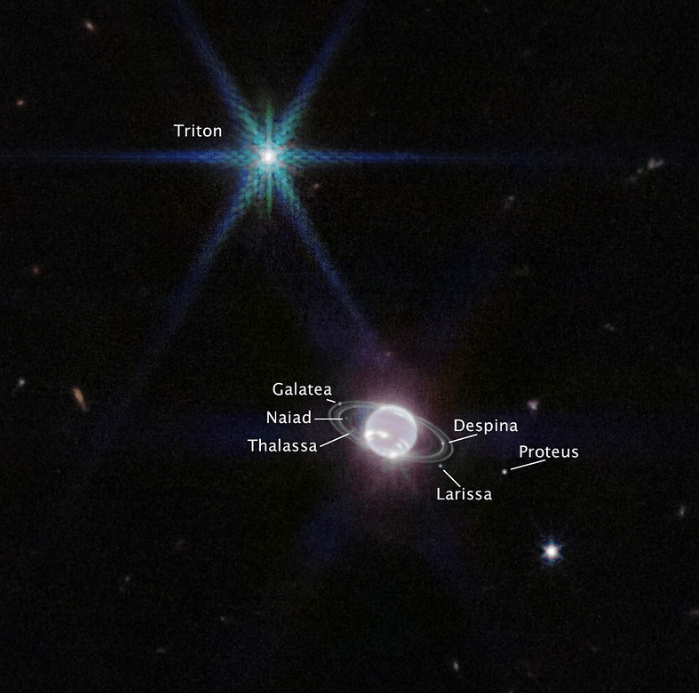
This week’s image is from the James Webb Space Telescope (JWST). It clearly shows the rings of Neptune as well as a number of its moons (the image below is a broader shot labeling those moons). It is an impressive shot by the JWST within our solar system, similar to the space telescope’s recent image of Jupiter.

Here is more about the image from NASA:

In this Webb image, Neptune resembles a pearl with rings that look like ethereal concentric ovals around it. There are 2 thinner, crisper rings and 2 broader, fainter rings. A few extremely bright patches on the lower half of Neptune represent methane ice clouds. Six tiny white dots, which are six of Neptune’s 14 moons, are scattered among the rings. The background of the image is black.

The Neptune image was uploaded to the NASA website on September 21, just a few days shy of the actual date in the calendar when Neptune was observed for the first time ever – September 23. The year was 1846 and the observer was German astronomer Johann Galle.

Image (Credit): JWST labeled image of Nepture showing its rings and moons. (NASA, ESA, CSA, STScI)