Image (Credit): A planetary nebula named Kohoutek 4-55. (ESA/Hubble & NASA, K. Noll)
This image is from the ESA/Hubble Picture of the Week website. It shows a colorful planetary nebula called Kohoutek 4-55, which is about 4600 light-years away.
A planetary nebula, a glowing shell of material thrown off by a star. A small central region of greenish clouds is encircled by a glowing, jagged ring, like a hole torn in fabric. A band of silvery-blue clouds outside this is again encircled by a larger, fainter yellow ring of gas. Puffy, smoky clouds of orange and red gas billow out from there into a large oval nebula, fading into the dark background of space.
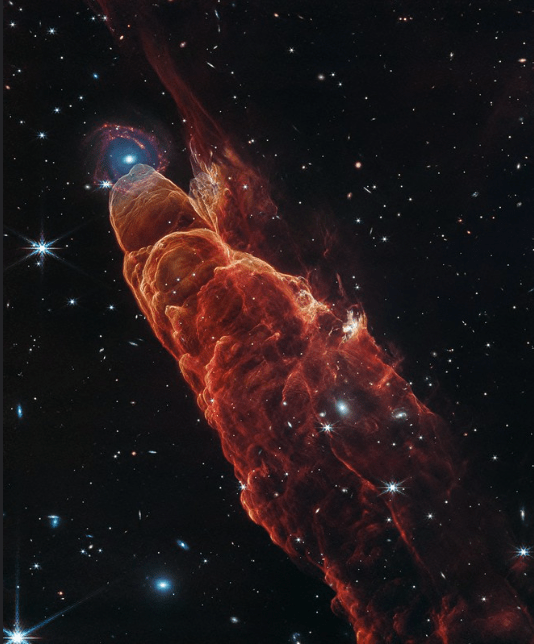
Image (Credit): Herbig-Haro 49/50 captured by the JWST. (NASA, ESA, CSA, STScI)
This week’s image is from the James Webb Space Telescope (JWST). The transparent red cloud in the middle of the image, nicknamed the “cosmic tornado,” is outflow of gas and dust from a newly formed star. Moreover, the bright blue glow at the top of the cloud has nothing to do with what you are seeing. The blue glow is a distant spiral galaxy.
Angled from the upper left corner to the lower right corner of the image is a cone-shaped orange-red cloud known as Herbig-Haro 49/50. This feature takes up about three-fourths of the length of this angle. The tip of the cone positioned at the upper left appears translucent with a rounded end. Coincidently, a background spiral galaxy appears right near the tip too. The galaxy has a concentrated blue center that fades outwards to blend in with red spiral arms. The cones-shaped feature widens slightly from tip down to the lower right. Along the way there are additional rounded edges, like edges of a wave, and intricate foamy-like details. The nebula appears even more translucent to the lower right providing a clearer view of the black background of space. The black background of space is clearer, speckled with some white stars and smaller, more numerous, fainter white galaxies.
Image (Credit): The Deep Field South captured by the ESA’s Euclid space telescope. (ESA/Euclid/Euclid Consortium/NASA, image processing by J.-C. Cuillandre, E. Bertin, G. Anselmi/Handout via REUTERS)
Last week, the European Space Agency released images from the Euclid space telescope, which was launched on July 1, 2023. The goal of the space telescope’s mission is to catalog more than 1.5 billion galaxies over a six year period.
The image above shows a part of the sky called the Deep Field South. One of the galaxy clusters near the center of the image is located almost 6 billion light-years away. At the center bottom of the image you can also clearly see a beautiful spiral galaxy.
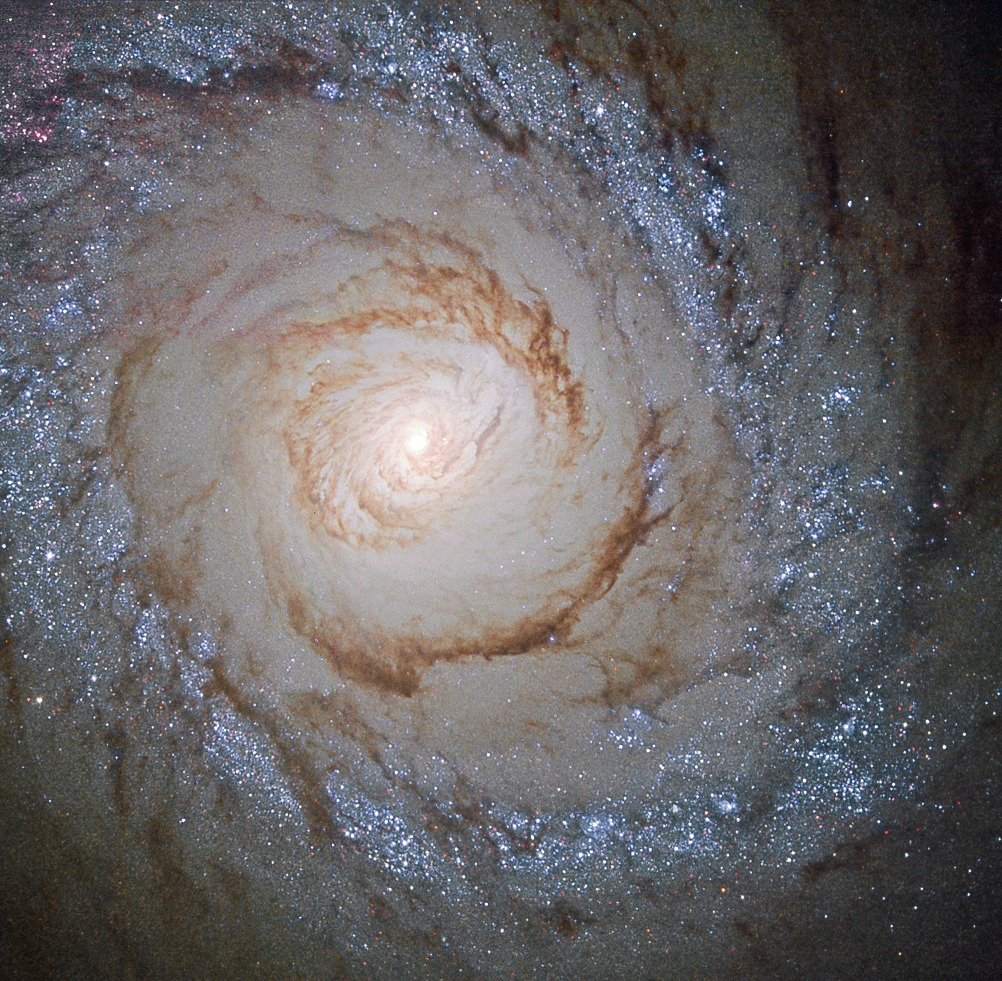
Image (Credit): Hubble Space Telescope image of a sparkling spiral galaxy paired with a prominent star, both in the constellation Virgo. (ESA/Hubble & NASA, S. J. Smartt, C. Kilpatrick)
This week’s image is from the NASA/ESA Hubble Space Telescope. It shows what appears to be two close neighbors – a star and a galaxy – but looks can be deceiving.
This NASA/ESA Hubble Space Telescope image features a sparkling spiral galaxy paired with a prominent star, both in the constellation Virgo. While the galaxy and the star appear to be close to one another, even overlapping, they’re actually a great distance apart. The star, marked with four long diffraction spikes, is in our own galaxy. It’s just 7,109 light-years away from Earth. The galaxy, named NGC 4900, lies about 45 million light-years from Earth.
This image combines data from two of Hubble’s instruments: the Advanced Camera for Surveys, installed in 2002 and still in operation today, and the older Wide Field and Planetary Camera 2, which was in use from 1993 to 2009. The data used here were taken more than 20 years apart for two different observing programs — a real testament to Hubble’s long scientific lifetime.
Image (Credit): Lynds 483 as captured by the JWST. (NASA, ESA, CSA, STScI)
This week’s image is from the James Webb Space Telescope. It shows two actively forming stars that are 650 light-years away. The formation is called Lynds 483, or L483, after American astronomer Beverly Turner Lynds, who studied nebulae in the early 1960s.
The two protostars responsible for this scene are at the center of the hourglass shape, in an opaque horizontal disk of cold gas and dust that fits within a single pixel. Much farther out, above and below the flattened disk where dust is thinner, the bright light from the stars shines through the gas and dust, forming large semi-transparent orange cones.
It’s equally important to notice where the stars’ light is blocked — look for the exceptionally dark, wide V-shapes offset by 90 degrees from the orange cones. These areas may look like there is no material, but it’s actually where the surrounding dust is the densest, and little starlight penetrates it. If you look carefully at these areas, Webb’s sensitive NIRCam (Near-Infrared Camera) has picked up distant stars as muted orange pinpoints behind this dust. Where the view is free of obscuring dust, stars shine brightly in white and blue.