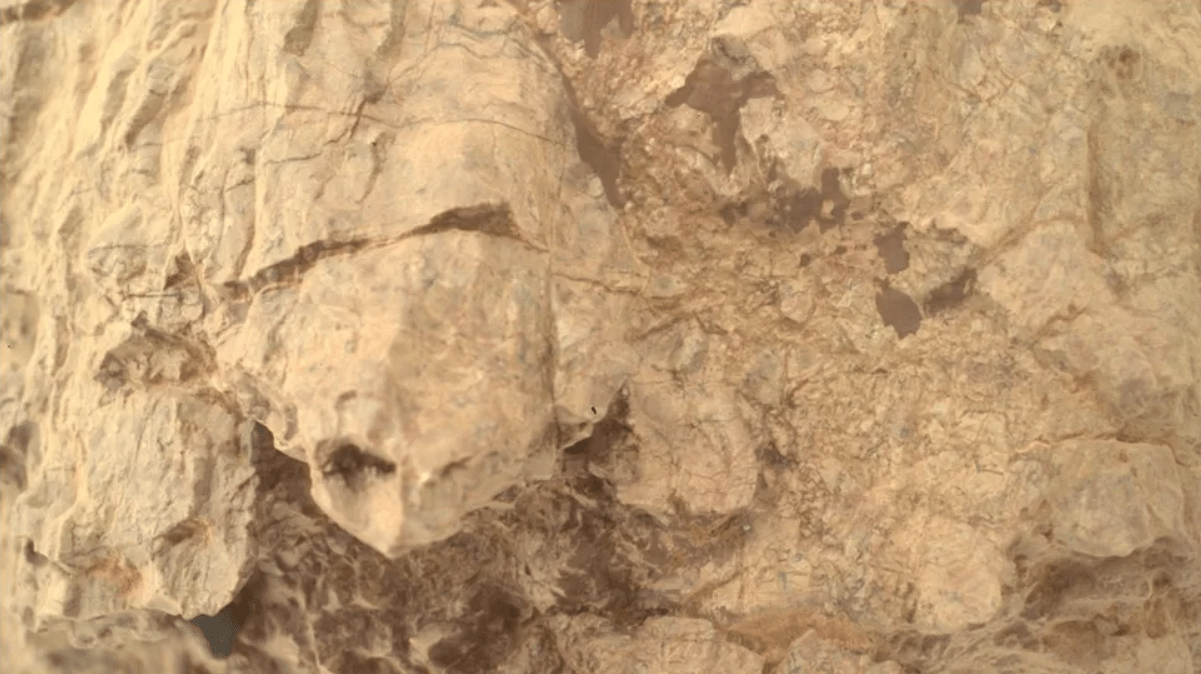
Image (Credit): Turtle-like Martian rock formation in Jezero Crater photographed by the Preservation rover. (NASA/JPL-Caltech)
While the Preservation rover on Mars has been busy looking for signs of life in Jezero Crater, it still had time to take a few fun photos as well, including the turtle image above (see the outline of the turtle below if you cannot find it). The rover captured the picture on August 31.
Image (Credit): Outline of turtle-like Martian rock formation in Jezero Crater photographed by the Preservation rover. (NASA/JPL-Caltech)
Image (Credit): The protostar IRAS 04302. (ESA/Webb, NASA & CSA, M. Villenave et al.)
This week’s image comes from the James Webb Space Telescope (JWST). It shows the beginning of exoplanets about 525 light-years away. Labeled the ever appealing name of IRAS 04302+2247, or better yet the Butterfly Star, the young star with its protoplanetary disc provides astronomers with plenty of information about the development of a protostar and its solar system.
In stellar nurseries across the galaxy, baby stars are forming in giant clouds of cold gas. As young stars grow, the gas surrounding them collects in narrow, dusty protoplanetary discs. This sets the scene for the formation of planets, and observations of distant protoplanetary discs can help researchers understand what took place roughly 4.5 billion years ago in our own Solar System, when the Sun, Earth, and the other planets formed.
IRAS 04302+2247, or IRAS 04302 for short, is a beautiful example of a protostar – a young star that is still gathering mass from its environment – surrounded by a protoplanetary disc in which baby planets might be forming. Webb is able to measure the disc at 65 billion km across – several times the diameter of our Solar System. From Webb’s vantage point, IRAS 04302’s disc is oriented edge-on, so we see it as a narrow, dark line of dusty gas that blocks the light from the budding protostar at its centre. This dusty gas is fuel for planet formation, providing an environment within which young planets can bulk up and pack on mass.
When seen face-on, protoplanetary discs can have a variety of structures like rings, gaps and spirals. These structures can be signs of baby planets that are burrowing through the dusty disc, or they can point to phenomena unrelated to planets, like gravitational instabilities or regions where dust grains are trapped. The edge-on view of IRAS 04302’s disc shows instead the vertical structure, including how thick the dusty disk is. Dust grains migrate to the midplane of the disc, settle there and form a thin, dense layer that is conducive to planet formation; the thickness of the disc is a measure of how efficient this process has been.
The dense streak of dusty gas that runs vertically across this image cocoons IRAS 04302, blotting out its bright light such that Webb can more easily image the delicate structures around it. As a result, we’re treated to the sight of two gauzy nebulas on either side of the disc. These are reflection nebulas, illuminated by light from the central protostar reflecting off of the nebular material. Given the appearance of the two reflection nebulas, IRAS 04302 has been nicknamed the ‘Butterfly Star’.
Image (Credit): Shortlisted image “Blood Moon Rising Behind the City Skyscrapers.” (Tianyao Yang)
ZWO’s annual Astronomy Photographer of the Year Contest recently highlighted its 2025 shortlisted images, such as the image above from photographer Tianyao Yang titled “Blood Moon Rising Behind the City Skyscrapers.”
Here is the photographer’s description of the photo:
This photograph captures a red Full Moon rising beside Shanghai’s tallest skyscrapers in Lujiazui. Taken from a distance of 26.5 km (16.5 miles) from the skyscrapers in a single exposure, this image’s alignment took five years of planning. The Full Moon appears perfectly positioned next to the illuminated skyline, creating a striking contrast.
Check out many other images at the contest site. The winning images will be announced at a ceremony on September 11, 2025.
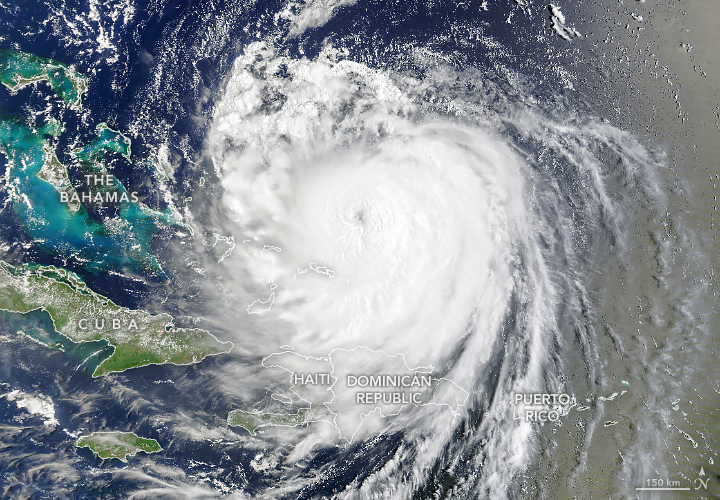
Image (Credit): Hurricane Erin in the Caribbean Sea on August 18, 2025. (NASA Earth Observatory images by Michala Garrison, using MODIS data from NASA EOSDIS LANCE and GIBS/Worldview, and the Suomi National Polar-orbiting Partnership)
This week’s image is from the NASA Earth Observatory. It shows Hurricane Erin, the first Atlantic hurricane in the 2025 season, as it travels through the Caribbean Sea earlier this week. The image below labels the various islands in the image.
Image (Credit): Hurricane Erin in the Caribbean Sea on August 18, 2025 (with island identifiers). (NASA Earth Observatory images by Michala Garrison, using MODIS data from NASA EOSDIS LANCE and GIBS/Worldview, and the Suomi National Polar-orbiting Partnership)
The above image is one of 24 winning posters designed by students at the School of Visual Arts (SVA) in New York City. The contest, sponsored by SVA and NASA, is called The Artemis II/Earthrise Poster Project.
All of the posters will be on display next month at the SVA Gramercy Gallery located at 209 East 23rd Street, 1st floor, New York, NY 10010.
You can learn more about the event and view more of these creative posters at this link.