Image (Credit): The Dragon capsule approaching the ISS earlier this week with Argentina in the background. (NASA)
This week’s image from NASA shows the uncrewed Dragon capsule approaching the International Space Station (ISS) on Tuesday, November 5th. Once connected with the station, the crew removed the cargo that included new scientific gear. You can read more about the ongoing operations on the ISS here.
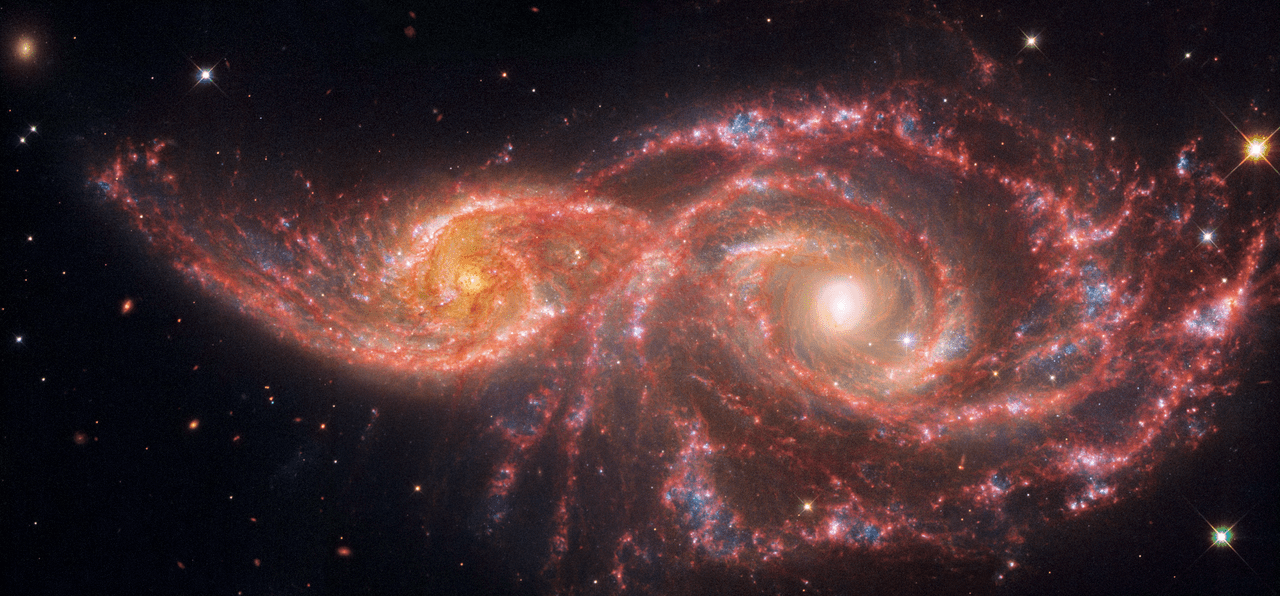
The gruesome palette of these galaxies is owed to a mix of mid-infrared light from NASA’s James Webb Space Telescope, and visible and ultraviolet light from NASA’s Hubble Space Telescope. The pair grazed one another millions of years ago. The smaller spiral on the left, cataloged as IC 2163, passed behind NGC 2207, the larger spiral galaxy at right.
Both have increased star formation rates. Combined, they are estimated to form the equivalent of two dozen new stars that are the size of the Sun annually. Our Milky Way galaxy forms the equivalent of two or three new Sun-like stars per year.
Both galaxies have hosted seven known supernovae, each of which may have cleared space in their arms, rearranging gas and dust that later cooled, and allowed new many stars to form. (Find these areas by looking for the bluest regions).
Image (Credit): The R Aquarii binary star system. (NASA, ESA, Matthias Stute , Margarita Karovska , Davide De Martin (ESA/Hubble), Mahdi Zamani (ESA/Hubble))
This week’s image is from the Hubble Space Telescope. It shows a brilliant pattern in the sky about 700 light-years away. It is the product of an odd dance between two symbiotic stars, one red and the other white.
Here is more information about the image from the Hubblesite:
Located approximately 700 light-years away, a binary star system called R Aquarii undergoes violent eruptions that blast out huge filaments of glowing gas. The twisted stellar outflows make the region look like a lawn sprinkler gone berserk. This dramatically demonstrates how the universe redistributes the products of nuclear energy that form deep inside stars and jet back into space.
R Aquarii belongs to a class of double stars called symbiotic stars. The primary star is an aging red giant and its companion is a compact burned-out star known as a white dwarf. The red giant primary star is classified as a Mira variable that is over 400 times larger than our Sun. The bloated monster star pulsates, changes temperature, and varies in brightness by a factor of 750 times over a roughly 390-day period. At its peak the star is blinding at nearly 5,000 times our Sun’s brightness.
When the white dwarf star swings closest to the red giant along its 44-year orbital period, it gravitationally siphons off hydrogen gas. This material accumulates on the dwarf star’s surface until it undergoes spontaneous nuclear fusion, making that surface explode like a gigantic hydrogen bomb. After the outburst, the fueling cycle begins again.
This outburst ejects geyser-like filaments shooting out from the core, forming weird loops and trails as the plasma emerges in streamers. The plasma is twisted by the force of the explosion and channeled upwards and outwards by strong magnetic fields. The outflow appears to bend back on itself into a spiral pattern. The plasma is shooting into space over 1 million miles per hour – fast enough to travel from Earth to the Moon in 15 minutes! The filaments are glowing in visible light because they are energized by blistering radiation from the stellar duo.
Image (Credit): Visitors at ESA’s control center in Germany watching the Hera launch. (ESA / J.Mai)
This week’s image shows a crowd in Germany watching the launch of the European Space Agency’s (ESA) Hera mission on October 7, 2024. The launch itself took place from Cape Canaveral Space Force Station in Florida via a SpaceX Falcon 9.
Hera’s goal is to study how binary asteroid systems like Didymos form and function to learn more about to defend the Earth from approaching asteroids. You may remember Didymos from the earlier NASA Double Asteroid Redirection Test (DART) mission.
Hera’s first deep space manoeuvre will begin in late October and put the spacecraft on course for its next major milestone, a flyby of Mars in March 2025. During this flyby, Hera will use its instruments to study Deimos, the smaller and more enigmatic of Mars’s two moons. This will serve as an important test for many of the spacecraft’s instruments, ensuring they are fully operational before the spacecraft arrives at its final destination, Didymos.
Hera will perform a second deep space manoeuvre in February 2026. An ‘impulsive rendezvous’ in October 2026 will bring Hera into the vicinity of the Didymos asteroid system. The spacecraft will begin its detailed survey of the moonlet Dimorphos in 2027, which will turn the 151 m asteroid into one of the most studied objects in the Solar System.
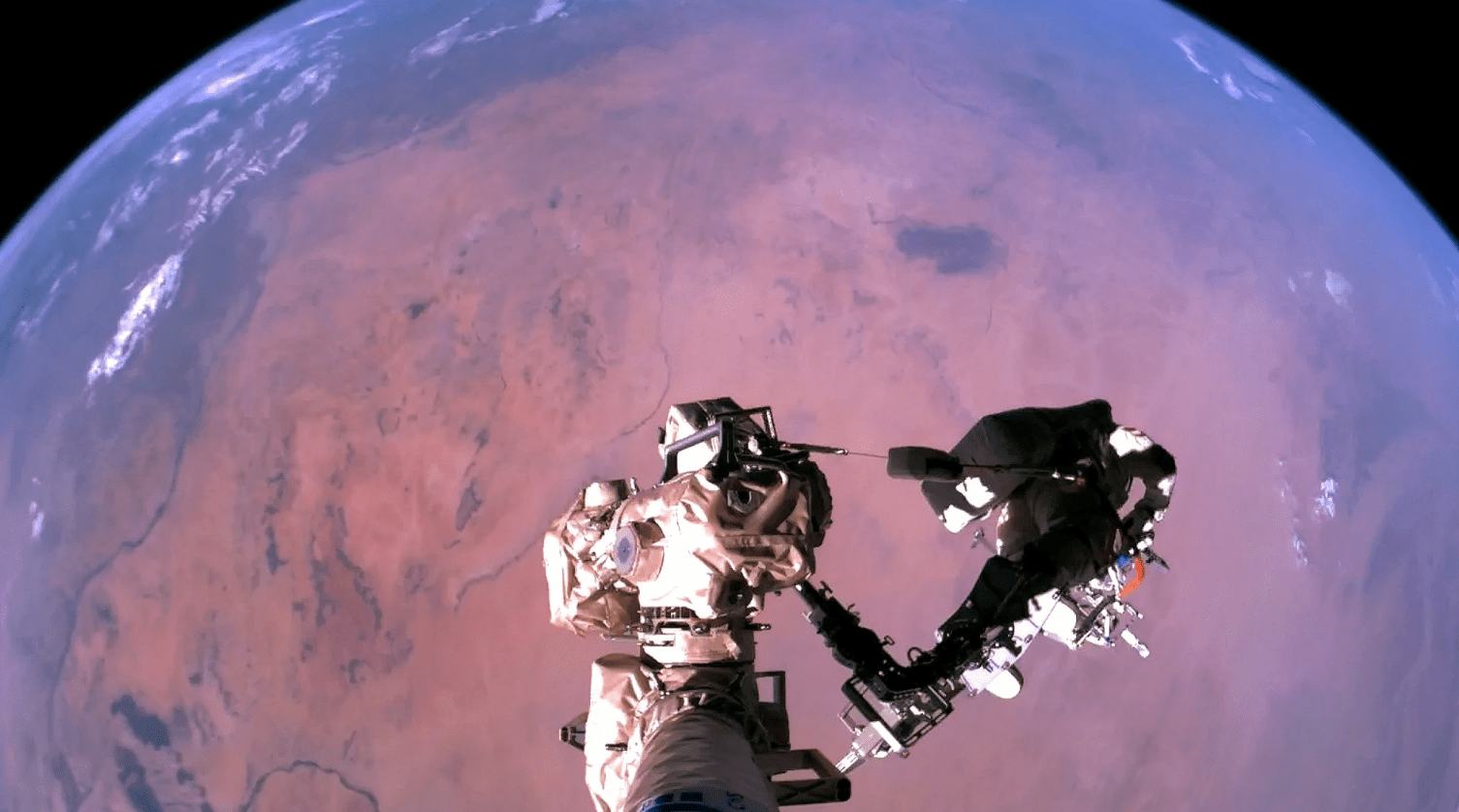
Image (Credit): Extravehicular activity on China’s Tiangong space station this past July. (CMSA)
This week’s image is from the China Manned Space Agency (CMSA). It shows taikonaut Li Cong on a spacewalk outside China’s Tiangong station on July 3, 2024.
The space station was first launched in April 2021 and has been permanently crewed since June 2022. The current crew, called Shenzhou 18, consists of Commander Ye Guangfu, Operator Li Cong, and System Operator Li Guangsu.




 Our Awesome Universe