Pic of the Week: Picture Perfect Spiral Galaxy

Image (Credit): Hubble’s view of spiral galaxy IC 4709. (ESA/Hubble & NASA, M. Koss, A, Barth)

This week’s image comes from the Hubble Space Telescope. It shows an almost too perfect spiral galaxy that might have come from AI software, but it is a real image from NASA and ESA. You are looking at spiral galaxy IC 4709, which is about 240 million light-years away.

Here is more information on the image from the ESA’s Hubble site:

Its view here is studded with stars, many of which appear particularly large and bright thanks to their nearby locations in our own galaxy, and which feature the characteristic diffraction patterns caused by Hubble’s optics. Much further away — around 240 million light-years distant in fact, in the southern constellation Telescopium — is the spiral galaxy IC 4709. Its swirling disc filled with stars and dust bands is beautifully captured, as is the faint halo surrounding it. The compact region at its core might be the most remarkable sight, however: this is an active galactic nucleus (AGN).
Pic of the Week: Sparkling Candy Floss

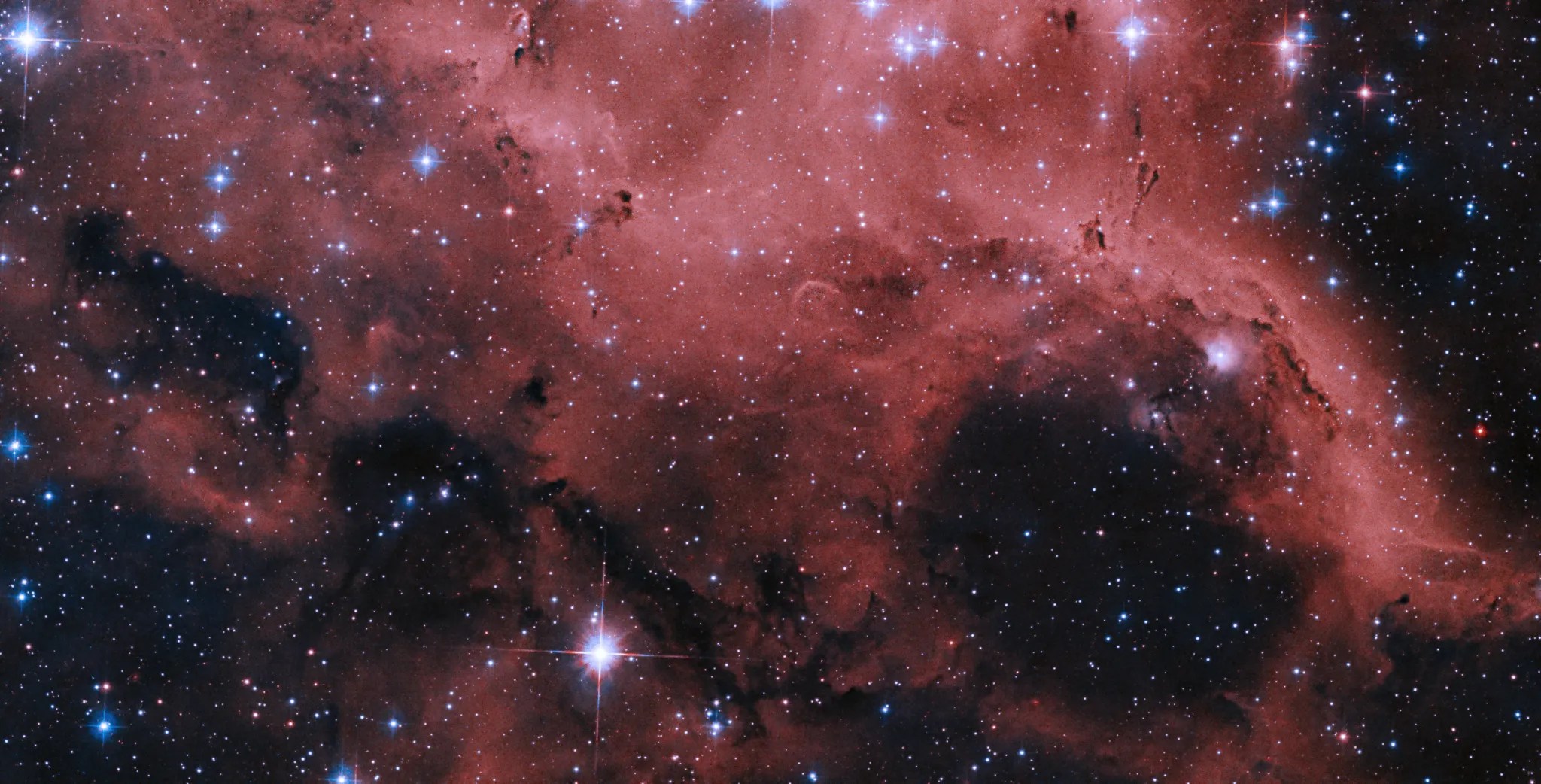
Image (Credit): The complex cluster of emission nebulae is known as N11. (NASA, ESA, J. M. Apellaniz from the Centro de Astrobiologia (CSIC/INTA Inst. Nac. de Tec. Aero., and Gladys Kober from NASA/Catholic University of America)

This week’s image is from the Hubble Space Telescope. It shows a cluster of stars that are about 160,000 light-years away in the Large Magellanic Cloud that orbits our Milky Way.

Here is the full story from NASA:

A bubbling region of stars both old and new lies some 160,000 light-years away in the constellation Dorado. This complex cluster of emission nebulae is known as N11, and was discovered by American astronomer and NASA astronaut Karl Gordon Henize in 1956. NASA’s Hubble Space Telescope brings a new image of the cluster in the Large Magellanic Cloud (LMC), a nearby dwarf galaxy orbiting the Milky Way.

About 1,000 light-years across, N11’s sprawling filaments weave stellar matter in and out of each other like sparkling candy floss. These cotton-spun clouds of gas are ionized by a burgeoning host of young and massive stars, giving the complex a cherry-pink appearance. Throughout N11, colossal cavities burst from the fog. These bubbles formed as a result of the vigorous emergence and death of stars contained in the nebulae. Their stellar winds and supernovae carved the surrounding area into shells of gas and dust.

Pic of the Week: Cygnus Approaching

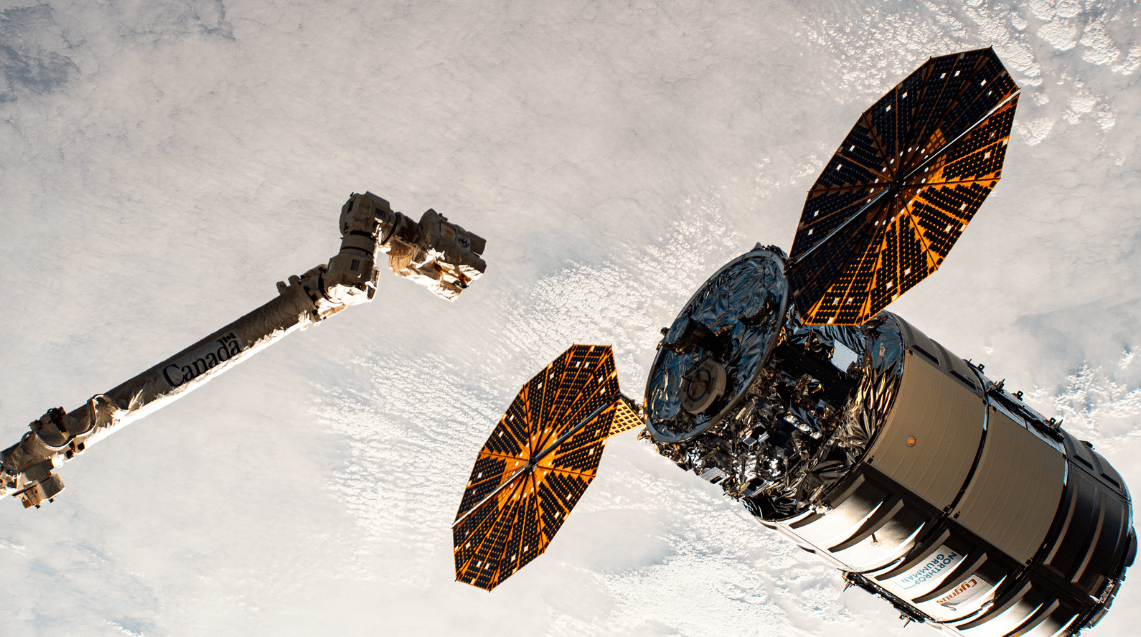
Image (Credit): The Cygnus cargo craft outside the ISS this week. (NASA)

This week’s image is from the International Space Station (ISS). It shows Northrop Grumman’s Cygnus resupply capsule on August 6, 2024 as the International Space Station’s (ISS) Canadarm2 robotic arm attempts to capture it. NASA noted that this Canadarm2 maneuver marked the 50th free-flying capture for the robotic arm.

Pic of the Week: View of a Nearby Exoplanet

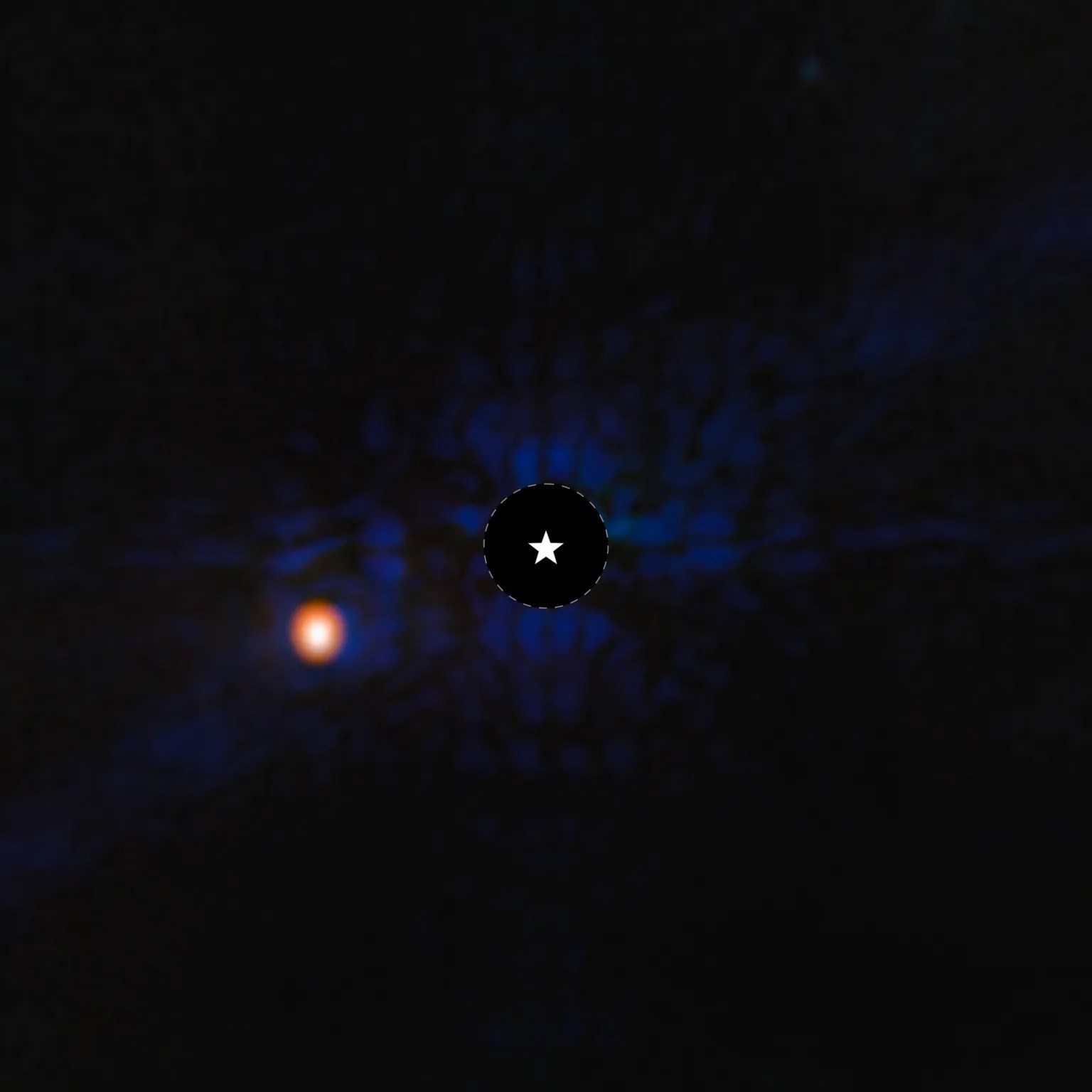
Image (Credit): JWST’s view of exoplanet Epsilon Indi Ab. (NASA, ESA, CSA, STScI, E. Matthews (Max Planck Institute for Astronomy))

This week’s image looks dark and simple, and yet it is an amazing sight provided by NASA’s James Webb Space Telescope (JWST). It shows a directly imaged exoplanets that resides about 12 light-years from us. It is called Epsilon Indi Ab and is several times the mass of Jupiter.

Here is an explanation from NASA about what you are seeing in the image:

This image of the gas-giant exoplanet Epsilon Indi Ab was taken with the on NASA’s James Webb Space Telescope’s MIRI (Mid-Infrared Instrument). A star symbol marks the location of the host star Epsilon Indi A, whose light has been blocked by the coronagraph, resulting in the dark circle marked with a dashed white line. Epsilon Indi Ab is one of the coldest exoplanets ever directly imaged. Light at 10.6 microns was assigned the color blue, while light at 15.5 microns was assigned the color orange. MIRI did not resolve the planet, which is a point source.