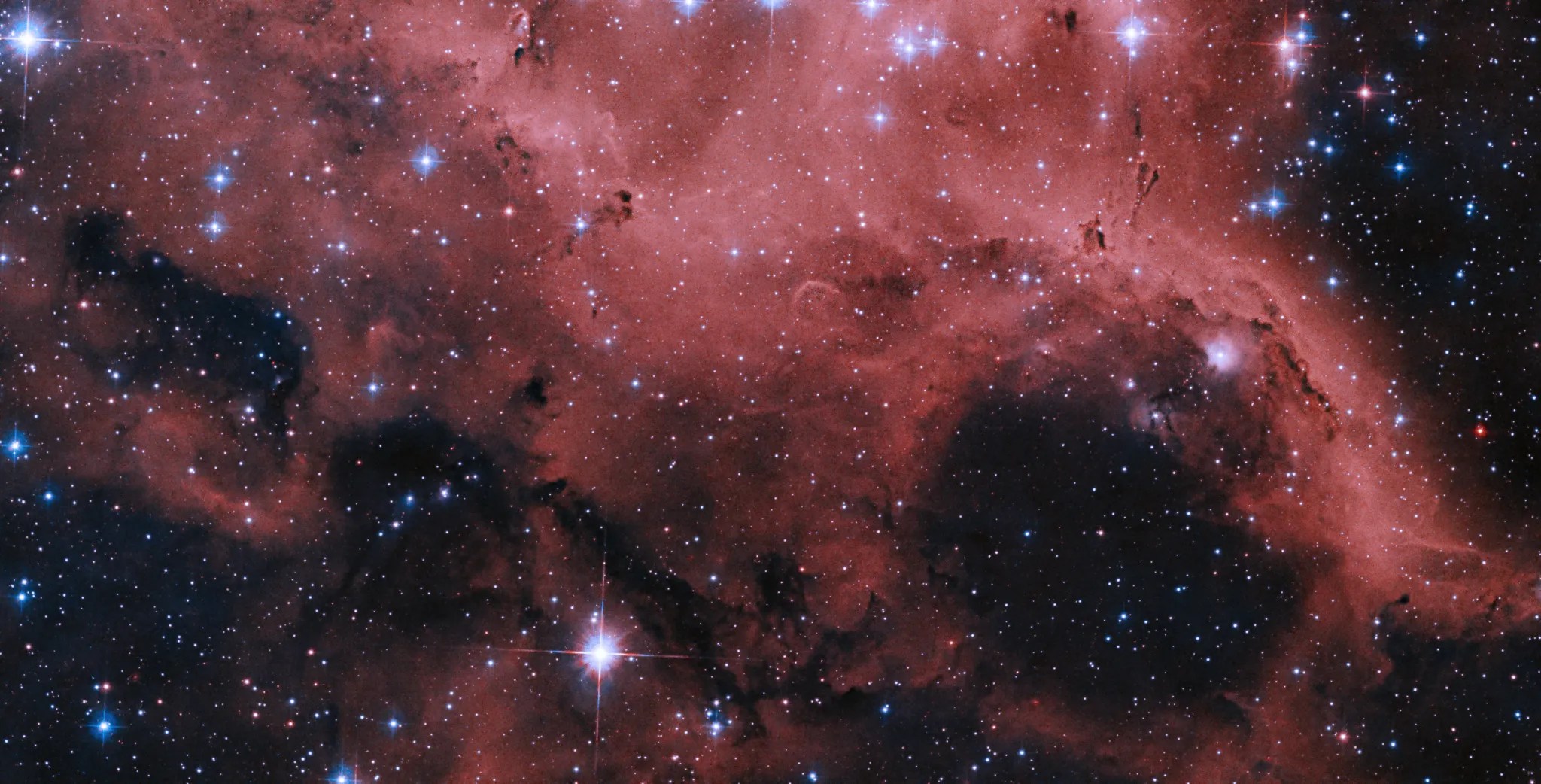
Pic of the Week: Celebrating Chandra’s 25th Anniversary

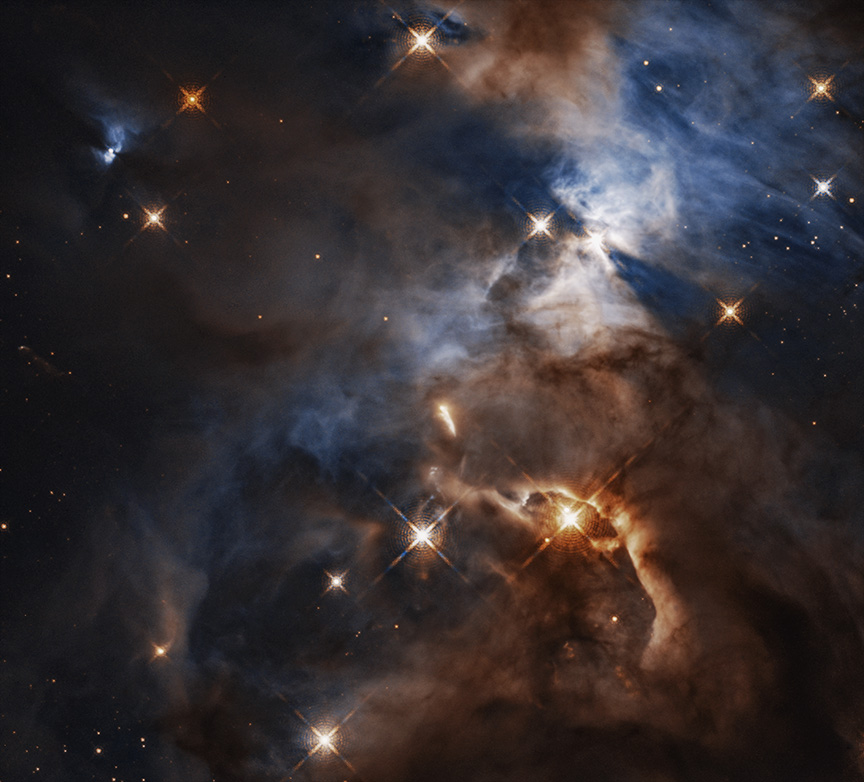
Image (Credit): Chandra X-ray Observatory image of the Bat Shadow. (X-ray: NASA/CXC/SAO; Optical: NASA/ESA/STScI; Image Processing: NASA/CXC/SAO/J. Major)

NASA’s Chandra X-ray Observatory is celebrating the 25th anniversary of the observatory, which means we get to view quite a few amazing images from over the years, such as the one above called the Bat Shadow.

Here is more from NASA on this image explaining the bat connection:

In this composite image, several pink and white stars gleam through murky cloud formations. These are young stars detected by Chandra. At our lower right, an opaque cloud resembling a veined slug rises out of a muddy brown mist. Blue and grey clouds with hints of brown stretch from our lower left, to our upper right. There, near the upper righthand corner, two long black triangles appear to burst from a central gleaming star. These triangles are in fact shadows from the young star, cast on distant blue and grey clouds. The eerie shape, reminiscent of the Batman call sign projected against a cloudy Gotham sky, has earned the phenomenon the nickname The Bat Shadow.

Pic of the Week: Stellar Penguin and Egg

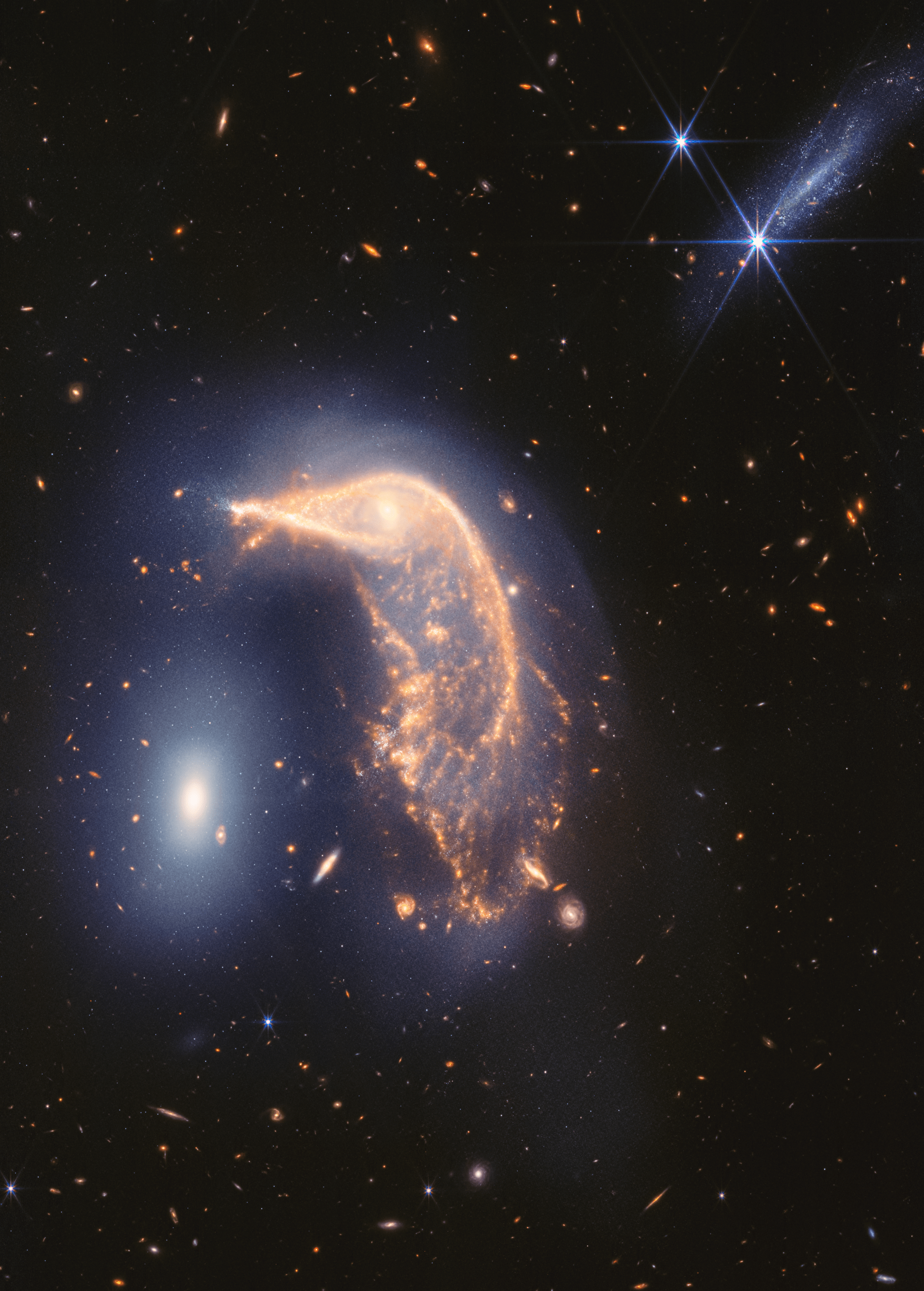
Image (Credit): The Penguin and Egg galaxies, known jointly as Arp 142. (NASA, ESA, CSA, STScI)

This week’s fun image comes from the James Webb Space Telescope. Called the Penguin and the Egg, these two galaxies of similar mass are locked together.

Here is the story of the two galaxies from NASA:

Before their first approach, the Penguin held the shape of a spiral. Today, its galactic center gleams like an eye, its unwound arms now shaping a beak, head, backbone, and fanned-out tail.

Like all spiral galaxies, the Penguin is still very rich in gas and dust. The galaxies’ “dance” gravitationally pulled on the Penguin’s thinner areas of gas and dust, causing them to crash in waves and form stars. Look for those areas in two places: what looks like a fish in its “beak” and the “feathers” in its “tail.”

Surrounding these newer stars is smoke-like material that includes carbon-containing molecules, known as polycyclic aromatic hydrocarbons, which Webb is exceptional at detecting. Dust, seen as fainter, deeper orange arcs also swoops from its beak to tail feathers.

In contrast, the Egg’s compact shape remains largely unchanged. As an elliptical galaxy, it is filled with aging stars, and has a lot less gas and dust that can be pulled away to form new stars. If both were spiral galaxies, each would end the first “twist” with new star formation and twirling curls, known as tidal tails.

Another reason for the Egg’s undisturbed appearance: These galaxies have approximately the same mass or heft, which is why the smaller-looking elliptical wasn’t consumed or distorted by the Penguin.

It is estimated that the Penguin and the Egg are about 100,000 light-years apart — quite close in astronomical terms. For context, the Milky Way galaxy and our nearest neighbor, the Andromeda Galaxy, are about 2.5 million light-years apart. They too will interact, but not for about 4 billion years.

Pic of the Week: Omega Centauri

Image (Credit): Hubble Space Telescope’s view of Omega Centauri. (ESA/Hubble & NASA, M. Häberle)

The colorful image this week is from the Hubble Space Telescope. It shows the stars that make up Omega Centauri, a globular cluster one can view with the naked eye.

Here’s a little more about this image from the European Space Agency (ESA):

Omega Centauri is visible from Earth with the naked eye and is one of the favourite celestial objects for stargazers in the southern hemisphere. Although the cluster is 17 000 light-years away, lying just above the plane of the Milky Way, it appears almost as large as the full Moon when seen from a dark rural area. The exact classification of Omega Centauri has evolved through time, as our ability to study it has improved. It was first listed in Ptolemy’s catalogue nearly two thousand years ago as a single star. Edmond Halley reported it as a nebula in 1677, and in the 1830s the English astronomer John Herschel was the first to recognise it as a globular cluster. Omega Centauri consists of roughly 10 million stars that are gravitationally bound.

Pic of the Week: Happy Fourth of July!

Image (Credit): Six U.S. astronauts currently aboard the ISS. From left to right they are Jeanette Epps, Tracy Dyson, Butch Wilmore, Mick Barratt, Suni Williams, and Matt Dominick. The are holding copies of the Declaration of Independence, U.S. Constitution, and Bill of Rights. (NASA)

This week’s image comes from the International Space Station (ISS) where the U.S. astronauts have a message for all of us regarding the Fourth of July. You can watch the entire video here and hear a message from each of the astronauts – Mike Barratt, Matt Dominick, Tracy Caldwell Dyson, Jeanette Epps, Suni Williams and Butch Wilmore.

Pic of the Week: The Dark Doodad Nebula

Image (Credit): The molecular cloud near star cluster NGC 4372. (NASA, Martin Pugh & Rocco Sung)

This week’s image is from NASA’s Astronomy Picture of the Day website. It shows a dark blur in the night sky caused by interstellar dust.

Here is the full description from NASA:

What is that strange brown ribbon on the sky? When observing the star cluster NGC 4372, observers frequently take note of an unusual dark streak nearby running about three degrees in length. The streak, actually a long molecular cloud, has become known as the Dark Doodad Nebula. (Doodad is slang for a thingy or a whatchamacallit.) Pictured here, the Dark Doodad Nebula sweeps across the center of a rich and colorful starfield. Its dark color comes from a high concentration of interstellar dust that preferentially scatters visible light. The globular star cluster NGC 4372 is visible as the fuzzy white spot on the far left, while the bright blue star gamma Muscae is seen to the cluster’s upper right. The Dark Doodad Nebula can be found with strong binoculars toward the southern constellation of the Fly (Musca).