Image (Credit): Six U.S. astronauts currently aboard the ISS. From left to right they are Jeanette Epps, Tracy Dyson, Butch Wilmore, Mick Barratt, Suni Williams, and Matt Dominick. The are holding copies of the Declaration of Independence, U.S. Constitution, and Bill of Rights. (NASA)
This week’s image comes from the International Space Station (ISS) where the U.S. astronauts have a message for all of us regarding the Fourth of July. You can watch the entire video here and hear a message from each of the astronauts – Mike Barratt, Matt Dominick, Tracy Caldwell Dyson, Jeanette Epps, Suni Williams and Butch Wilmore.
What is that strange brown ribbon on the sky? When observing the star cluster NGC 4372, observers frequently take note of an unusual dark streak nearby running about three degrees in length. The streak, actually a long molecular cloud, has become known as the Dark Doodad Nebula. (Doodad is slang for a thingy or a whatchamacallit.) Pictured here, the Dark Doodad Nebula sweeps across the center of a rich and colorful starfield. Its dark color comes from a high concentration of interstellar dust that preferentially scatters visible light. The globular star cluster NGC 4372 is visible as the fuzzy white spot on the far left, while the bright blue star gamma Muscae is seen to the cluster’s upper right. The Dark Doodad Nebula can be found with strong binoculars toward the southern constellation of the Fly (Musca).
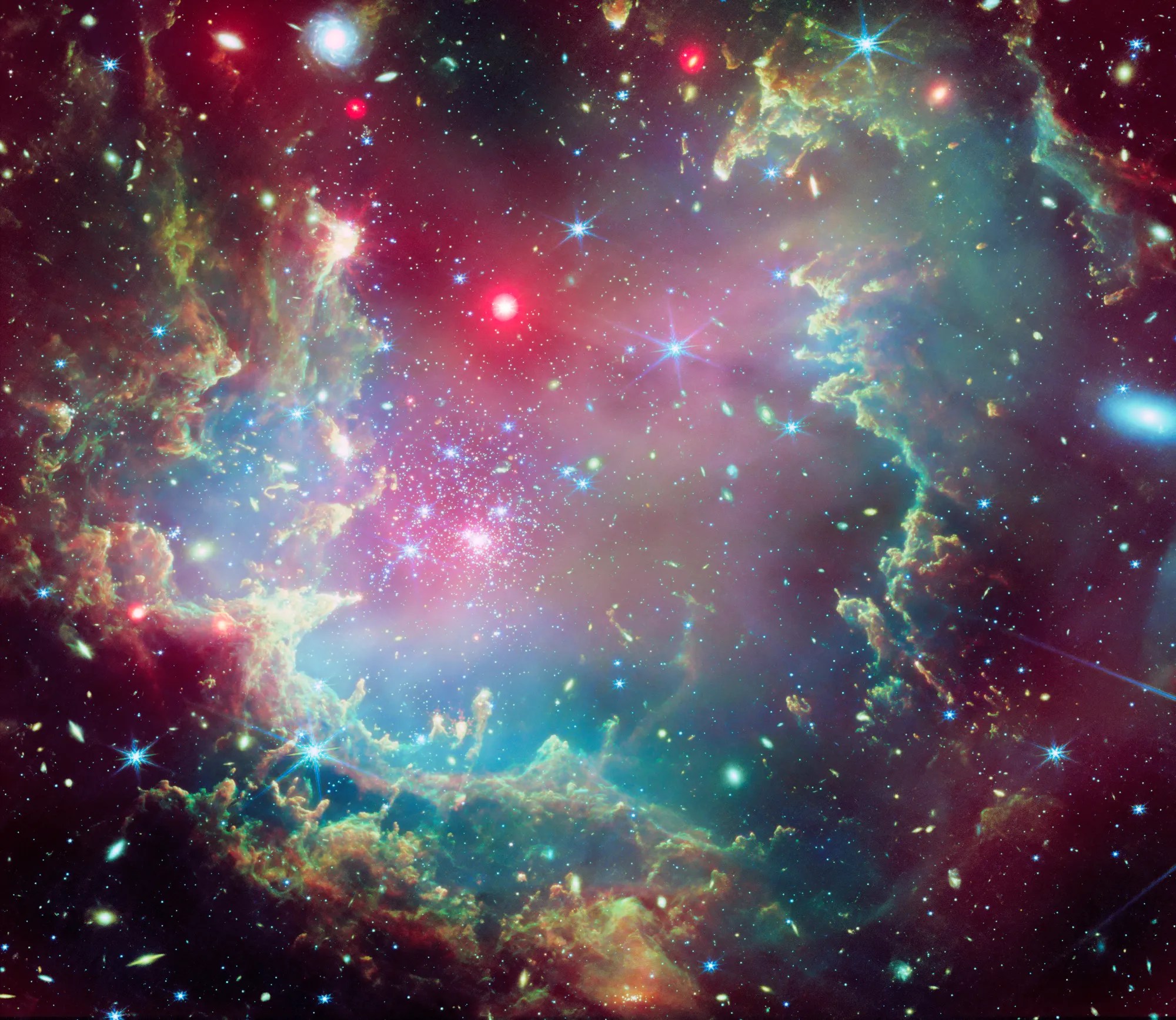
Image (Credit): RCW 7, a nebula located just over 5,300 light-years from Earth. (ESA/Hubble & NASA, J. Tan (Chalmers University & University of Virginia), R. Fedriani (Institute for Astrophysics of Andalusia))
This week’s image is from the NASA/European Space Agency’s (ESA) Hubble space telescope. It shows the nebula called RCW 7, which is located about 5,300 light-years away.
Clouds of gas and dust with many stars. The clouds form a flat blue background towards the bottom, and become more thick and smoky towards the top. They are lit on one side by stars in the nebula. A thick arc of gas and dust reaches around from the top, where it is brightly lit by many stars in and around it, to the bottom where it is dark and obscuring. Other large stars lie between the clouds and the viewer.
Image (Credit): Frosty summit of Mar’s Olympus Mons. (ESA/DLR/FU Berlin)
This week’s image is from the European Space Agency (ESA) and shows Olympus Mons on Mars, the tallest volcano in the solar system. Captured by ESA’s Mars Express, it shows water frost close to the planet’s equator, which was unexpected.
Colin Wilson, ESA project scientist for both ExoMars Trace Gas Orbiter and Mars Express, stated:
Finding water on the surface of Mars is always exciting, both for scientific interest and for its implications for human and robotic exploration…Even so, this discovery is particularly fascinating. Mars’s low atmospheric pressure creates an unfamiliar situation where the planet’s mountaintops aren’t usually colder than its plains – but it seems that moist air blowing up mountain slopes can still condense into frost, a decidedly Earth-like phenomenon.
Image (Credit): The Starship rocket lifting off its launch pad in Texas earlier today. (SpaceX)
This week’s image shows the launch of the forth test of SpaceX’s Starship, which went further than any of the tests to date. In it’s summary of the flight, SpaceX noted:
Flight 4 ended with Starship igniting its three center Raptor engines and executing the first flip maneuver and landing burn since our suborbital campaign, followed by a soft splashdown of the ship in the Indian Ocean one hour and six minutes after launch.
As with yesterday’s successful launch of Boeing’s Starliner, today’s successful flight gave NASA greater assurance that the commercial sector is picking up the pace to assist the U.S. with both the International Space Station and Artemis program to the Moon (and eventually Mars).
Note: I like The Economist’sheadline on the mission: “Elon Musk’s Starship Makes a Test Flight Without Exploding.”