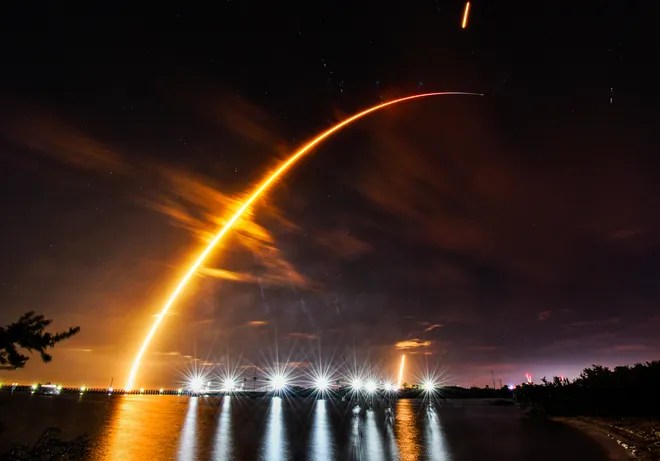
Image (Credit): Today’s launch of the Intuitive Machines IM-1 mission from the Kennedy Space Center. (Malcolm Denemark/Florida Today)
This week’s image shows the early morning launch of Intuitive Machines’ IM-1 mission via a SpaceX Falcon 9 rocket. The rocket carries the Nova-C robotic lander, also called “Odysseus,” that includes both NASA and commercial payloads. If all goes well, the lander will be on the surface of the moon next week.
This image from Florida Today is unique in that it is a time exposure showing both the launch from the Kennedy Space Center as well as the booster landing shortly afterward.
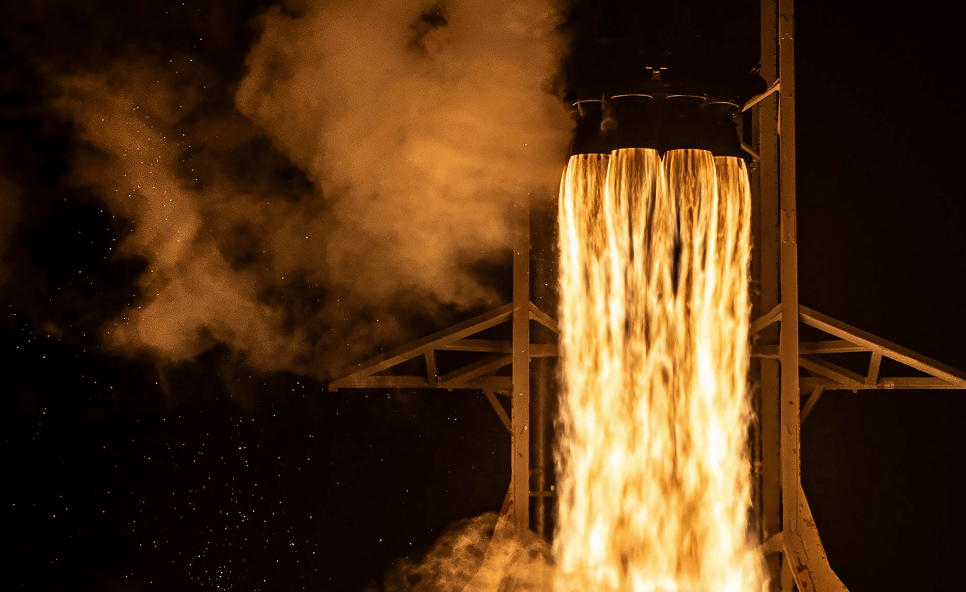
Image (Credit): Engines of the SpaceX rocket carrying the PACE spacecraft into orbit. (SpaceX)
This week’s image is from SpaceX, which launched NASA’s Plankton, Aerosol, Cloud, ocean Ecosystem (PACE) mission into orbit earlier today (the Falcon 9 rocket engines are shown above).
The spacecraft is designed to monitor the Earth from orbit. NASA explains the mission is this way:
Information collected throughout PACE’s mission will benefit society in the areas of ocean health, harmful algal bloom monitoring, ecological forecasting, and air quality. PACE also will contribute new global measurements of ocean color, cloud properties, and aerosols, which will be essential to understanding the global carbon cycle and ocean ecosystem responses to a changing climate.
The PACE’s mission is designed to last at least three years, though the spacecraft is loaded with enough propellant to expand that timeline more than three times as long.
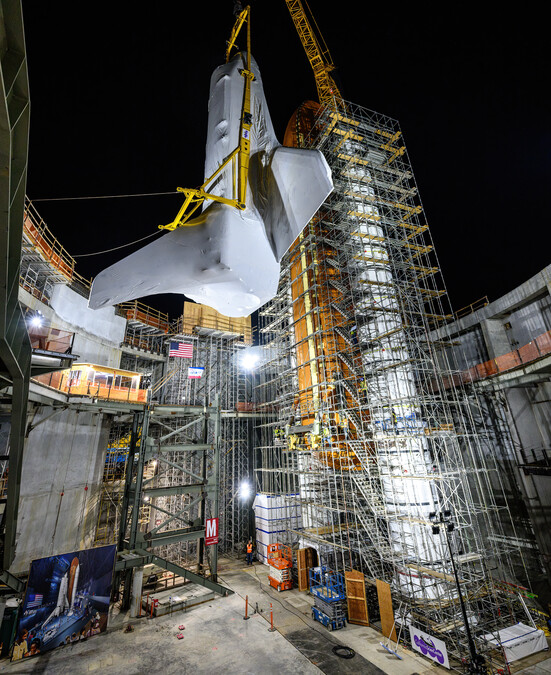
Image (Credit): Ongoing construction work assembling the Space Shuttle Endeavor and related stack elements at the planned Samuel Oschin Air and Space Center. (California Science Center)
This week’s image comes from California and shows the construction of a new giant exhibit at the future Samuel Oschin Air and Space Center. What you are seeing is a covered Space Shuttle Endeavour, which flew its final mission back in May 2011.
You can view more images and videos related to the creation of this new exhibit by visiting the California Science Center site. The site notes:
This will be the only complete stack of authentic space shuttle flight hardware in existence, making the Endeavour exhibit even more significant than before. In addition to allowing the public unprecedented, unique vantage points, this configuration retains a complete flight stack for engineers and historians to examine in the future. NASA and aerospace companies frequently visit museums to look at hardware from previous programs in order to design for the future projects.
Image (Credit): Shadow of the Ingenuity helicopter’s rotor blade on the surface of Mars. (NASA, JPL-Caltech)
This week’s image shows the shadow of little helicopter that could and continued to do so for 72 flights on Mars. The photo taken by NASA’s Ingenuity Mars helicopter shows one of its rotor blades after it finished its last flight on January 18, 2024. During the landing, one of the blades was damaged, permanently grounded the helicopter forever more.
The amazing little helicopter surpassed all expectations and became a very helpful buddy to the Perseverance rover. It may be the end of Ingenuity, but it should also be seen as the start of more missions that pair rovers and helicopters on Mars.
NASA Administrator Bill Nelson has some final words regarding this unique helicopter in a video that you can watch here.
In addition, Teddy Tzanetos, Ingenuity’s project manager at NASA JPL, had this to say:
It’s humbling Ingenuity not only carries onboard a swatch from the original Wright Flyer, but also this helicopter followed in its footsteps and proved flight is possible on another world.
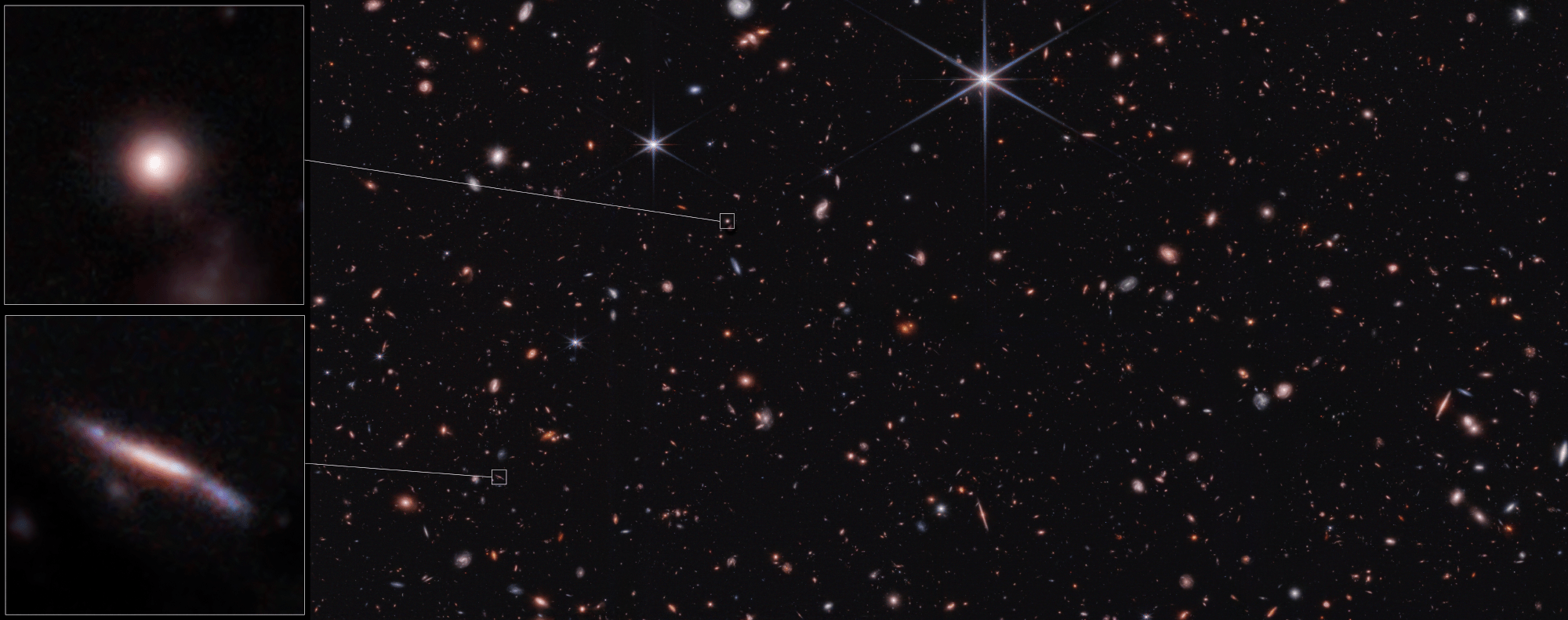
Image (Credit): JWST image showing an array of odd shapes when the universe was only 600 million to 6 billion years old. The elongated shape in the left bottom part of the image is one of the most common identified shapes so far in Webb’s survey. (NASA, ESA, CSA, Steve Finkelstein (UT Austin), Micaela Bagley (UT Austin), Rebecca Larson (UT Austin))
This week’s image is one from the James Webb Space Telescope (JWST) showing galaxies from long ago. Many of these galaxies have an elongated shape similar to a surfboard. Again, JWST is opening our eyes everyday to the wonder and weirdness of the universe.
Researchers analyzing images from NASA’s James Webb Space Telescope have found that galaxies in the early universe are often flat and elongated, like surfboards and pool noodles – and are rarely round, like volleyballs or frisbees. “Roughly 50 to 80% of the galaxies we studied appear to be flattened in two dimensions,” explained lead author Viraj Pandya, a NASA Hubble Fellow at Columbia University in New York. “Galaxies that look like pool noodles or surfboards seem to be very common in the early universe, which is surprising, since they are uncommon nearby.”
The team focused on a vast field of near-infrared images delivered by Webb, known as the Cosmic Evolution Early Release Science (CEERS) Survey, plucking out galaxies that are estimated to exist when the universe was 600 million to 6 billion years old.



 Our Awesome Universe