Pic of the Week: Herbig-Haro 211

Image (Credit): Herbig-Haro 211 as captured by the JWST.

This week’s image is from the James Webb Space Telescope (JWST). It shows a colorful and expansive Herbig-Haro 211, with a Herbig-Haro (HH) being “…luminous regions surrounding newborn stars, formed when stellar winds or jets of gas spewing from these newborn stars form shock waves colliding with nearby gas and dust at high speeds.”

NASA explains what we are seeing:

This image of HH 211 from NASA’s James Webb Space Telescope reveals an outflow from a Class 0 protostar, an infantile analog of our Sun when it was no more than a few tens of thousands of years old and with a mass only 8% of the present-day Sun (it will eventually grow into a star like the Sun).

Infrared imaging is powerful in studying newborn stars and their outflows, because such stars are invariably still embedded within the gas from the molecular cloud in which they formed. The infrared emission of the star’s outflows penetrates the obscuring gas and dust, making a Herbig-Haro object like HH 211 ideal for observation with Webb’s sensitive infrared instruments. Molecules excited by the turbulent conditions, including molecular hydrogen, carbon monoxide, and silicon monoxide, emit infrared light that Webb can collect to map out the structure of the outflows.

The image showcases a series of bow shocks to the southeast (lower-left) and northwest (upper-right) as well as the narrow bipolar jet that powers them. Webb reveals this scene in unprecedented detail — roughly 5 to 10 times higher spatial resolution than any previous images of HH 211. The inner jet is seen to “wiggle” with mirror symmetry on either side of the central protostar. This is in agreement with observations on smaller scales and suggests that the protostar may in fact be an unresolved binary star.
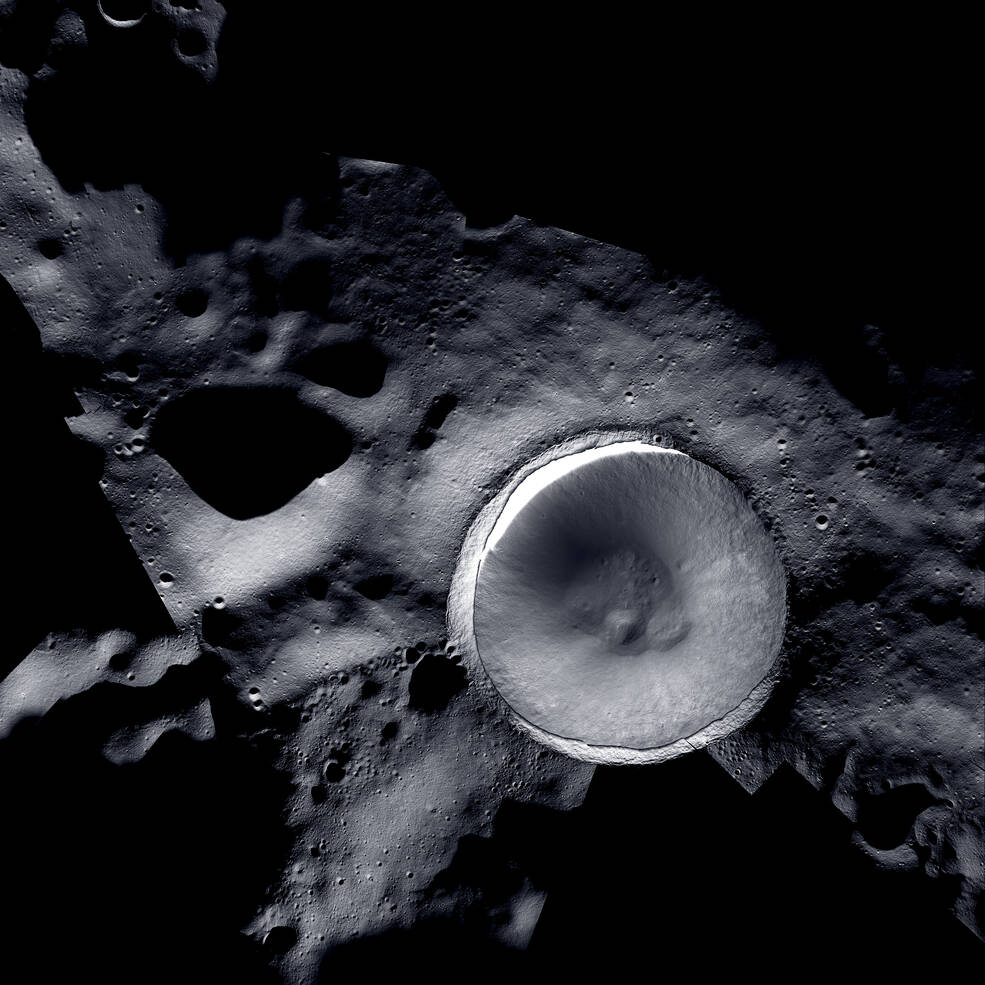
Pic of the Week: Shackleton Crater

Image (Credit): Shackleton Crater on the lunar surface. (Mosaic created by LROC and ShadowCam teams with images provided by NASA/KARI/ASU)

This week’s image shows the Shackleton Crater located at the Moon’s South Pole. To create what you see above, an image from NASA’s Lunar Reconnaissance Orbiter Camera (LROC) was combined with another image from ShadowCam, a NASA instrument on board a KARI (Korea Aerospace Research Institute) spacecraft called Danuri,

Here is more information from NASA concerning the two cameras:

LROC can capture detailed images of the lunar surface but has limited ability to photograph shadowed parts of the Moon that never receive direct sunlight, known as permanently shadowed regions. ShadowCam is 200-times more light-sensitive than LROC and can operate successfully in these extremely low-light conditions, revealing features and terrain details that are not visible to LROC. ShadowCam relies on sunlight reflected off lunar geologic features or the Earth to capture images in the shadows.

ShadowCam’s light sensitivity, however, renders it unable to capture images of parts of the Moon that are directly illuminated, delivering saturated results. With each camera optimized for specific lighting conditions found near the lunar poles, analysts can combine images from both instruments to create a comprehensive visual map of the terrain and geologic features of both the brightest and darkest parts of the Moon. The permanently shadowed areas in this mosaic, such as the interior floor and walls of Shackleton Crater, are visible in such detail because of the imagery from ShadowCam. In contrast, the sunlit areas in this mosaic, like the rim and flanks of the crater, are a product of imagery collected by LROC.

Pic of the Week: Cosmic Smokescreen

Image (Credit): NGC 6530 as captured by the NASA/ESA Hubble Space Telescope. (ESA/Hubble & NASA, ESO, O. De Marco)

This week’s image is from the Hubble Space Telescope. It shows a fantastic array of colors from a portion of NGC 6530, which is about 4,350 light-years from Earth.

Here is more about this image from the European Space Agency (ESA):

A portion of the open cluster NGC 6530 appears as a roiling wall of smoke studded with stars in this image from the NASA/ESA Hubble Space Telescope…The cluster is set within the larger Lagoon Nebula, a gigantic interstellar cloud of gas and dust. It is the nebula that gives this image its distinctly smokey appearance; clouds of interstellar gas and dust stretch from one side of this image to the other.

You can also watch this short video that pans over the cluster.

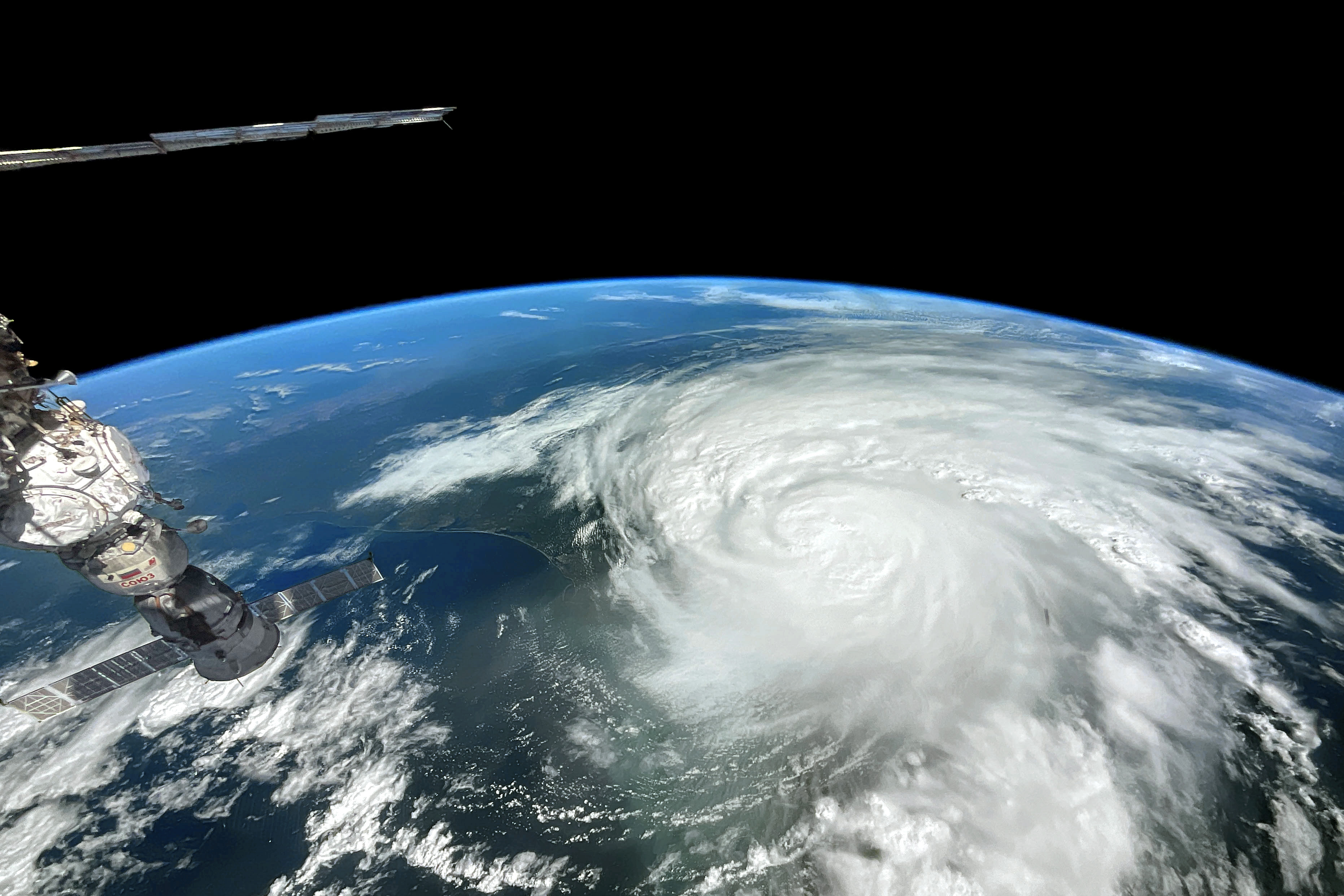
Pic of the Week: Hurricane Idalia Over Florida

Image (Credit): Hurricane Idalia as it travels over Florida. (NASA)

The image above showing Idalia hitting Florida was captured from the International Space Station on August 30, 2023.

Here is the full explanation about the image from the site:

An astronaut on the International Space Station used a handheld camera to capture the second photo (below) at 10:44 a.m. Eastern Time (14:44 Universal Time) on August 30, several hours after landfall. Idalia had weakened to a category 1 storm by this time with sustained winds of 150 kilometers (90 miles) per hour. It continued to weaken as it moved northeast over Georgia, South Carolina, and then offshore over the Atlantic Ocean on August 31.

You can see this image and others at NASA’s Earth Observatory site.

Pic of the Week: Cape Byron Lighthouse Moonrise

Image (Credit): “Cape Byron Lighthouse Moonrise” by Kevin Hennessey. (Australia Geographic)

The winners of the Australia Geographic astronomy photography contest have been named, and the photo above is one that won honorable mention in the Nightscapes Category, “Cape Byron Lighthouse Moonrise” by Kevin Hennessey.

Here is a little more about the impressive image:

The full moon rises behind the Cape Byron Lighthouse at the most easterly point of mainland Australia, silhouetting a group of spectators gathered at its base. Taken through a high-powered telescope from a distance of 5.1km away makes the moon appear extraordinarily large in this photo. The shooting location had to be accurate to within a couple of meters, determined with the help of the “Photopills” iPhone app, Google Earth and an aircraft-grade GPS.