Image (Credit): NGC 6530 as captured by the NASA/ESA Hubble Space Telescope. (ESA/Hubble & NASA, ESO, O. De Marco)
This week’s image is from the Hubble Space Telescope. It shows a fantastic array of colors from a portion of NGC 6530, which is about 4,350 light-years from Earth.
A portion of the open cluster NGC 6530 appears as a roiling wall of smoke studded with stars in this image from the NASA/ESA Hubble Space Telescope…The cluster is set within the larger Lagoon Nebula, a gigantic interstellar cloud of gas and dust. It is the nebula that gives this image its distinctly smokey appearance; clouds of interstellar gas and dust stretch from one side of this image to the other.
You can also watch this short video that pans over the cluster.
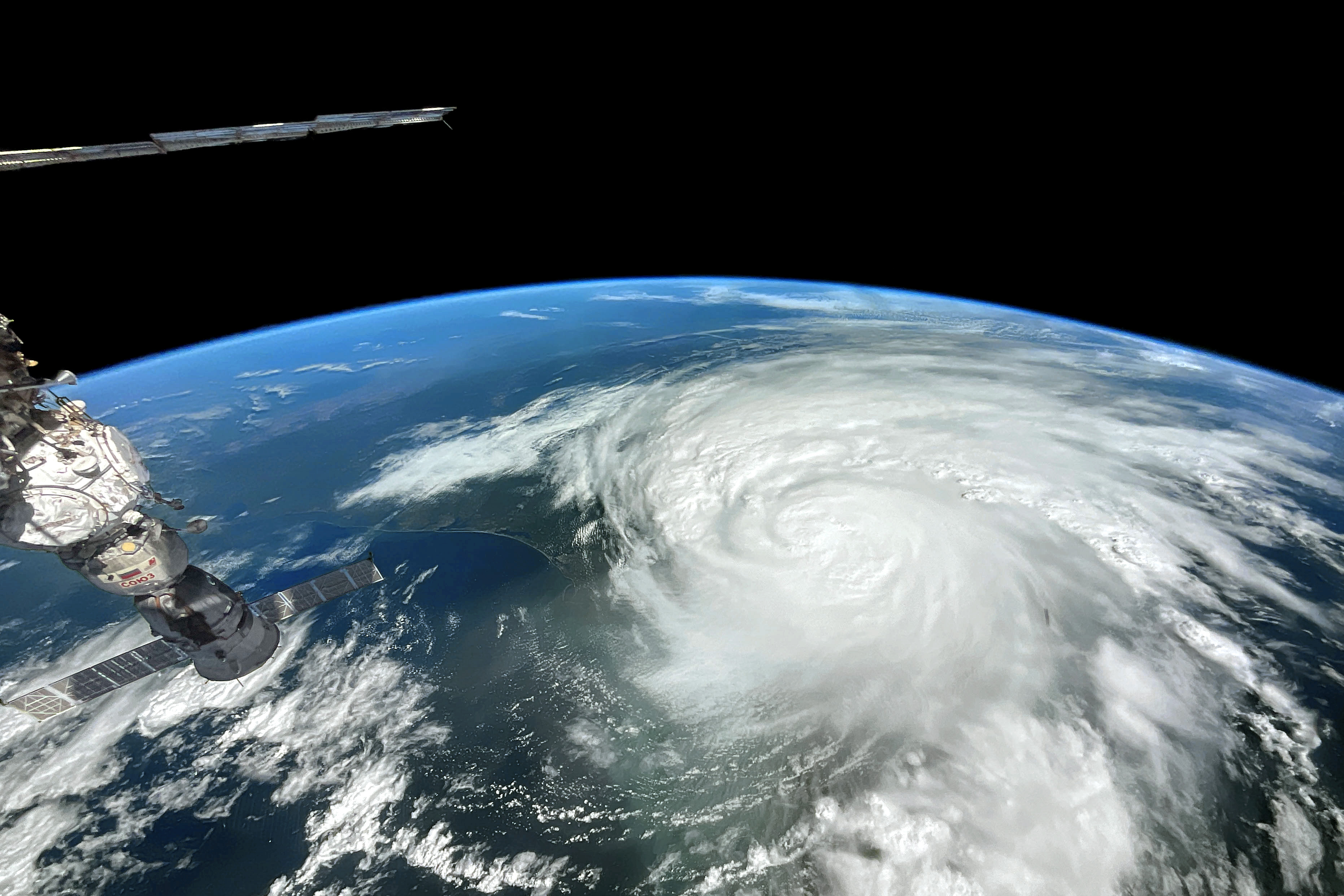
Image (Credit): Hurricane Idalia as it travels over Florida. (NASA)
The image above showing Idalia hitting Florida was captured from the International Space Station on August 30, 2023.
Here is the full explanation about the image from the site:
An astronaut on the International Space Station used a handheld camera to capture the second photo (below) at 10:44 a.m. Eastern Time (14:44 Universal Time) on August 30, several hours after landfall. Idalia had weakened to a category 1 storm by this time with sustained winds of 150 kilometers (90 miles) per hour. It continued to weaken as it moved northeast over Georgia, South Carolina, and then offshore over the Atlantic Ocean on August 31.
Image (Credit): “Cape Byron Lighthouse Moonrise” by Kevin Hennessey. (Australia Geographic)
The winners of the Australia Geographic astronomy photography contest have been named, and the photo above is one that won honorable mention in the Nightscapes Category, “Cape Byron Lighthouse Moonrise” by Kevin Hennessey.
Here is a little more about the impressive image:
The full moon rises behind the Cape Byron Lighthouse at the most easterly point of mainland Australia, silhouetting a group of spectators gathered at its base. Taken through a high-powered telescope from a distance of 5.1km away makes the moon appear extraordinarily large in this photo. The shooting location had to be accurate to within a couple of meters, determined with the help of the “Photopills” iPhone app, Google Earth and an aircraft-grade GPS.
Image (Credit): Galaxy NGC 6684 captured by the NASA/ESA Hubble Space Telescope. (ESA/Hubble & NASA, R. Tully)
This week’s image is from NASA/European Space Agency’s (ESA) Hubble Space Telescope. It shows the glowing galaxy NGC 6684, which is around 44 million light-years from Earth.
This oddly shaped galaxy is explained on the ESA’s website:
Lenticular galaxies like NGC 6684 (lenticular means lens-shaped) possess a large disc but lack the prominent spiral arms of galaxies like the Andromeda Galaxy. This leaves them somewhere between elliptical galaxies and spiral galaxies, and lends these galaxies a diffuse, ghostly experience. NGC 6684 also lacks the dark dust lanes that thread through other galaxies, adding to its spectral, insubstantial appearance.
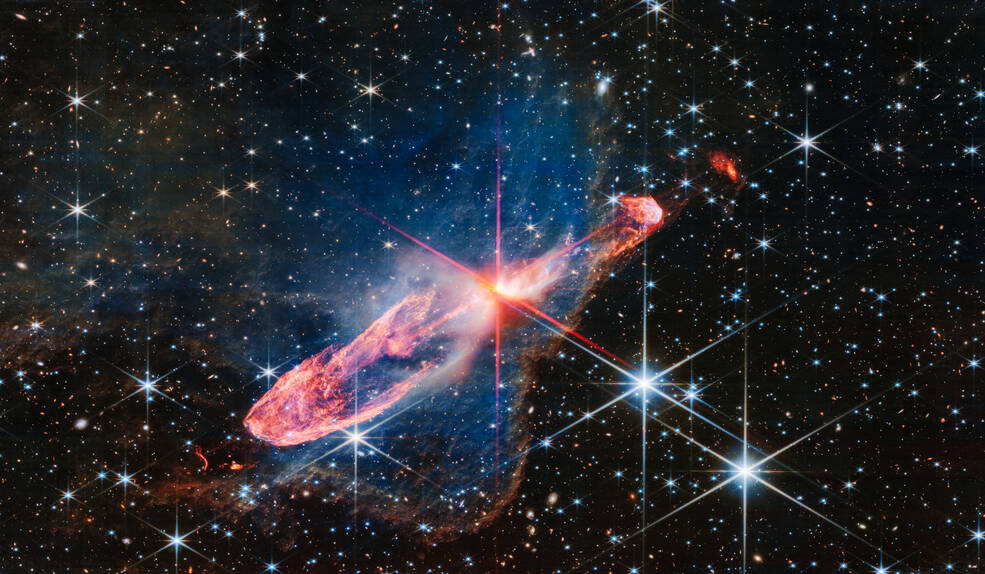
Image (Credit): JWST image showing the formation of a pair of new stars. (NASA, ESA, CSA. Image Processing: Joseph DePasquale (STScI))
This week’s image is from the James Webb Space Telescope (JWST). It shows the formation of new stars 1,470 light-years away that will take millions of years to form.
Here is a partial description of what you are seeing from NASA (visit the link for the full desciption):
NASA’s James Webb Space Telescope has captured the “antics” of a pair of actively forming young stars, known as Herbig-Haro 46/47, in high-resolution near-infrared light. To find them, trace the bright pink and red diffraction spikes until you hit the center: The stars are within the orange-white splotch. They are buried deeply in a disk of gas and dust that feeds their growth as they continue to gain mass. The disk is not visible, but its shadow can be seen in the two dark, conical regions surrounding the central stars.
The most striking details are the two-sided lobes that fan out from the actively forming central stars, represented in fiery orange. Much of this material was shot out from those stars as they repeatedly ingest and eject the gas and dust that immediately surround them over thousands of years.
When material from more recent ejections runs into older material, it changes the shape of these lobes. This activity is like a large fountain being turned on and off in rapid, but random succession, leading to billowing patterns in the pool below it. Some jets send out more material and others launch at faster speeds. Why? It’s likely related to how much material fell onto the stars at a particular point in time.




 Our Awesome Universe