Pic of the Week/A Day in Astronomy: Moon Landing

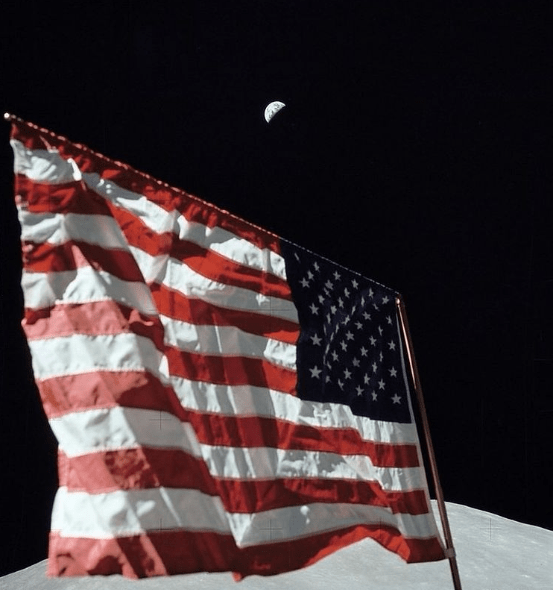
Image (Credit): Astronaut Edwin E. (Buzz) Aldrin Jr., Lunar Module (LM) pilot, climbs down the LM ladder, preparing for his first steps on the Moon. (NASA)

On this day in 1969, the Apollo 11 crew stepped on the Moon for the first time, showing that mankind could actually travel to another world. The image above shows Astronaut Buzz Aldrin preparing the step on the Moon as the second human to ever walk on the lunar surface.

Buzz Aldrin has plenty of quotes related to his Moon mission and life in general, but I like his quotes about our next trip to Mars, like this one:

When we set out to land people on the surface of Mars, I think we should as a nation, as a world, commit ourselves to supporting a growing settlement and colonization there. To visit a few times and then withdraw would be an unforgivable waste of resources.

NASA’s Artemis mission is retracing Buzz Adrin’s steps, which is a good sign given that we visited only a few times and then withdrew for decades. Let’s hope Artemis gets us settlements on both the Moon and Mars.

Pic of the Week: Anniversary Image from JWST

Image (Credit): The Rho Ophiuchi cloud complex as captured by JWST. (NASA, ESA, CSA, STScI, Klaus Pontoppidan (STScI))

This amazing image was released by NASA earlier this week in celebration of the James Webb Space Telescope’s (JWST) one year anniversary. It shows the Rho Ophiuchi cloud complex, which is the closest star-forming region to Earth.

Here is more from NASA:

Webb’s image shows a region containing approximately 50 young stars, all of them similar in mass to the Sun, or smaller. The darkest areas are the densest, where thick dust cocoons still-forming protostars. Huge bipolar jets of molecular hydrogen, represented in red, dominate the image, appearing horizontally across the upper third and vertically on the right. These occur when a star first bursts through its natal envelope of cosmic dust, shooting out a pair of opposing jets into space like a newborn first stretching her arms out into the world. In contrast, the star S1 has carved out a glowing cave of dust in the lower half of the image. It is the only star in the image that is significantly more massive than the Sun.

“Webb’s image of Rho Ophiuchi allows us to witness a very brief period in the stellar lifecycle with new clarity. Our own Sun experienced a phase like this, long ago, and now we have the technology to see the beginning of another’s star’s story,” said Klaus Pontoppidan, who served as Webb project scientist at the Space Telescope Science Institute in Baltimore, Maryland, since before the telescope’s launch and through the first year of operations.

Pic of the Week: Starship Prepares for a Future Flight

Image (Credit): June 26, 2023 Starship engine test viewed from above. (SpaceX)

The image above shows the SpaceX Ship 25 rocket from above as it tested it engines on June 26, 2023. Presumably, Elon Musk was tweeting out this and other such shots, but given the restrictions placed on Twitter these days, you may not be able to acquire this on your own without an account.

As far as the next Starship launch, the exact date has yet to be shared. However, NASA is already talking about delaying the Artemis III lunar mission, which will use the Starship, from 2025 to 2026.

Pic of the Week: Solar Flare X1 from AR2994 in ‘Motion’

Image (Credit): Solar Flare X1 from AR2994 in ‘Motion.’ (Miguel Claro)

This week’s image is one of the finalist photos in the 2023 Astronomy Photographer of the Year shortlist held by the Royal Museums Greenwich. Check out the site for other fascinating finalist images.

Here is a little more about this solar flare image from photographer Miguel Claro taken in the Dark Sky Alqueva region, Évora district, Portugal:

“I was testing my new camera from Player One Apollo-M Max and photographing another region of the Sun, when I was notified by the SpaceWeatherLive app that an eruption was ongoing at 13.47 (UTC, Universal Time) with the release of an extraordinary X1-class solar flare [X class flares are the largest],” Miguel says.

“I had to immediately change my initial plans and pointed the telescope as quickly as possible to the limb where the flare departed from sunspot AR2994, already hidden behind the edge of the Sun. According to SpaceWeatherLive, ‘the explosion produced enough radiation for a strong shortwave radio blackout over the mid-Atlantic ocean and Europe’. Conditions were unstable, but I managed to make a short timelapse of about 27 minutes.”

Pic of the Week: Jellyfish Galaxy JO206 

Image (Credit): The jellyfish galaxy JO206 trails across this image from the NASA/ESA Hubble Space Telescope. (ESA/Hubble & NASA, M. Gullieuszik and the GASP team)

This week’s image is from the Hubble Space Telescope. It shows the jellyfish galaxy JO206, which is about 700 million light-years away. A close-up of the galaxy iteself is provided below.

Here is more about the image from the European Space Agency (ESA):

[Galaxy JO206 is] showcasing a colorful star-forming disk surrounded by a pale, luminous cloud of dust. A handful of foreground bright stars with crisscross diffraction spikes stands out against an inky black backdrop at the bottom of the image…

Jellyfish galaxies are so-called because of their resemblance to their aquatic namesakes. In the bottom right of this image, long tendrils of bright star formation trail the disk of JO206, just as jellyfish trail tentacles behind them. The tendrils of jellyfish galaxies are formed by the interaction between galaxies and the intra-cluster medium, a tenuous superheated plasma that pervades galaxy clusters. As galaxies move through galaxy clusters, they ram into the intracluster medium, which strips gas from the galaxies and draws it into the long tendrils of star formation.

The tentacles of jellyfish galaxies give astronomers a unique opportunity to study star formation under extreme conditions, far from the influence of the galaxy’s main disk. Surprisingly, Hubble revealed that there are no striking differences between star formation in the disks of jellyfish galaxies and star formation in their tentacles, which suggests the environment of newly formed stars has only a minor influence on their formation.

Image (Credit): Close-up of the jellyfish galaxy JO206 from the NASA/ESA Hubble Space Telescope. (ESA/Hubble & NASA, M. Gullieuszik and the GASP team)