Euclid shows us a spectacularly panoramic and detailed view of the Horsehead Nebula, also known as Barnard 33 and part of the constellation Orion. In Euclid’s new observation of this stellar nursery, scientists hope to find many dim and previously unseen Jupiter-mass planets in their celestial infancy, as well as young brown dwarfs and baby stars.
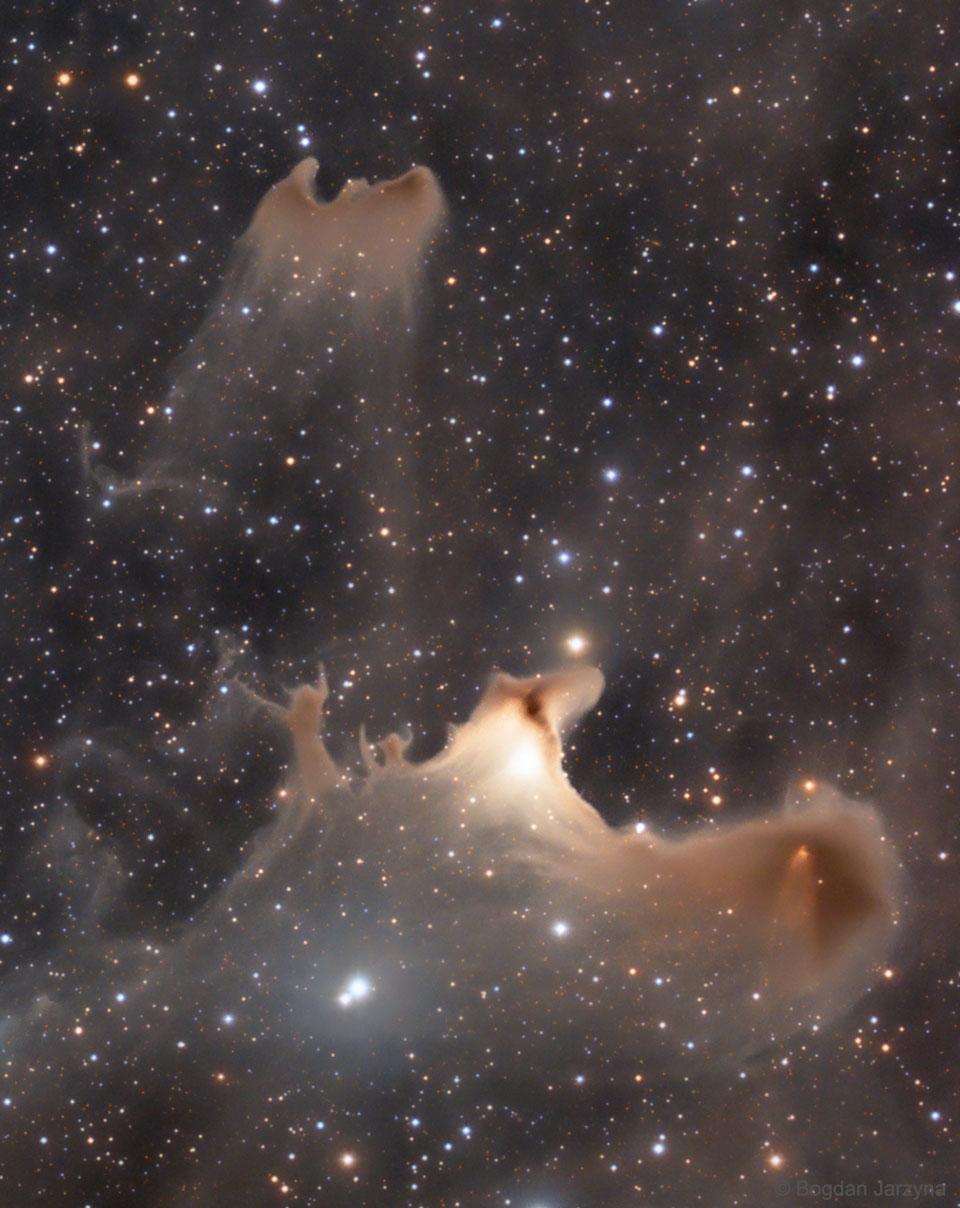
The jeweled expanse, filled with faint, starlight-reflecting clouds, drifts through the night in the royal constellation of Cepheus. Far from your own neighborhood on planet Earth, these ghostly apparitions lurk along the plane of the Milky Way at the edge of the Cepheus Flare molecular cloud complex some 1,200 light-years away. Over two light-years across and brighter than the other spooky chimeras, VdB 141 or Sh2-136 is also known as the Ghost Nebula, seen toward the bottom of the featured image. Within the reflection nebula are the telltale signs of dense cores collapsing in the early stages of star formation.
Image (Credit): View of Jupiter taken by the NASA’s Juno mission. (NASA/JPL-Caltech/SwRI/MSSS, Vladimir Tarasov)
NASA has an image for all of us just in time for Halloween. The strange face you see above is a view of Jupiter taken on September 7, 2023 by NASA’s Juno spacecraft on its 54th close flyby of the planet.
NASA explains what you are seeing in this northern region of Jupiter:
The image shows turbulent clouds and storms along Jupiter’s terminator, the dividing line between the day and night sides of the planet. The low angle of sunlight highlights the complex topography of features in this region, which scientists have studied to better understand the processes playing out in Jupiter’s atmosphere.
Now I want to see the images from the first 53 flybys to understand what we might have missed.
Image (Credit): Lunar shadow captured on October 14, 2023. (NASA)
This image of last week’s annular solar eclipse was captured by NASA’s Earth Polychromatic Imaging Camera (EPIC) imager carried aboard the Deep Space Climate Observatory (DSCVR), which is a joint venture between NASA, NOAA, and the U.S. Air Force.
An annular eclipse occurs when the Moon passes in front of the Sun but is too far from Earth to completely obscure it. The Moon is at or near its farthest distance from Earth—known as its apogee—during an annular eclipse, making it look smaller in the sky. This leaves the Sun’s edges exposed in a red-orange ring, dubbed the “ring of fire.” A satellite caught an earthly view of the event, as the Moon’s shadow crossed North America.
NASA also provided a map showing those areas in the United States most impacted by the eclipse (shown below).
Image (Credit): Map showing the dark path of the annularity stretching across the lower 48 states from Oregon to Texas. (NASA)
Image (Credit): The Ring Nebula as captured by the JWST. (ESA/Webb, NASA, CSA, M. Barlow (University College London), N. Cox (ACRI-ST), R. Wesson (Cardiff University))
This week’s image comes from the Jame Webb Space Telescope’s (JWST) Near-Infrared Camera (NIRCam). It shows the Ring Nebula, which is approximately 2,500 light-years away. It looks like a heavenly eyeball. with an Earth-colored iris.
Here is more on the image from NASA:
The NASA/ESA/CSA James Webb Space Telescope has observed the well-known Ring Nebula with unprecedented detail. Formed by a star throwing off its outer layers as it runs out of fuel, the Ring Nebula is an archetypal planetary nebula. Also known as M57 and NGC 6720, it is both relatively close to Earth at roughly 2,500 light-years away. This new image provides unprecedented spatial resolution and spectral sensitivity. For example, the intricate details of the filament structure of the inner ring are particularly visible in this dataset. There are some 20,000 dense globules in the nebula, which are rich in molecular hydrogen. In contrast, the inner region shows very hot gas. The main shell contains a thin ring of enhanced emission fromcarbon-based molecules known as polycyclic aromatic hydrocarbons (PAHs). Roughly ten concentric arcs are located just beyond the outer edge of the main ring. The arcs are thought to originate from the interaction of the central star with a low-mass companion orbiting at a distance comparable to that between the Earth and the dwarf planet Pluto. In this way, nebulae like the Ring Nebula reveal a kind of astronomical archaeology, as astronomers study the nebula to learn about the star that created it.