Image (Credit): “Cape Byron Lighthouse Moonrise” by Kevin Hennessey. (Australia Geographic)
The winners of the Australia Geographic astronomy photography contest have been named, and the photo above is one that won honorable mention in the Nightscapes Category, “Cape Byron Lighthouse Moonrise” by Kevin Hennessey.
Here is a little more about the impressive image:
The full moon rises behind the Cape Byron Lighthouse at the most easterly point of mainland Australia, silhouetting a group of spectators gathered at its base. Taken through a high-powered telescope from a distance of 5.1km away makes the moon appear extraordinarily large in this photo. The shooting location had to be accurate to within a couple of meters, determined with the help of the “Photopills” iPhone app, Google Earth and an aircraft-grade GPS.
Image (Credit): Galaxy NGC 6684 captured by the NASA/ESA Hubble Space Telescope. (ESA/Hubble & NASA, R. Tully)
This week’s image is from NASA/European Space Agency’s (ESA) Hubble Space Telescope. It shows the glowing galaxy NGC 6684, which is around 44 million light-years from Earth.
This oddly shaped galaxy is explained on the ESA’s website:
Lenticular galaxies like NGC 6684 (lenticular means lens-shaped) possess a large disc but lack the prominent spiral arms of galaxies like the Andromeda Galaxy. This leaves them somewhere between elliptical galaxies and spiral galaxies, and lends these galaxies a diffuse, ghostly experience. NGC 6684 also lacks the dark dust lanes that thread through other galaxies, adding to its spectral, insubstantial appearance.
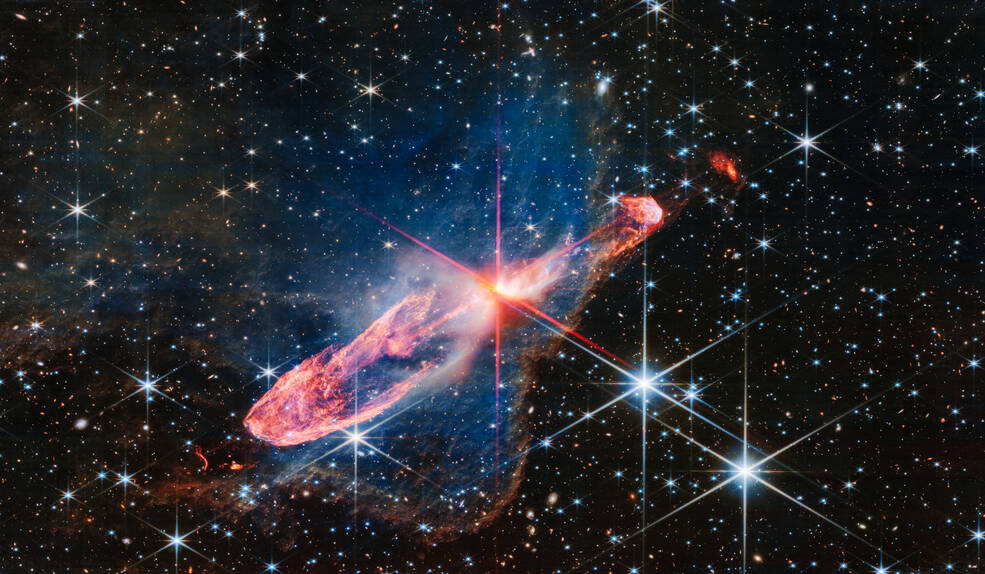
Image (Credit): JWST image showing the formation of a pair of new stars. (NASA, ESA, CSA. Image Processing: Joseph DePasquale (STScI))
This week’s image is from the James Webb Space Telescope (JWST). It shows the formation of new stars 1,470 light-years away that will take millions of years to form.
Here is a partial description of what you are seeing from NASA (visit the link for the full desciption):
NASA’s James Webb Space Telescope has captured the “antics” of a pair of actively forming young stars, known as Herbig-Haro 46/47, in high-resolution near-infrared light. To find them, trace the bright pink and red diffraction spikes until you hit the center: The stars are within the orange-white splotch. They are buried deeply in a disk of gas and dust that feeds their growth as they continue to gain mass. The disk is not visible, but its shadow can be seen in the two dark, conical regions surrounding the central stars.
The most striking details are the two-sided lobes that fan out from the actively forming central stars, represented in fiery orange. Much of this material was shot out from those stars as they repeatedly ingest and eject the gas and dust that immediately surround them over thousands of years.
When material from more recent ejections runs into older material, it changes the shape of these lobes. This activity is like a large fountain being turned on and off in rapid, but random succession, leading to billowing patterns in the pool below it. Some jets send out more material and others launch at faster speeds. Why? It’s likely related to how much material fell onto the stars at a particular point in time.
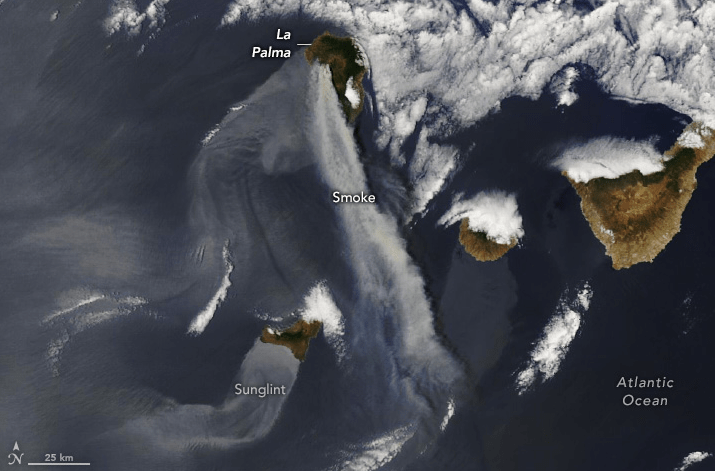
Image (Credit): July 15, 2023 fire in the Canary Islands. (NASA Earth Observatory images by Wanmei Liang, using MODIS data from NASA EOSDIS LANCE and GIBS/Worldview)
This week’s image is from NASA’s Earth Observatory showing the recent fires in the Canary Islands. The image below provides great detail regarding what you are seeing.
In the early hours of July 15, 2023, a wildfire broke out on La Palma, the most northwesterly of the Canary Islands….The bright areas near islands south of La Palma resemble smoke, but they are actually the result of an optical phenomenon caused by sunglint.
The fire burned through pine forests west of a large caldera on the northern part of the island. At least 20 buildings were destroyed and 4,000 people evacuated their homes, according to Reuters. On July 16, authorities reported that the fire had charred at least 4,650 hectares (18 square miles)…
Fires on La Palma are common in summer due to the island’s dry climate. One analysis of tree rings suggests that intense fires burn the island’s forests roughly every 7 years on average, with less intense fires burning every 2-4 years.
Image (Credit): Greater details showing the July 15, 2023 fire in the Canary Islands. (NASA Earth Observatory images by Wanmei Liang, using MODIS data from NASA EOSDIS LANCE and GIBS/Worldview)
Image (Credit): Astronaut Edwin E. (Buzz) Aldrin Jr., Lunar Module (LM) pilot, climbs down the LM ladder, preparing for his first steps on the Moon. (NASA)
On this day in 1969, the Apollo 11 crew stepped on the Moon for the first time, showing that mankind could actually travel to another world. The image above shows Astronaut Buzz Aldrin preparing the step on the Moon as the second human to ever walk on the lunar surface.
Buzz Aldrin has plenty of quotes related to his Moon mission and life in general, but I like his quotes about our next trip to Mars, like this one:
When we set out to land people on the surface of Mars, I think we should as a nation, as a world, commit ourselves to supporting a growing settlement and colonization there. To visit a few times and then withdraw would be an unforgivable waste of resources.
NASA’s Artemis mission is retracing Buzz Adrin’s steps, which is a good sign given that we visited only a few times and then withdrew for decades. Let’s hope Artemis gets us settlements on both the Moon and Mars.