Image (Credit): NASA’s Perseverance Mars rover captured this mosaic of a hill nicknamed “Pinestand.” (NASA/JPL-Caltech/ASU/MSSS)
This week’s image comes from NASA’s Mars rover Perseverance as it explores the to Jezero Crater. The photo was posted last month. It has been a little while since we directly our attention at the Red Planet.
The image shows what may be the result of a fast-moving river some time in the past. In the NASA write-up accompanying the photo above, we read:
“Pinestand” is an isolated hill bearing sedimentary layers that curve skyward, some as high as 66 feet (20 meters). Scientists think these tall layers may also have been formed by a powerful river, although they’re exploring other explanations, as well.
“These layers are anomalously tall for rivers on Earth,” [postdoctoral researcher at NASA’s Jet Propulsion Laboratory in Southern California Libby] Ives said. “But at the same time, the most common way to create these kinds of landforms would be a river.”
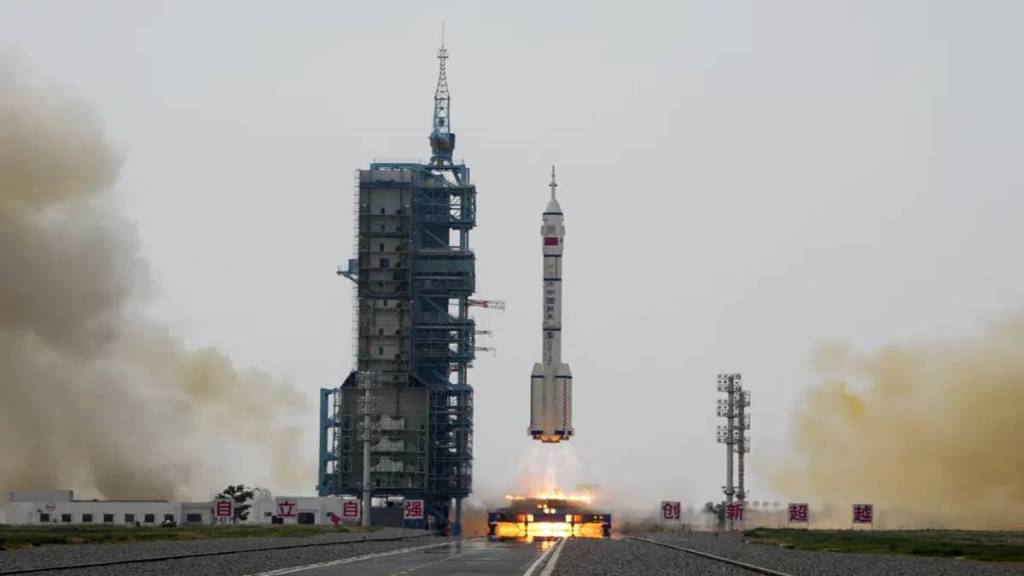
Image (Credit): Launch of China’s Shenzhou 16 spacecraft. (AP)
This week’s image shows China’s launch of the Shenzhou 16 spacecraft earlier this week atop a Long March 2-F rocket. The launch included a three-man crew, one being the first civilian astronaut in the Chinese crew rotation, who will relieve the current crew on the Tiangong Space Station.
Image (Credit): NGC 1333 as captured by the Hubble Space Telescope. (NASA, ESA, STScI)
This week’s image is from the Hubble Space Telescope. It captures the colorful, star-filled NGC 1333, which is about 960 light-years away. Quite a lot is going on in this image – both seen and unseen.
This explanations from the European Space Agency (ESA) will hopefully answer many of your questions regarding this image:
Hubble’s colourful view, showcasing its unique capability to obtain images in light from ultraviolet to near-infrared, unveils an effervescent cauldron of glowing gases and pitch-black dust stirred up and blown around by several hundred newly forming stars embedded within the dark cloud. Even then, Hubble just scratches the surface; most of the star-birthing firestorm is hidden behind clouds of fine dust — essentially soot — that are thicker toward the bottom of the image. The black areas of the image are not empty space, but are filled with obscuring dust.
To capture this image, Hubble peered through a veil of dust on the edge of a giant cloud of cold molecular hydrogen — the raw material for fabricating new stars and planets under the relentless pull of gravity. The image underscores the fact that star formation is a messy process in a rambunctious Universe.
Ferocious stellar winds, likely from the bright blue star at the top of the image, are blowing through a curtain of dust. The fine dust scatters the starlight at blue wavelengths.
Farther down, another bright super-hot star shines through filaments of obscuring dust, looking like the Sun shining through scattered clouds. A diagonal string of fainter accompanying stars looks reddish because the dust is filtering their starlight, allowing more of the red light to get through.
The bottom of the picture presents a keyhole peek deep into the dark nebula. Hubble captures the reddish glow of ionised hydrogen. It looks like the finale of a fireworks display, with several overlapping events. This is caused by pencil-thin jets shooting out from newly forming stars outside the frame of view. These stars are surrounded by circumstellar discs, which may eventually produce planetary systems, and powerful magnetic fields that direct two parallel beams of hot gas deep into space, like a double lightsaber from science fiction films. They sculpt patterns on the hydrogen cocoon, like laser lightshow tracings. The jets are a star’s birth announcement.
This view offers an example of the time when our own Sun and planets formed inside such a dusty molecular cloud, 4.6 billion years ago. Our Sun didn’t form in isolation but was instead embedded inside a mosh pit of frantic stellar birth, perhaps even more energetic and massive than NGC 1333.
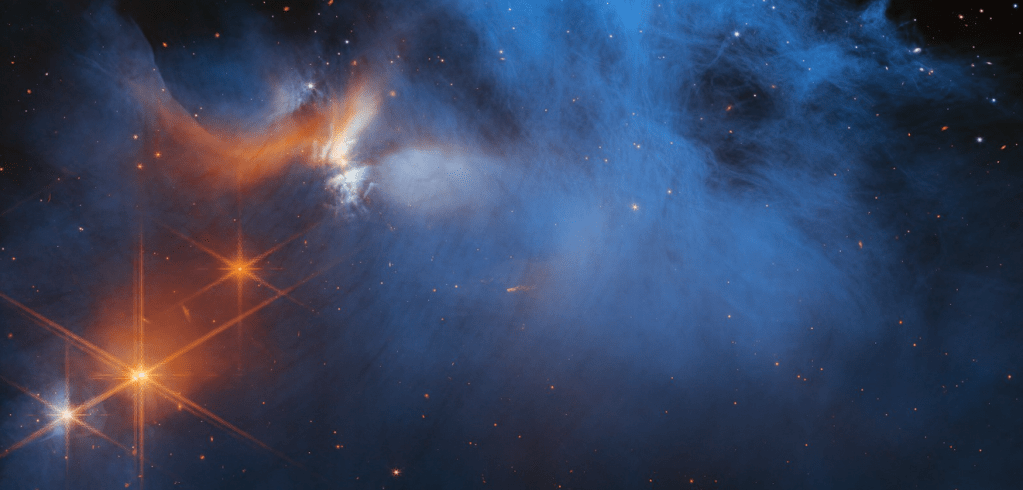
Image (Credit): The Chamaeleon I dark molecular cloud. (NASA, ESA, CSA, and M. Zamani (ESA). Science: M. K. McClure (Leiden Observatory), F. Sun (Steward Observatory), Z. Smith (Open University), and the Ice Age ERS Team)
This week’s image is from the James Webb Space Telescope (JWST). It shows Chamaeleon I dark molecular cloud where both stars and planets are born. Here is more about the image from NASA:
A Webb image of the central region of the Chamaeleon I dark molecular cloud, which resides 630 light-years away. This image primarily shows blue smoky wisps on a dark background. The left top side additionally features orange and white wisps. Just below them are four bright points of light. Three are orange and one is a mix of white and orange. Each of these points have Webb’s signature 8-point diffraction spikes emanating around them in long, thick orange lines, so that they look like huge snowflakes. Scattered throughout the image are distant stars or galaxies in shades of red, orange and blue, seen as tiny blobs.
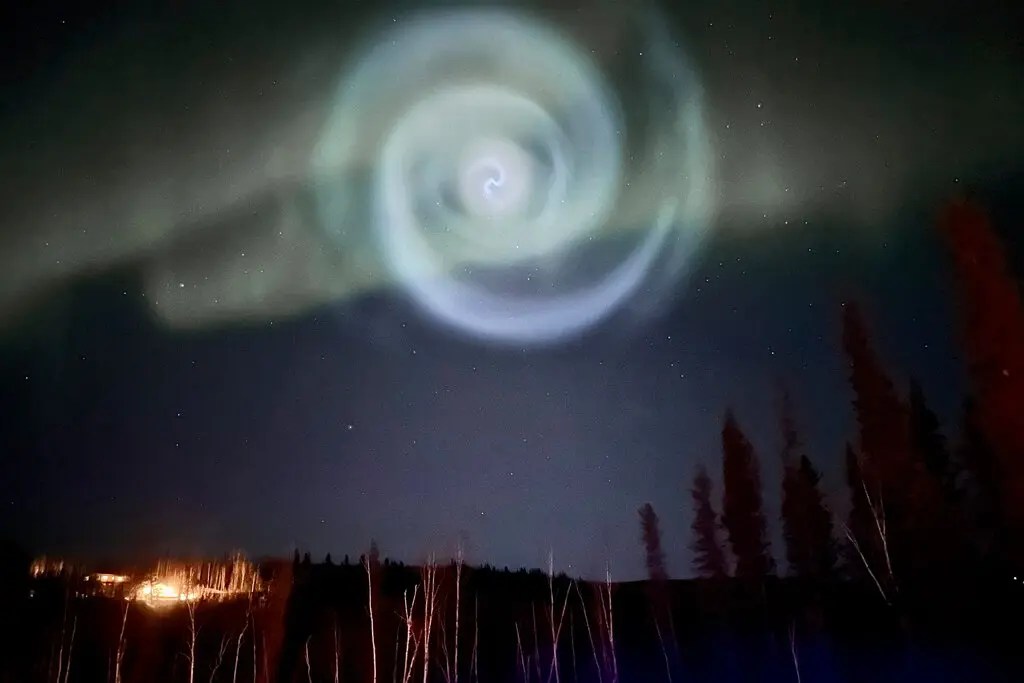
Image (Credit): The northern lights and a spiral in the early morning sky over Fairbanks, Alaska. (Christopher Hayden, via Associated Press)
This week’s image was captured in the morning sky over Alaska on April 15. It was later determined to be related to a SpaceX Falcon 9 launch the prior day in California. As The New York Times reported, the spiral was attributed to “…the reflection of the excess fuel it released into the atmosphere.”
Below is another image taken by a local resident. The Internet is full of them.
While the northern lights are impressive enough, the addition of the spiral is extra special.
Image (Credit): Another image of the northern lights and a spiral over Fairbanks, Alaska. (Nick Marchuk/KTVF)