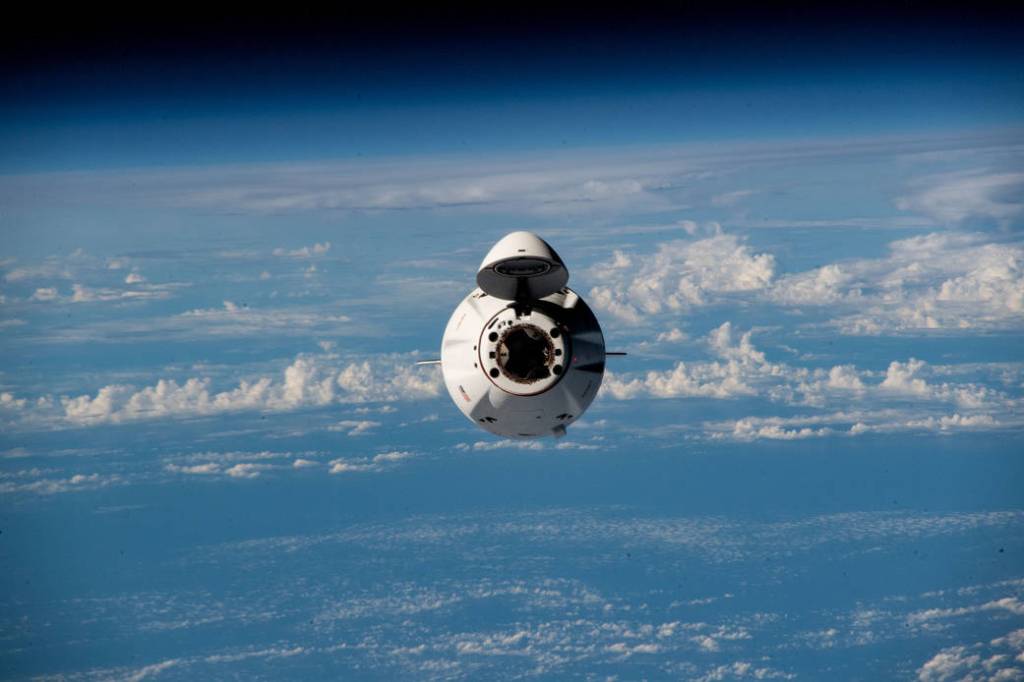
Image (Credit): SpaceX Dragon approaching the ISS. (NASA)
This week’s image comes from NASA showing a Dragon cargo ship approaching the International Space Station (ISS) earlier this month with supplies for the Expedition 68 crew. In this photo, the Dragon is above the Indian Ocean near Madagascar.
It is an amazing image each and every time. What a workplace and what a view. Telework just isn’t the same.
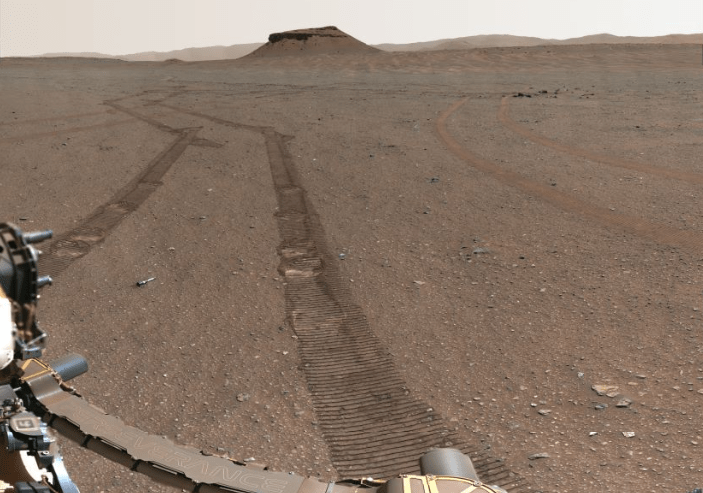
Image (Credit): NASA’s Perseverance Mars rover captured this portrait of its recently completed sample depot on Jan. 31, 2023. (NASA/JPL-Caltech/ASU/MSSS)
This week’s image shows the Perseverance Mars rover looking back on its work – the depositing of 10 titanium sample tubes on the surface of the Red Planet should they be needed as backups (see image below marking the sample locations). The rover is carrying the official samples, but this depot was set up just in case something happens to the rover.
Eight of those tubes are filled with rock and regolith (broken rock and dust), while one is an atmospheric sample and one is a “witness” tube...
The depot represents a backup collection of samples that could be recovered in the future by the Mars Sample Return campaign, a joint effort between NASA and ESA (European Space Agency) that aims to bring Mars samples to Earth for closer study. The rover began building the depot on Dec. 21, 2022, precisely spacing the tubes in case they need to be retrieved at a future date.
The primary tubes reside in the belly of Perseverance, which would pass them, along with future samples taken during the mission to a Sample Retrieval Lander as part of the campaign. If anything were to happen to the rover to prevent it from delivering tubes directly to the lander, samples could be retrieved from the depot instead. (Learn more about all 18 samples taken so far.)
Image (Credit): NASA’s Perseverance Mars rover captured this portrait of its recently completed sample depot on Jan. 31, 2023. The locations of the 10 samples are clearly marked. (NASA/JPL-Caltech/ASU/MSSS)
Image (Credit): Irregular Spiral Galaxy NGC 5486. (ESA/Hubble & NASA, C. Kilpatrick)
This week’s image is from the Hubble Space Telescope. It shows the irregular spiral galaxy NGC 5486 with pink areas indicating the formation of new stars.
NGC 5486 hangs against a background of dim, distant galaxies in this image from the NASA/ESA Hubble Space Telescope. The tenuous disc of the galaxy is threaded through with pink wisps of star formation, which stand out from the diffuse glow of the galaxy’s bright core. While this particular galaxy has indistinct, meandering spiral arms it lies close to the much larger Pinwheel Galaxy, one of the best known examples of ‘grand design’ spiral galaxies with prominent and well-defined spiral arms. In 2006 Hubble captured an image of the Pinwheel Galaxy which was — at the time — the largest and most detailed photo of a spiral galaxy ever taken with Hubble.
NGC 5486 lies 110 million light-years from Earth in the constellation Ursa Major. This observation comes from a selection of Hubble images exploring debris left behind by Type II supernovae. As massive stars reach the end of their lives, they cast off huge amounts of gas and dust before ending their lives in titanic supernova explosions. NGC 5486 hosted a supernova in 2004, and astronomers used the keen vision of Hubble’s Advanced Camera for Surveys to explore the aftermath in the hopes of learning more about these explosive events.
Image (Credit): Barred spiral galaxy NGC 7496. (NASA, ESA, CSA, Janice Lee (NOIRLab), Joseph DePasquale (STScI))
This week’s image from the James Webb Space Telescope shows the barred spiral galaxy NGC 7496, which is over 24 million light-years away from Earth. The glowing center is a supermassive black hole.
The spiral arms of NGC 7496, one of a total of 19 galaxies targeted for study by the Physics at High Angular resolution in Nearby Galaxies (PHANGS) collaboration, are filled with cavernous bubbles and shells overlapping one another in this image from Webb’s Mid-Infrared Instrument (MIRI). These filaments and hollow cavities are evidence of young stars releasing energy and, in some cases, blowing out the gas and dust of the interstellar medium surrounding them.
Until Webb’s high resolution at infrared wavelengths came along, stars at the earliest point of the lifecycle in nearby galaxies like NGC 7496 remained obscured by gas and dust. Webb’s specific wavelength coverage allows for the detection of complex organic molecules called polycyclic aromatic hydrocarbons, which play a critical role in the formation of stars and planets. In Webb’s MIRI image, these are mostly found within the main dust lanes in the spiral arms.
In their analysis of the new data from Webb, scientists were able to identify nearly 60 new, embedded cluster candidates in NGC 7496. These newly identified clusters could be among the youngest stars in the entire galaxy.
At the center of NGC 7496, a barred spiral galaxy, is an active galactic nucleus (AGN). AGN is another way to refer to an active supermassive black hole that is emitting jets and winds. This glows quite brightly at the center of the Webb image. Additionally, Webb’s extreme sensitivity also picks up various background galaxies, which appear green or red in some instances.
Image (Credit): A SpaceX Falcon 9 rocket with the company’s Dragon spacecraft on top. (NASA/Joel Kowsky)
This week’s image shows the SpaceX Falcon 9 rocket and Dragon capsule awaiting the launch of the Crew-6 mission to the International Space Station. The rocket launched at 12:34 a.m. EST today from Launch Complex 39A at NASA’s Kennedy Space Center in Florida. You can read more about the successful launch here.