Pic of the Week: Dazzling Star Cluster

Image (Credit): Globular cluster Liller 1 (ESA/Hubble & NASA, F. Ferraro)

The image this week is from the NASA/ESA Hubble Space Telescope. It shows a cluster of old and young stars in the globular cluster Liller 1 located within the bulge of the Milky Way Galaxy. Here is a full explanation from NASA:

The muted red tones of the globular cluster Liller 1 are partially obscured in this image by a dense scattering of piercingly blue stars. In fact, it is thanks to Hubble’s Wide Field Camera 3 (WFC3) that we are able to see Liller 1 so clearly in this image, because the WFC3 is sensitive to wavelengths of light that the human eye cannot detect. Liller 1 is only 30 000 light-years from Earth — relatively neighbourly in astronomical terms — but it lies within the Milky Way’s ‘bulge’, the dense and dusty region at our galaxy’s centre. Because of that, Liller 1 is heavily obscured from view by interstellar dust, which scatters visible light (particularly blue light) very effectively. Fortunately, some infrared and red visible light are able to pass through these dusty regions. WFC3 is sensitive to both visible and near-infrared (infrared that is close to the visible) wavelengths, allowing us to see through the obscuring clouds of dust, and providing this spectacular view of Liller 1. 

Liller 1 is a particularly interesting globular cluster, because unlike most of its kind, it contains a mix of very young and very old stars. Globular clusters typically house only old stars, some nearly as old as the Universe itself. Liller1 instead contains at least two distinct stellar populations with remarkably different ages: the oldest one is 12 billion years old and the youngest component is just 1-2 billion years old. This led astronomers to conclude that this stellar system was able to form stars over an extraordinary long period of time. 

Pic of the Week:  Gypsum Dunes on Mars

Image (Credit): Gypsum dunes on Mars. (NASA, Univ. of Arizona’s Lunar & Planetary Laboratory)

This week’s amazing image was taken by the High Resolution Imaging Science Experiment (HiRISE) camera onboard NASA’s Mars Reconnaissance Orbiter launched in 2005. The University of Arizona’s Lunar & Planetary Laboratory, which operates HiRISE, described the image in this way:

This image suggestion outlines a contact between gypsum-rich dunes in Olympia Undae and flat-lying layers of the basal (or bottom) unit. Our goal is to look for a stratigraphic and compositional comparison between the dunes and the basal unit.

Olympia Undae, the largest continuous dune field on Mars,  is in the northern polar region of Mars.

Pic of the Week: Eerie Crater Marks the Spot

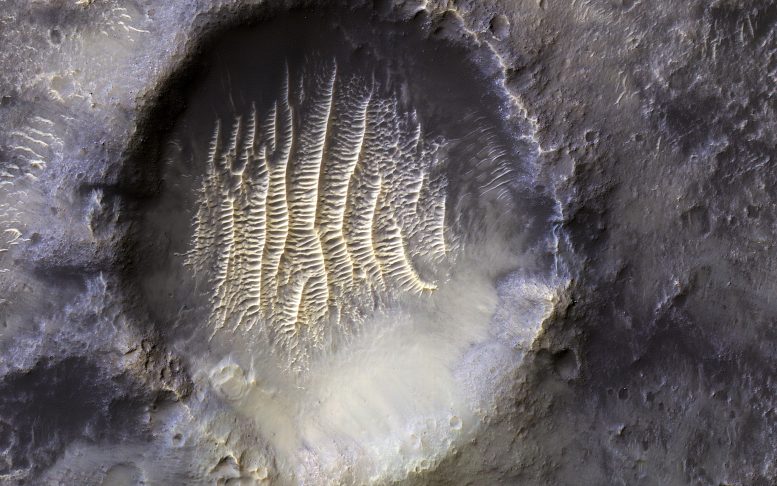
Image (Credit): Martian crater Airy-0. (NASA/JPL-Caltech/University of Arizona)

This week’s pic is an eerie crater within the Airy Crater on Mars that marks an important spot – 0° longitude on Mars. You can see this position of this smaller crater, Airy-0, within the larger crater below. NASA posted this image on Instagram with a few more details:

The larger crater that sits within this crater, called the Airy Crater, originally defined zero longitude for Mars, but as higher resolution photos became available, a smaller feature was needed. This crater, called Airy-0 (zero) was selected because it did not need to adjust existing maps.

This image was captured by the High-Resolution Imaging Science Experiment (HiRISE), on the Mars Reconnaissance Orbiter. The map is projected here at a scale of 50 centimeters (19.7 inches) per pixel.

The Airy Crater is names after Sir George Biddell Airy, the 7th Astronomer Royal, in 1850.

Image (Credit): Martian crater Airy. (Wikimedia Commons)

Pic of the Week: Mars InSight Lander

Image (Credit): Mars InSight lander on the Martian surface. (NASA)

NASA recently shared an image showing the accumulation of Martian dust on the solar panels of the Interior exploration using Seismic Investigations, Geodesy, and Heat Transport (InSight) Mars lander. The photo above was taken on April 24, 2022.

The Mars Insight lander was launched May 5, 2018 to study the interior of Mars. The lander already accomplished its primary mission and has been on extended mission. It has detected more than 1,300 marsquakes. However, as a result of the dust buildup, the mission is expected to end this summer.

In the NASA news release, Lori Glaze, director of NASA’s Planetary Science Division, stated:

InSight has transformed our understanding of the interiors of rocky planets and set the stage for future missions…We can apply what we’ve learned about Mars’ inner structure to Earth, the Moon, Venus, and even rocky planets in other solar systems.

You may recall an earlier posting about Martian dust and its impact on another mission.

Pic of the Week: The Cat’s Paw Nebula

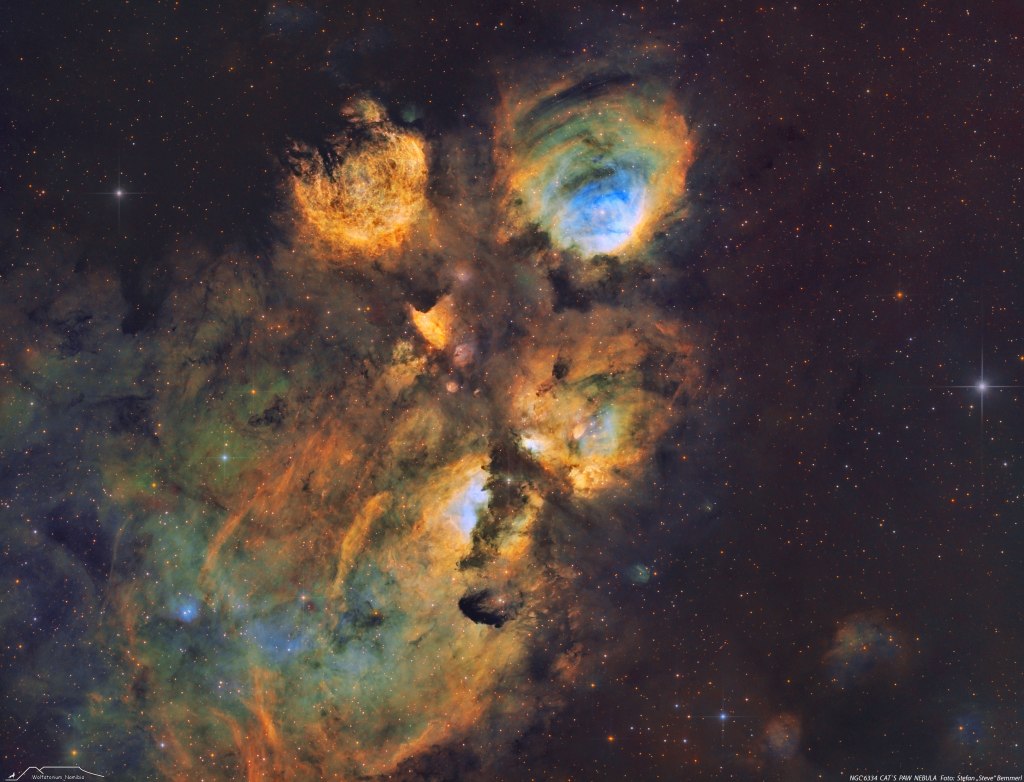
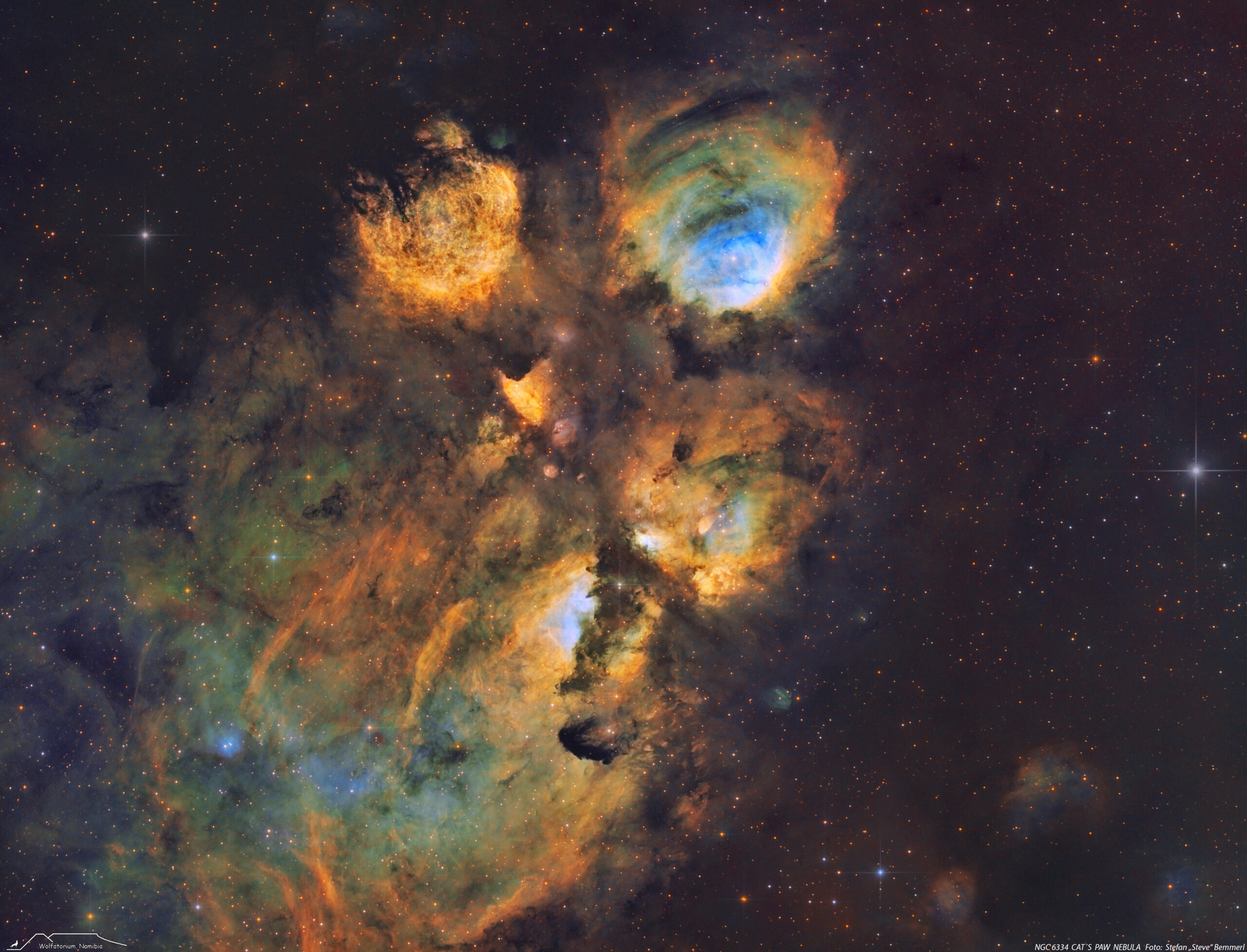
Image (Credit): The Cat’s Paw Nebula. (Stefan Steve Bemmerl & Team Wolfatorium, Hakos/Namibia)

This week’s image is from NASA’s Astronomy Picture of the Day website. It was the picture of the day for May 10, 2022. This is the story that goes with the image:

Nebulas are perhaps as famous for being identified with familiar shapes as perhaps cats are for getting into trouble. Still, no known cat could have created the vast Cat’s Paw Nebula visible toward the constellation of the Scorpion (Scorpius). At 5,500 light years distant, Cat’s Paw is an emission nebula with a red color that originates from an abundance of ionized hydrogen atoms. Alternatively known as the Bear Claw Nebula and cataloged as NGC 6334, stars nearly ten times the mass of our Sun have been born there in only the past few million years. Pictured here is a deep field image of the Cat’s Paw Nebula in light emitted by hydrogen, oxygen, and sulfur.