Image (Credit): The Sun’s coronal mass ejection. (Andrew McCarthy/@cosmic_background)
This week’s image is from LiveScience’s “10 most jaw-dropping space images of 2022.” It is described as a “false-color composite image of a coronal mass ejection measuring around 1 million miles firing away from the sun.” The image, attributed to photographer Andrew McCarthy, was created from hundreds of thousands of individual shots taken over six hours.
The photographer went on a nine-day, 2500-mile road trip, chasing gaps in the clouds, to capture the Aurora Borealis above the wreck of the Gardur in the Westfjords region of Iceland.
This week’s image is from the Royal Observatory Greenwich’s Astronomy Photographer of the Year 2022 contest. The image above is the winner of the 2022 contest. It is titled “Disconnection Event,” captured by Gerald Rhemann.
Here is the language accompanying the winning image:
Comet Leonard was discovered by GJ Leonard on 3 January 2021. It made its closest pass on 12 December 2021 and, having left the solar system, won’t be seen from Earth again. On 25 Dec 2021, a piece of the comet’s tail was pinched off and carried away by the solar wind – a dramatic tail disconnection event. “Astronomy, myth and art come together beautifully in this shot. It holds great value to scientists, as it elegantly captures a disconnection event” – Imad Ahmed
Please visit The Guardian site for images from all of the winners.
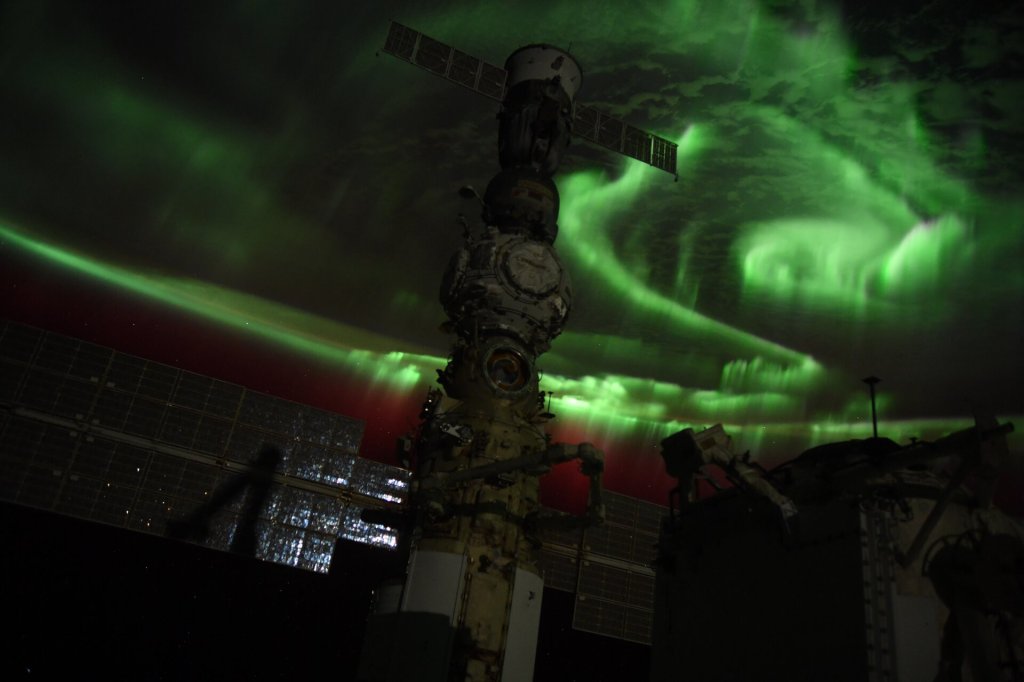
Image (Credit): View from the ISS – further description below. (ESA/NASA-S.Cristoforetti)
This week’s image is from the European Space Agency’s (ESA) Year in Images 2022 collection and shows a view from the International Space Station (ISS).
Here is the description of the image from the ESA:
Aurorae observed by ESA astronaut Samantha Cristoforetti aboard the International Space Station for her Minerva Mission. She shared these images to her social media on 21 August 2022 with the caption: “The Sun has been really active lately. Last week we saw the most stunning auroras I have ever experienced in over 300 days in space!”
You can read more about ESA astronaut Cristoforetti’s work on the ISS here.
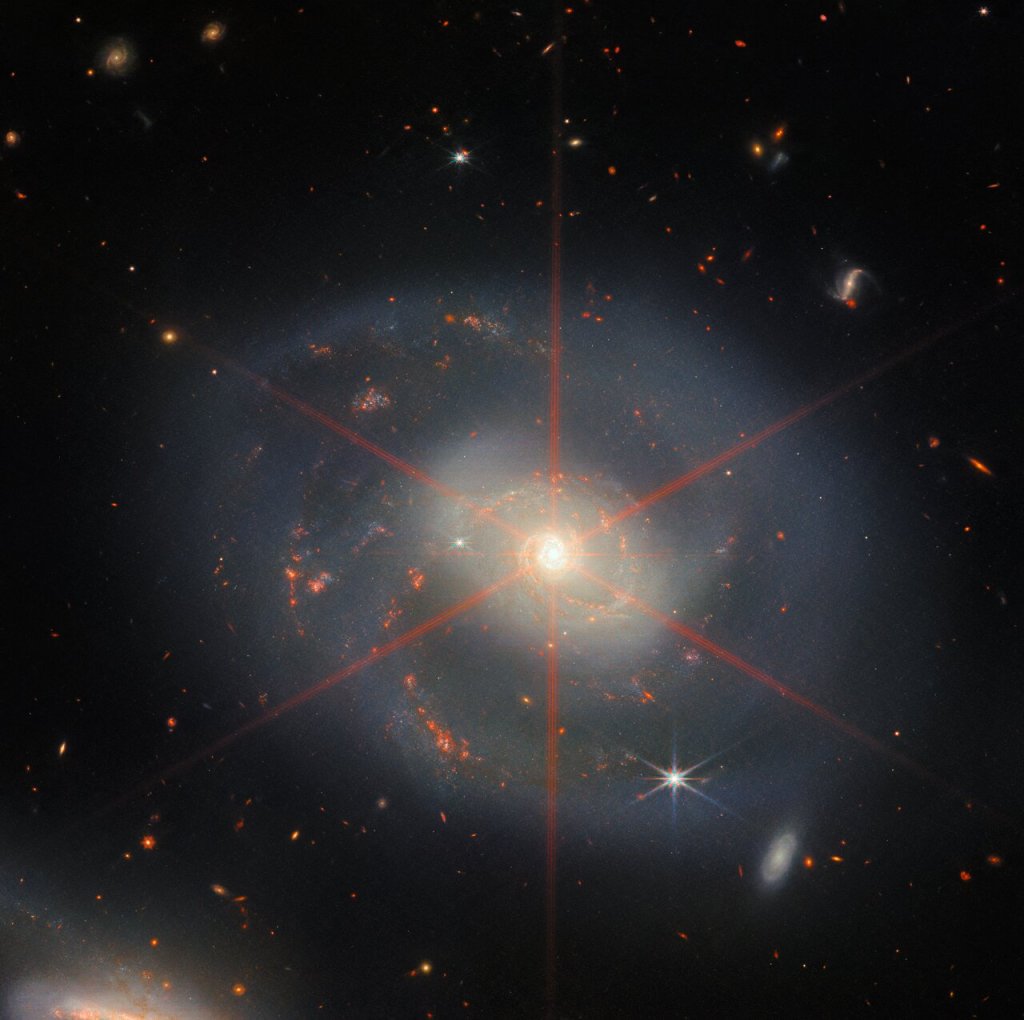
Image (Credit): Spiral galaxy NGC 7469 face-on. (NASA)
This week’s image is from the James Webb Space Telescope (JWST). It is a face-on view of wreath-like spiral galaxy NGC 7469, which is about 220 million light-years from Earth.
While NGC 7469 is one of the best studied AGNs in the sky, the compact nature of this system and the presence of a great deal of dust have made it difficult for scientists to achieve both the resolution and sensitivity needed to study this relationship in the infrared. Now, with Webb, astronomers can explore the galaxy’s starburst ring, the central AGN, and the gas and dust in between. Using Webb’s MIRI, NIRCam and NIRspec instruments to obtain images and spectra of NGC 7469 in unprecedented detail, the GOALS team has uncovered a number of details about the object. This includes very young star-forming clusters never seen before, as well as pockets of very warm, turbulent molecular gas, and direct evidence for the destruction of small dust grains within a few hundred light-years of the nucleus — proving that the AGN is impacting the surrounding interstellar medium. Furthermore, highly ionised, diffuse atomic gas seems to be exiting the nucleus at roughly 6.4 million kilometres per hour — part of a galactic outflow that had previously been identified, but is now revealed in stunning detail with Webb. With analysis of the rich Webb datasets still underway, additional secrets of this local AGN and starburst laboratory are sure to be revealed.
A prominent feature of this image is the striking six-pointed star that perfectly aligns with the heart of NGC 7469. Unlike the galaxy, this is not a real celestial object, but an imaging artifact known as a diffraction spike, caused by the bright, unresolved AGN. Diffraction spikes are patterns produced as light bends around the sharp edges of a telescope. Webb’s primary mirror is composed of hexagonal segments that each contain edges for light to diffract against, giving six bright spikes. There are also two shorter, fainter spikes, which are created by diffraction from the vertical strut that helps support Webb’s secondary mirror.