Pic of the Week: Open Clusters NGC 460 and NGC 456

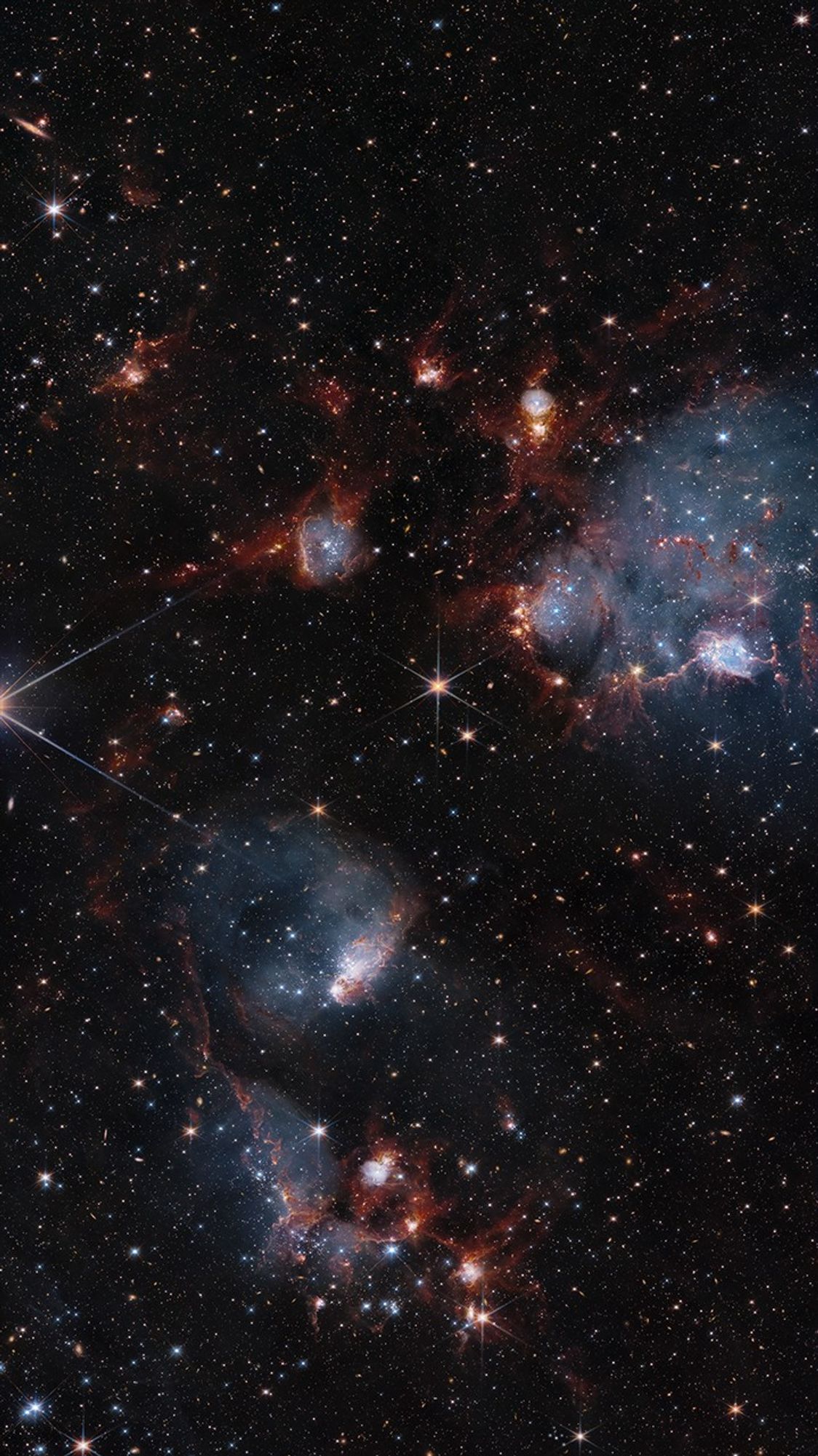
Image (Credit): Open clusters NGC 460 and NGC 456 within the Small Magellanic Cloud, a dwarf galaxy orbiting the Milky Way. (NASA, ESA, and C. Lindberg (The Johns Hopkins University); Processing: Gladys Kober (NASA/Catholic University of America))

This week’s image combines images from the James Webb Space Telescope (JWST) and the Hubble Space Telescope to create a compressive view of open clusters NGC 460 and NGC 456, which are located within the Small Magellanic Cloud orbiting the Milky Way. If you go to the NASA website hosting this image, you can see the original JWST and Hubble images that were combined to create that you see above.

Here is a little more from NASA explaining what you are seeing:

A riotous expanse of gas, dust, and stars stake out the dazzling territory of a duo of star clusters in this combined image from NASA’s Hubble and Webb space telescopes.

Open clusters NGC 460 and NGC 456 reside in the Small Magellanic Cloud, a dwarf galaxy orbiting the Milky Way. Open clusters consist of anywhere from a few dozen to a few thousand young stars loosely bound together by gravity. These particular clusters are part of an extensive complex of star clusters and nebulae that are likely linked to one another. As clouds of gas collapse, stars are born. These young, hot stars expel intense stellar winds that shape the nebulae around them, carving out the clouds and triggering other collapses, which in turn give rise to more stars.

In these images, Hubble’s view captures the glowing, ionized gas as stellar radiation blows “bubbles” in the clouds of gas and dust (blue), while Webb’s infrared vision highlights the clumps and delicate filamentary structures of dust (red). In Hubble images, dust is often seen silhouetted against and blocking light, but in Webb’s view, the dust – warmed by starlight – shines with its own infrared glow. This mixture of gas and dust between the universe’s stars is known as the interstellar medium.

Pic of the Week: Spiral Galaxy UGC 11397

Image (Credit): The spiral galaxy UGC 11397 as captured by the Hubble Space Telescope. (ESA/Hubble & NASA, M. J. Koss, A. J. Barth)

This week’s image is from the Hubble Space Telescope. It is an image of the spiral galaxy UGC 11397, which is located about 250 million years light-years away.

At the time the light we are now seeing left UGC 11397, the Earth was a very different place. It was dealing with the Permian–Triassic mass extinction, also called the Great Dying. During this period about 94 percent of marine species and 70 percent of terrestrial vertebrate families disappeared from the planet.

Anyway, getting back to the image itself, here is a little more information from NASA to explain what you are seeing:

What sets UGC 11397 apart from a typical spiral lies at its center, where a supermassive black hole containing 174 million times the mass of our Sun grows. As a black hole ensnares gas, dust, and even entire stars from its vicinity, this doomed matter heats up and puts on a fantastic cosmic light show.

Material trapped by the black hole emits light from gamma rays to radio waves, and can brighten and fade without warning. But in some galaxies, including UGC 11397, thick clouds of dust hide much of this energetic activity from view in optical light. Despite this, UGC 11397’s actively growing black hole was revealed through its bright X-ray emission — high-energy light that can pierce the surrounding dust. This led astronomers to classify it as a Type 2 Seyfert galaxy, a category used for active galaxies whose central regions are hidden from view in visible light by a donut-shaped cloud of dust and gas.

Pic of the Week: Trifid and Lagoon Nebulas

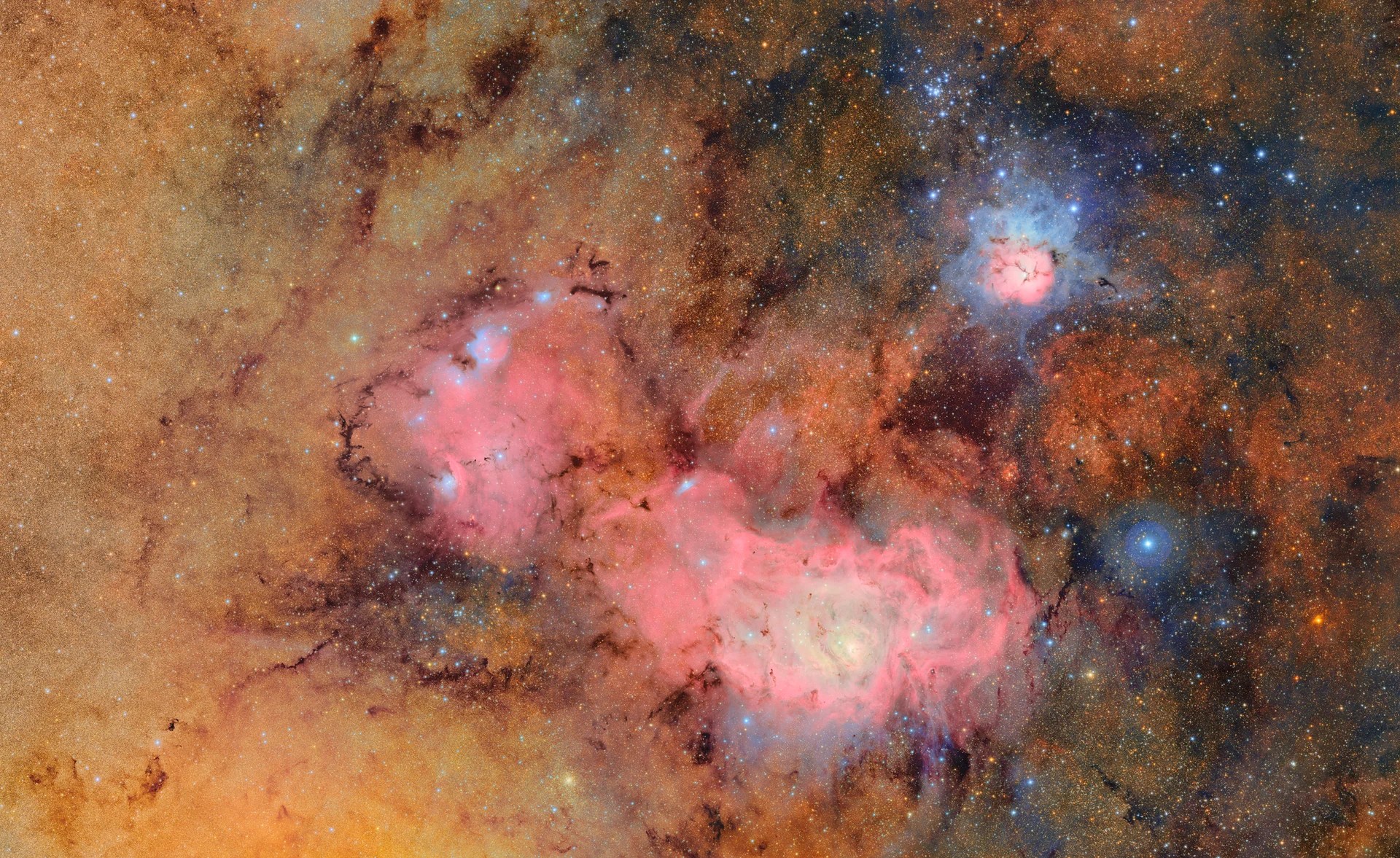
Image (Credit): The Trifid and Lagoon Nebulas as captured by the Vera C. Rubin Observatory. (NSF–DOE Vera C. Rubin Observatory)

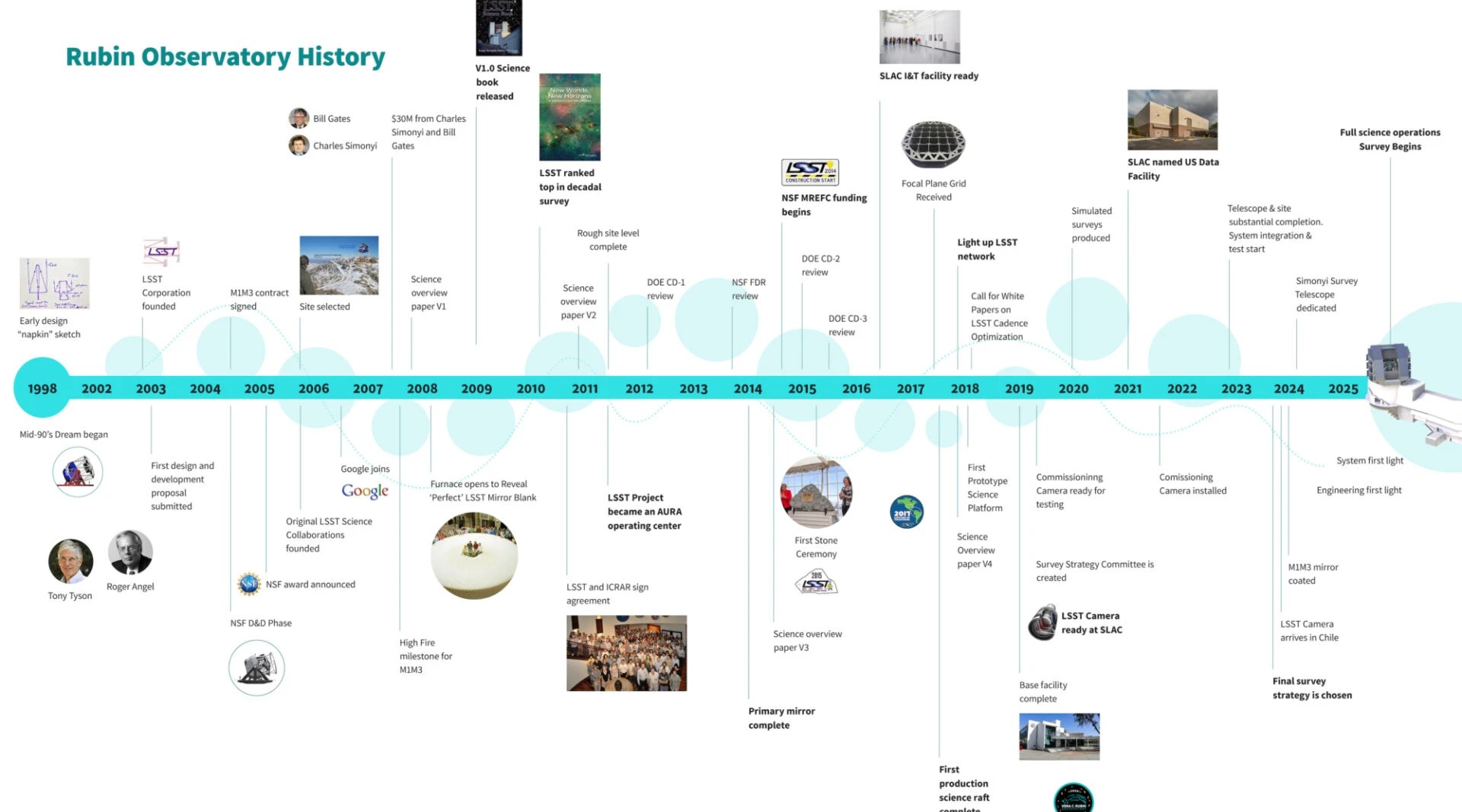
This week’s colorful image is from the new Vera C. Rubin Observatory in Chile. It is part of the initial images being released as the observatory comes online. This particular image was created by combining 678 separate images. It shows clouds of gas and dust that comprise the Trifid nebula (top of image) and the Lagoon nebula (middle of image).

The new observatory is funded by the U.S. National Science Foundation and the U.S. Department of Energy’s Office of Science, and is expected to operate for at least 10 years so it can provide more amazing images and information for astronomers. The timeline related to the creation of the observatory is provided below as well as via this link.

Dr. Vera C. Rubin was an American astronomer known for her work proving the existence “dark matter” in the Universe.

Credit: Vera C. Rubin Observatory.

Pic of the Week: Mars or Bust?

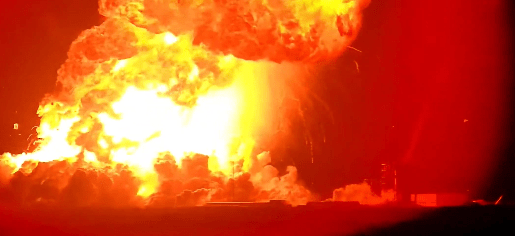
Image (Credit): The explosion of a Starship rocket during testing at the Brownsville, Texas Starbase on June 18, 2025. (LabPadre Space)

As shown in the image above, SpaceX lost one of its Starships yesterday in a massive explosion at the Brownsville, Texas Starbase, making the Moon and Mars seem even farther away. Fortunately, no one was injured during this failed test firing of the Starship 36 rocket engines.

We should expect some problems along the way, but the trend is going backwards for Mr. Musk.

In a press release, SpaceX stated:

Engineering teams are actively investigating the incident and will follow established procedures to determine root cause. Initial analysis indicates the potential failure of a pressurized tank known as a COPV, or composite overwrapped pressure vessel, containing gaseous nitrogen in Starship’s nosecone area, but the full data review is ongoing. There is no commonality between the COPVs used on Starship and SpaceX’s Falcon rockets.

In separate comments, Mr. Musk initially stated:

Just a scratch.

Yes, the scratch heard round the world.

Pic of the Week: A Fun Evening Steven Colbert’s Guests

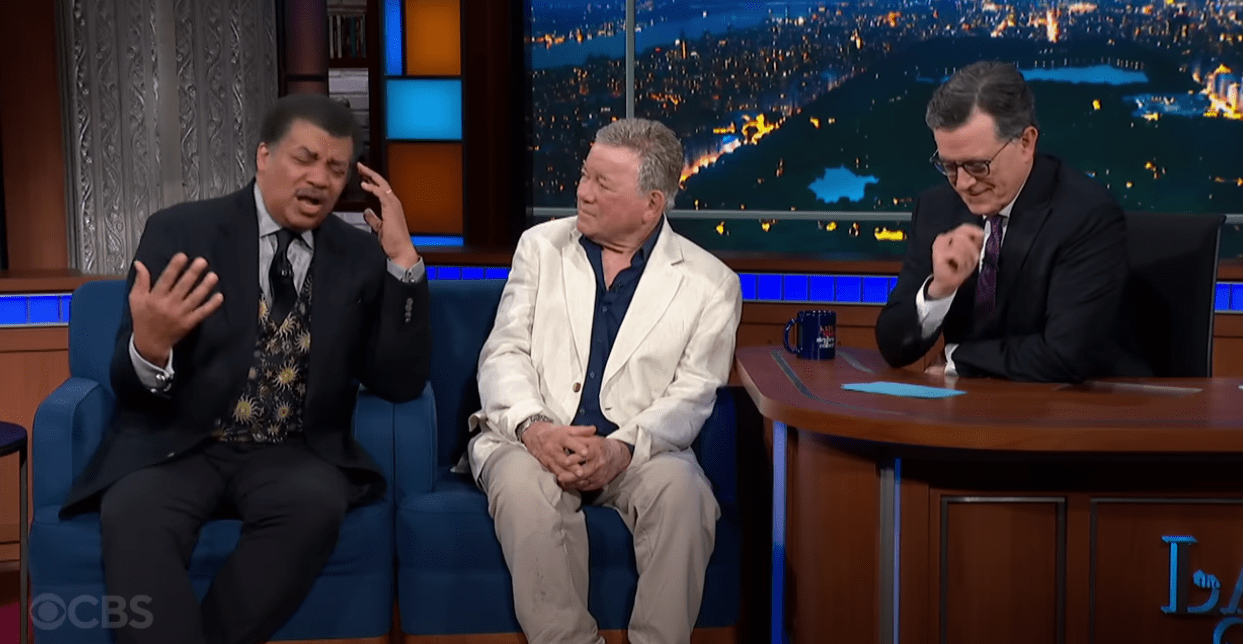
Image (Credit): William Shatner and Neil deGrasse Tyson on The Late Show with Stephen Colbert. (CBS)

This week’s image comes from an episode of The Late Show with Stephen Colbert, which aired earlier this week. Mr. Colbert was interviewing William Shatner and Neil deGrasse Tyson about the absurdities on Earth and in the galaxy.

In an odd twist, Dr. Tyson was generally quiet on the sofa while Mr. Shatner carried the show with his antics. The image above shows one of the few times Dr. Tyson had a chance to explain a point. It is worth watching.

Shatner and Tyson will soon be on the road together with their own show. It is a live stage event on Wednesday, June 18, called ROCKING: The Universe is Absurd.