Image (Credit): William Shatner and Neil deGrasse Tyson on TheLate Show with Stephen Colbert. (CBS)
This week’s image comes from an episode of TheLate Show with Stephen Colbert, which aired earlier this week. Mr. Colbert was interviewing William Shatner and Neil deGrasse Tyson about the absurdities on Earth and in the galaxy.
In an odd twist, Dr. Tyson was generally quiet on the sofa while Mr. Shatner carried the show with his antics. The image above shows one of the few times Dr. Tyson had a chance to explain a point. It is worth watching.
Shatner and Tyson will soon be on the road together with their own show. It is a live stage event on Wednesday, June 18, called ROCKING: The Universe is Absurd.
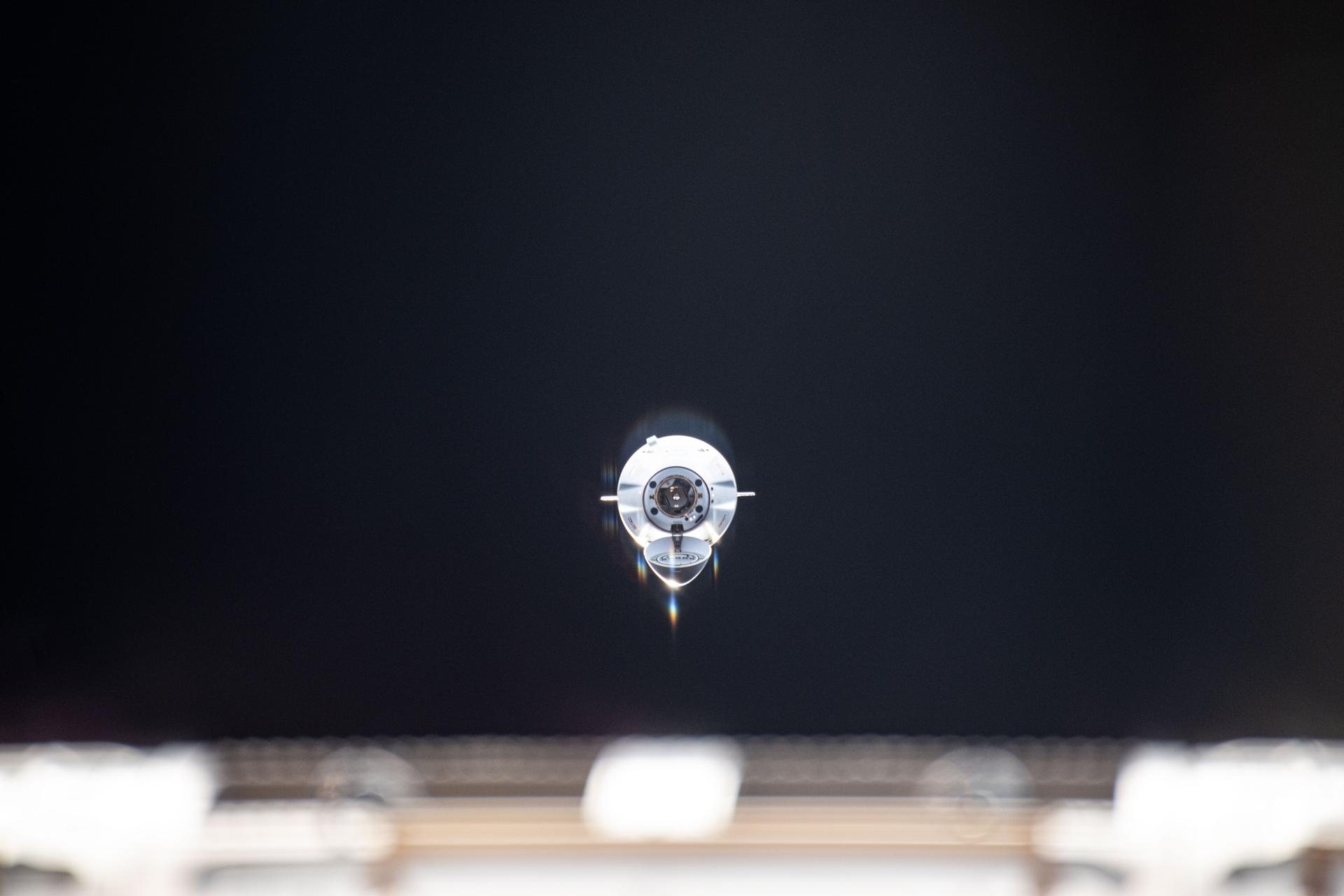
Image (Credit): The SpaceX Dragon cargo craft, nosecone open, preparing to dock with the ISS on April 22, 2025. (NASA)
This week’s image shows the latest, but hopefully not last, docking of the SpaceX Dragon with the International Space Station (ISS) back in April.
Future flights of the Dragon to the ISS are now in question due to an ongoing feud between Elon Musk and Donald Trump, presumably over a bloated House budget bill. However, the issues also involve budget bill cuts to EV programs, the dropping of Musk’s friend as NASA administrator, and Musk’s departure from Washington after a less than sensational attempt to cut government programs.
In light of the President’s statement about cancellation of my government contracts, @SpaceX will begin decommissioning its Dragon spacecraft immediately.
Oh yeah, Trump also threatened to end all SpaceX contracts, so I guess the Dragon would go anyway.
This is serious stuff, particularly after Musk and Trump attached Boeing earlier this year for “abandoning NASA astronauts on the ISS,” which was not true. Who is doing the abandoning now?
It appears Musk is already backing down, but the damage is done. He is demonstrating how NASA’s programs are under the control of this one, erratic man. Can things really go back to normal?
Stay tuned for more. I really just wanted to post a pic, but I had to say more today.
Image (Credit): Galaxy cluster Abell S1063. (ESA/Webb, NASA & CSA, H. Atek, M. Zamani (ESA/Webb), R. Endsley)
This week’s image comes from the James Webb Space Telescope (Webb). The colorful image shows galaxy cluster Abell S1063 at its center. You can get dizzy if you stare at it too long. You are looking far back in time, which would make anyone dizzy.
Here is a description of what you are seeing:
This behemoth collection of galaxies, lying 4.5 billion light-years from Earth in the constellation Grus (the Crane), dominates the scene. Looking more closely, this dense collection of heavy galaxies is surrounded by glowing streaks of light, and these warped arcs are the true object of scientists’ interest: faint galaxies from the Universe’s distant past.
Abell S1063 was previously observed by the NASA/ESA Hubble Space Telescope’s Frontier Fields programme. It is a strong gravitational lens: the galaxy cluster is so massive that the light of distant galaxies aligned behind it is bent around it, creating the warped arcs that we see here. Like a glass lens, it focuses the light from these faraway galaxies. The resulting images, albeit distorted, are both bright and magnified — enough to be observed and studied. This was the aim of Hubble’s observations, using the galaxy cluster as a magnifying glass to investigate the early Universe.
The new imagery from Webb’s Near-Infrared Camera (NIRCam) takes this quest even further back in time. This image showcases an incredible forest of lensing arcs around Abell S1063, which reveal distorted background galaxies at a range of cosmic distances, along with a multitude of faint galaxies and previously unseen features.
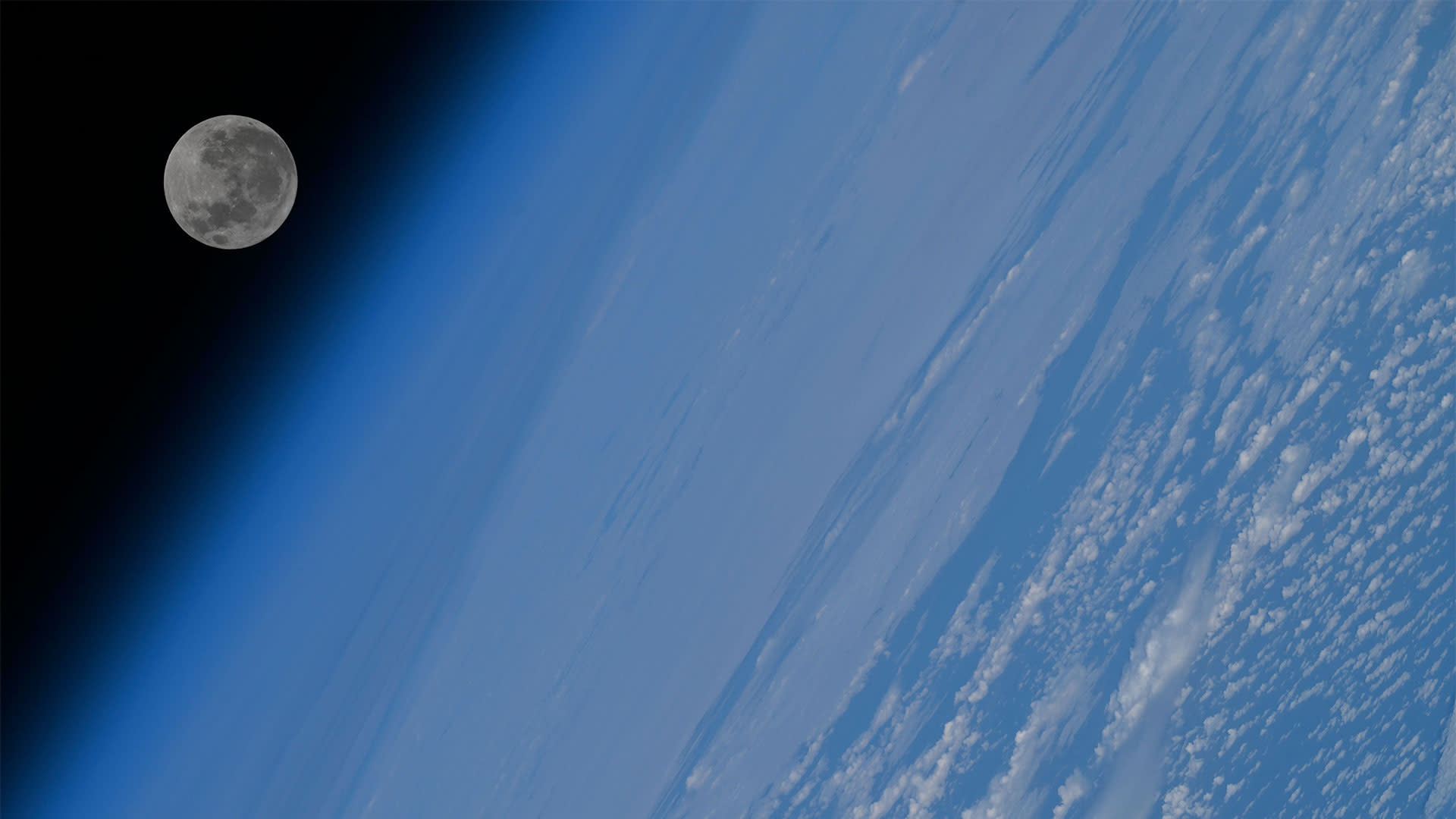
Image (Credit): The Flower Moon captured this month by NASA astronaut Nichole Ayers aboard the International Space Station (ISS) . (NASA/Nichole Ayers)
While it almost looks like the Death Star on the horizon, you are looking at this month’s Flower Moon, as captured by NASA astronaut Nichole Ayers from the ISS.
This month’s Moon was called the “Three-Milkings Month” back in 703 AD, but now it has a Native American name, either the Flower Moon, the Corn Moon, or even the Corn Planting Moon.
You can read more than you would ever want to know about this Moon via this NASA page.
Image (Credit): Barred Spiral Galaxy NGC 5335 (NASA, ESA, STScI)
This week’s image looks like something ginned up by AI, but it is from the Hubble Space Telescope. Just the number of stray galaxies in the image is amazing.
Barred spiral galaxy NGC 5335 observed by the Hubble Space Telescope takes up the majority of the view. At its center is a milky yellow, flattened oval that extends bottom left to top. Within the oval is a bright central region that looks circular, with the very center the brightest. In the bright central region is what looks like a bar, extending from top left to bottom right. Around this is a thick swath of blue stars speckled with white regions. Multiple arms wrap up and around in a counterclockwise direction, becoming fainter the farther out they are. Both the white core and the spiral arms are intertwined with dark streaks of dust. The background of space is black. Thousands of distant galaxies in an array of colors are speckled throughout.




 Our Awesome Universe