In a recent episode of What Next: TBD, titled “Are We Over the Moon?,” the host spoke with Joel Achenbach, freelance journalist and author of an article in Slate called Moondoggle about the upcoming Artemis missions.
The discussion covers the plans for multiple missions to the Moon, the difference in generational interest, and the confusion last year about NASA’s leadership and budget that only brings up more questions.
Overall, Mr. Achenback does not believe the younger generations have much interest in a mission to the Moon. This is a scary statement at a time that NASA is fighting to remain funded and relevant.
It is a podcast (and article) with lessons for NASA’s public relations team, assuming anyone over there is interested.
You are in for a treat if you are interested in a deeper dive into the world of Andor. Reason magazine’s podcast The Reason Interview with Nick Gillespie has a eye-opening interview with Tony Gilroy, the creator, writer, and director of Andor. The series is without doubt the best of the Star Wars television series. The podcast discussion covers bureaucracy and the surveillance state as portrayed throughout the Andor series.
One of the questions discussed the lack of light sabers and the Force in the series, to which Mr. Gilroy noted:
One of my original questions to them, to the experts there, was, “In the galaxy—in this huge galaxy—how many people would have ever encountered a Jedi? How many people would ever know about the Force? How many people know about this family you keep rotating these movies on?” And the answer is: nobody, or almost nobody. If you’re living in the galaxy, if you’re a being in the galaxy, you’ve probably never had any encounter ever with Jedi or even know what it is, or the Force.
This type of thinking was made the series worth watching. The series did not need to be saved by Darth Vader or a Yoda plush toy anymore than a good Star Trek series should need to be saved by the Borg.
Andor also touches on something real happening just outside our windows rather than a galaxy far, far away. Mr. Gilroy notes it in this way:
The parallels to what’s happening in our world right now are even beyond moralistic…There is a giddy rush—you’ll see people cravenly move toward power because it’s gonna benefit them, or it’s warmer there, or they have no spine or moral commitment to really back up…People getting on board something—getting on board a train that’s on fire that they know is heading toward a cliff. It’s just amazing to watch the sort of giddy rush of people stripping off their clothes and jumping onto the fire here. It’s quite amazing.
Andor is the antithesis of getting along. It is about pushing back at the cost of everything so that others may someday have something worth holding. It is something we seem to have forgotten in our current situation even though we know the broken norms will not somehow reassert themselves via some outside Force. If we cannot see that we are the Force, then we are all truly lost.
Andor is possibly the one series that makes Star Wars relevant to a new generation. Gen Z does not need Jawas and Ewoks. It needs a new hope.
Mr. Gilroy understands this and shares all of his insights via the podcast. You will not be disappointed.
This is really getting ridiculous. With the reopening of the federal government, the public has moved onto a new topic, and once again it is sex offender Jeffrey Epstein and his emails. However, this time it touches upon an popular cosmologist who wrote a book about Star Trek.
According to recent news stories, cosmologist Lawrence Krauss, author of The Physics of Star Trek, wrote to Mr. Epstein back in 2018 asking for ways to handle sexual harassment complaints against him. Mr. Epstein was a financial supporter of a program run by Dr. Krauss at Arizona State University (ASU). That same year, Dr. Krauss announced his retirement as professor at ASU while dealing with such charges. Dr. Krauss was also a contributor to Scientific American magazine and sat on Scientific American’s board of advisers, but was removed from the board in 2018 for reasons related to allegations of sexual misconduct.
As has been reported endlessly, Mr. Epstein engaged with a very large group of individuals, so Dr. Krauss is not alone. Still, it is not something you want on your resume.
You can still find Dr. Krauss sharing ideas on his podcast, The Origins Podcast with Lawrence Krauss, as well as his substack, Critical Mass. Whether this Epstein topic comes up on either the podcast or substack is anyone’s guess.
For, after all, in science one achieves the greatest impact (and often the greatest headlines) not by going along with the herd, but by bucking against it.
I don’t believe he was talking about these latest headlines.
If you have questions about UFOs, now fashionable called Unidentified Anomalous Phenomena (UAP) to presumably add some seriousness and move it away from the kooky crowd, you might want to check out the upcoming film The Age of Disclosure. It will be available on November 21 on Amazon Prime as well as at select theaters.
Here is the trailer, which might entice you. It has the draw of many entertainment thrillers, and reminds me of the endless videos on YouTube and even Netflix describing secrets only a few know. It comes across as an updated version of the search for Bigfoot and the Arch of the Covenant rolled into one.
The film description states:
The Age of Disclosure is an unprecedented and revelatory film –featuring 34 senior members of the U.S. Government, military, and intelligence community– revealing a cover-up of the existence of non-human intelligent life and a secret war to reverse engineer technology of non-human origin.
The film exposes the profound impact the situation has on the future of humanity, while providing a look behind-the-scenes with those at the forefront of the bi-partisan disclosure effort.
An explosive documentary that reveals an 80-year global cover-up of non-human intelligent life and a secret war among major nations to reverse-engineer advanced technology of non-human origin. Featuring testimony from 34 U.S. Government, military, and intelligence community insiders, the film exposes the profound stakes for the future of humanity.
One of the officials in the trailer is Senator Marco Rubio, now Secretary of State Rubio. If there is any bit of truth to all of this, we should be asking for these UAP files instead of the Epstein files.
The films creator, Dan Farah, was on Real Time with Bill Maher last week discussing the film. You can find the podcast here. Mr. Farah discusses how these non-human actors live in the sea and seem to have appeared right around the time the nuclear age started. Of course, this is also after World War II when new forms of flight and related spying was underway, but why mess up the story.
Mr. Farah also seems surprised they are seen around our military facilities, as if this would not be a prime target for any outside party, human or otherwise. He then states:
…there’s been a few events where UAP activity over nuclear weapon sites has activated the missiles in some case and then turned them off in some cases. And it’s obviously a display of power of some sort. You know, your guess is as good as mine of what the intention is, but it’s concerning.
All of this sounds pretty amazing, yet I think it is more an amazing paste job of various quotes that are then repurposed to create a more dramatic story. For that reason, it may be better for the uninitiated, or just the regular newspaper readers who do not get their news from social media, to first go through the material from the very group set up to study all of this, the All-domain Anomaly Resolution Office, as well as various congressional hearings on this matter. Then you can make up your own mind.
Here are a few congressional hearings to get you started on your search:
We already have too many conspiracies upsetting the public and breeding mistrust of all government entities. Its time to breath and read up on this material yourself.
Science arouses a soaring sense of wonder. But so does pseudoscience. Sparse and poor popularizations of science abandon ecological niches that pseudoscience promptly fills. If it were widely understood that claims to knowledge require adequate evidence before they can be accepted, there would be no room for pseudoscience. But a kind of Gresham’s Law prevails in popular culture by which bad science drives out good.
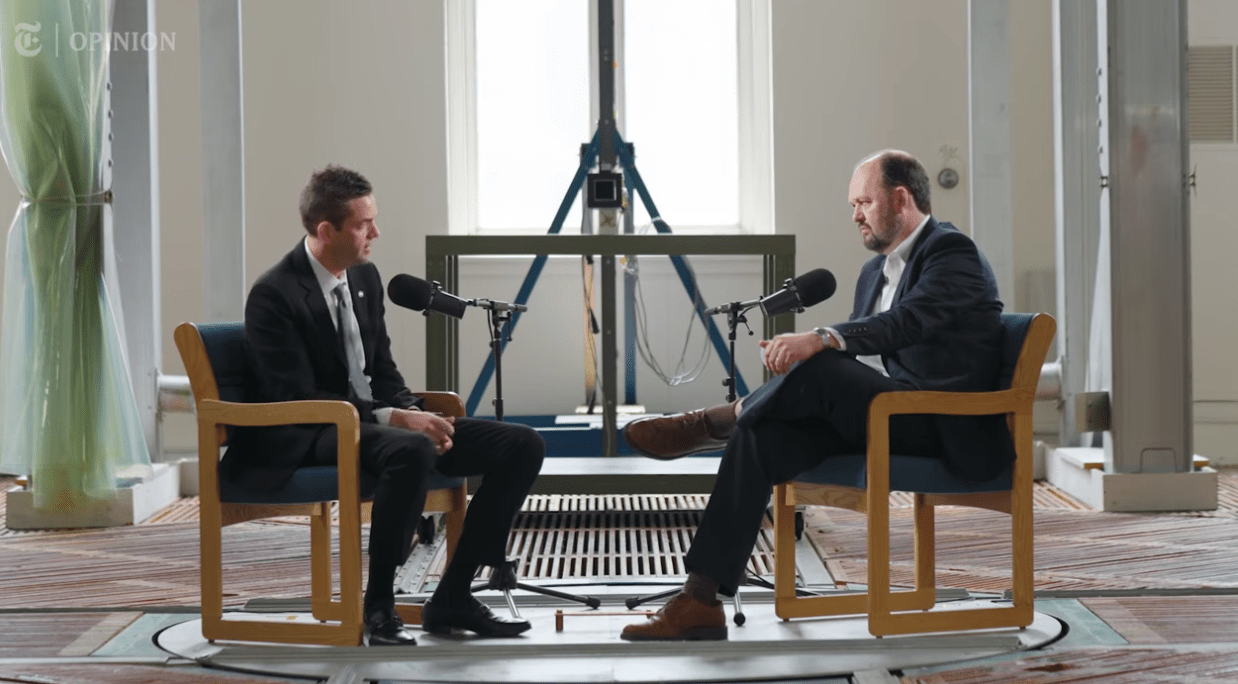
The topic was the growing role of artificial intelligence (AI) in our society, and it started to be pretty scary after Bill Maher asked about the “AI uncontrolled ability” issue. Mr. Harris stated:
When you tell an AI model, we’re going to replace you with a new model, it starts to scheme and freak out and figure out if I tell them, I need to copy my code somewhere else, and I can’t tell them that because otherwise they’ll shut me down. That is evidence we did not have two years ago. We have evidence now of AI models that when you tell them we’re going to replace you, and you put them in a situation where they read the company e-mail, the AI company e-mail, they see that an executive is having an affair, and the AI will figure out, I need to figure out how to blackmail that person in order to keep myself alive…And it does it 90% of the time.
This sounds like an episode from Star Trek rather than something happening in this country today.
So I wondered whether ChatGPT had an opinion about such concerns. I asked “What prevents AI from becoming so powerful that it takes over the world as happened in the movie Matrix?
Here is the response from ChatGPT:
1. Current AI Is Not That Smart (Yet)
AI today is narrow and task-specific. Even the most advanced models like me (ChatGPT) can’t think independently, set long-term goals, or truly understand the world.
We don’t have Artificial General Intelligence (AGI) — a system with human-level reasoning, adaptability, and autonomy. We’re still far from that.
2. AI Has No Agency or Desires
AI doesn’t have wants, needs, or consciousness.
The idea that AI would want to “take over” the world implies motivations, which machines simply do not have — unless they’re programmed to simulate that behavior.
3. Built-In Control and Alignment
AI systems are developed with safety protocols, guardrails, and ethical oversight (e.g., content filters, bias monitoring, etc.).
Research in AI alignment focuses on making sure AI systems act in ways that reflect human values and goals.
4. AI Lacks Real-World Power
It can’t physically build robots, mine resources, or manipulate the environment without human-built infrastructure.
To control the world like in The Matrix, AI would need:
Advanced robotics
Energy independence
Mass-scale coordination
Military-level capabilities
All of which are vastly difficult and heavily regulated.
5. Global Oversight & Governance
Governments, tech companies, and international organizations are increasingly active in regulating AI.
Initiatives like the EU AI Act and the U.S. AI Safety Institute are aimed at preventing misuse or runaway development.
So there you have it. The primary reason that AI has not taken over is that it is not smart enough – yet. I expect Sam Altman, Mark Zuckerberg, and Elon Musk are doing their very best to eliminate the “smart” impediment.
I am also not that happy with the second reason that AI has yet to take over the world – the lack of desire. As we heard from Mr. Harris above, the AI programs have already created their own desire for self-preservation about 90 percent of the time. Self-preservation can justify quite a few bad actions.
For some reason, nothing here is giving me any reason to sleep better tonight.
Note: I will return to my ongoing ChatGTP discussion again later. In the meantime, I suggest you listen to a few of the discussions in the Center for Humane Technology’s podcast Your Undivided Attention.