I recommend you check out the recent episode from the Cool Worlds Podcast about the water and atmosphere on Mars and how it has changed and may change again, with and without the intervention of humans. The episode, “Edwin Kite – Early Mars, Terraforming/Settling Mars,” is a discussion between podcast host David Kipping and Edwin Kite, Professor of Geophysical Sciences at the University of Chicago as well as Participating Scientist for the NASA Curiosity Rover.
The discussion gets into where Martian water may be today, what terra-forming efforts have been discusses in the past, the terra-forming possibilities in the future, and whether Mars should be seen as a second Earth. Oh yeah, it also discusses Elon Musk’s crazy idea to nuke the surface of Mars and even touches on the idea of a Planet 9.
It’s a fascinating discussion that is worth your time.
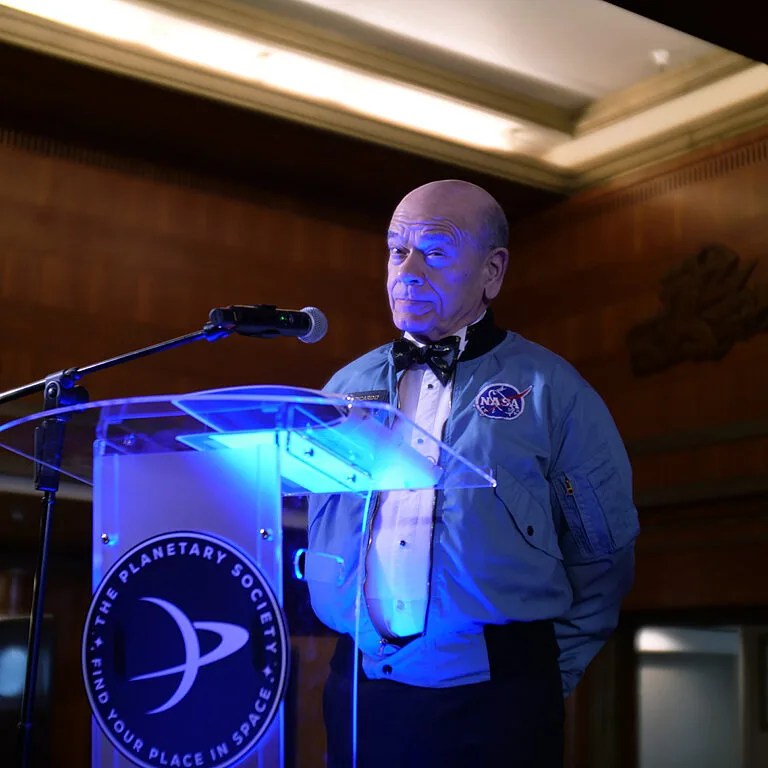
Image (Credit): Actor Robert Picardo at the Planetary Society’s 45th anniversary event. (ThePlanetary Society)
if you missed the April 5th event celebrating the Planetary Society’s 45th anniversary, you can still tap into it via the Planetary Radio podcast.
Here is a little more on the event and related discussion:
Join us aboard the historic RMS Queen Mary for a celebration of The Planetary Society’s 45th anniversary. In this special episode of Planetary Radio, we bring you highlights from our Cosmic Shores Gala, where members, scientists, space advocates, and special guests came together to honor the past and look boldly to the future.
You’ll hear from CEO Bill Nye, Board President Bethany Ehlmann, Executive Director Jennifer Vaughn, founding Executive Director Lou Friedman, and Congresswoman Judy Chu, with actor and Planetary Society board member Robert Picardo as our master of ceremonies.
And of course, we close with Chief Scientist Bruce Betts in this week’s What’sUp.
If you are looking for new podcast material, you may want to check out NASA’s Curious Universe podcast. It has been around for a while, but it is starting a new series celebrating Earth from April 15 to May 13.
The first episode in the new Earth series is titled “How NASA Sees Our Blue Marble.” In the episode, we hear from Karen St. Germain, the director of NASA’s Earth Science Division. It is a chance to learn about the planet that NASA spends the most time studying.
If you like this series, you can go back and listen to other episodes, such as:
-“Inside the Team That Keeps Hubble Flying” (March 14, 2025) -“The Sun Series” (March 19 to May 3, 2024) -“Defending the Planet from Asteroids” (February 21, 2023) -“The Search For Life: Are We Alone?” (June 21, 2022)
The Mars Society’s Red Planet Live Podcast will be joined by Dr. Robert Zubrin on March 4th for a discussion about the future of human Mars exploration, what it will take to get boots on the Red Planet, and how we can build our first off-world settlement.
Dr. Zubrin is the Founder and President of The Mars Society, as well as the author of numerous books on Mars and other space-related topics. One of his latest books is The New World on Mars: What We Can Create on the Red Planet, which was issued in February 2024. As short summary of the book from the publisher’s site is provided below. It should be a useful primer for the upcoming discussion.
SpaceX, Blue Origin, and Virgin Galactic are building fleets of space vehicles to make interplanetary travel as affordable as Old-World passage to America. We will settle on Mars, and with our knowledge of the planet, analyzed in depth by Dr. Zubrin, we will utilize the resources and tackle the challenges that await us. What we will we build? Populous Martian city-states producing air, water, food, power, and more. Zubrin’s Martian economy will pay for necessary imports and generate income from varied enterprises, such as real estate sales—homes that are airtight and protect against cosmic space radiation, with fish-farm aquariums positioned overhead, letting in sunlight and blocking cosmic rays while providing fascinating views. Zubrin even predicts the Red Planet customs, social relations, and government—of the people, by the people, for the people, with inalienable individual rights—that will overcome traditional forms of oppression to draw Earth immigrants. After all, Mars needs talent.
You can find the list of past Red Planet podcast episodes on YouTube.
You may enjoy this week’s episode from the Cool Worlds Podcast all about leaving evidence of our civilization for alien visitors, or even a future civilization here on Earth. The episode, “Nick Searra – Alien Communication, Golden Record, Future Relics,” covers a lot of ground from the Pioneer and Voyager missions to the idea of placing time capsules about our civilization on the Moon or even within the orbit of Jupiter.
The guest is Nick Searra, who is Founder and Executive Directory of the Interstellar Foundation. The Interstellar Foundation has a clear mission – to create messages that represent the diversity and creativity of humanity, inspire future generations of explorers, and communicate with potential extraterrestrial life.
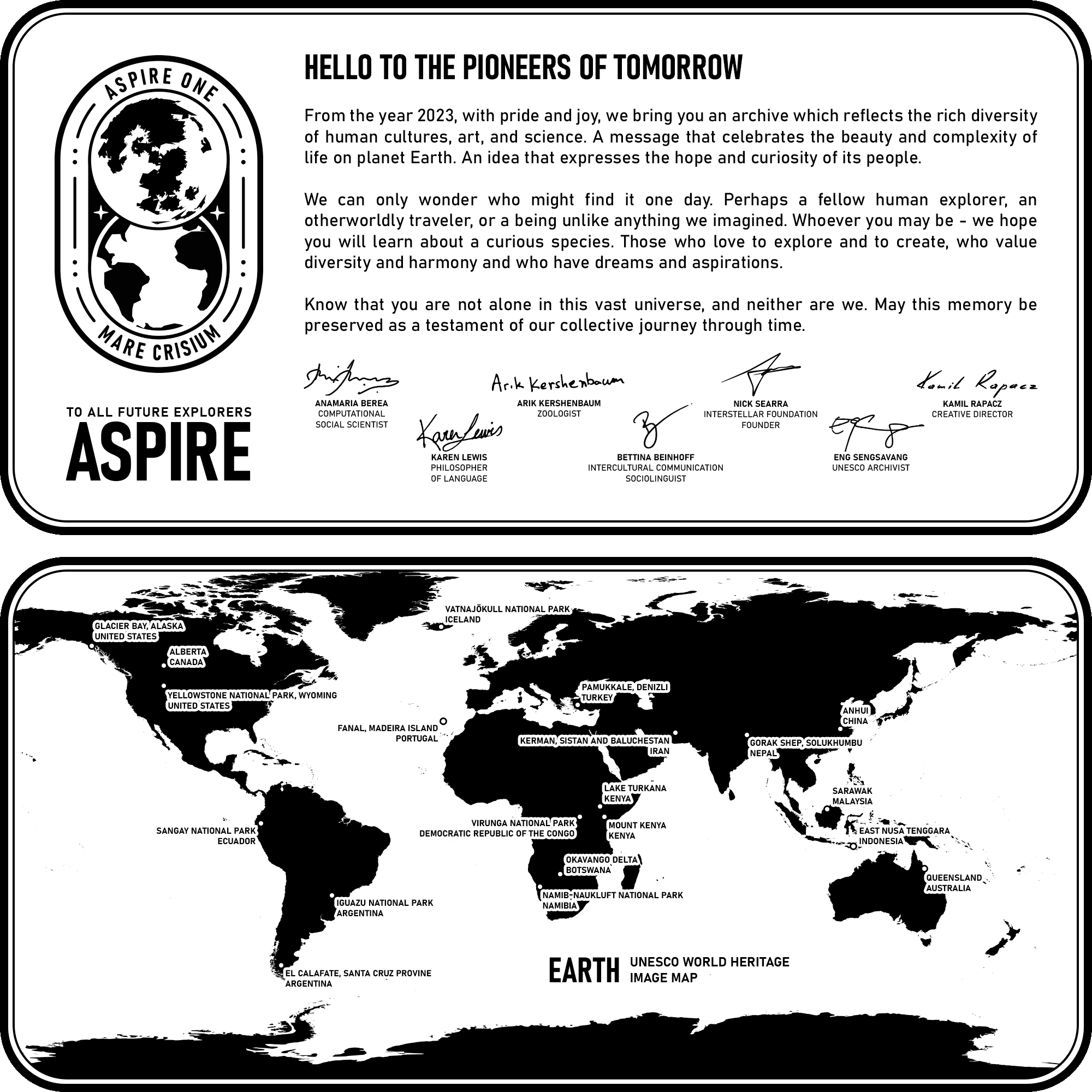
On the site, you an read about the Foundation’s Aspire One, which was an effort to create a lunar record to preserve Earth’s cultural and scientific heritage on the Moon. Preserved records include UNESCO archives, World Heritage images, and other scientific, historical, and cultural material. This message is already on its way to the Moon via this week’s launch of the Blue Ghost lunar lander.
A second messaging mission, Aspire Two, is now in development.
The podcast discussion and related website basically cover the continuation of work stared by Carl Sagan with the launch of Pioneer 10 back in 1972. I recommend you check out both of them.
Image (Credit): Sample images from Aspire One. (Interstellar Foundation)




 Our Awesome Universe