WTF Podcast host Marc Maron interviewed William Shatner recently. Overall, it was a fun conversation with Mr. Shatner discussing his early acting career, his family, his flight into space on Blue Origin, his various ongoing projects, and more.
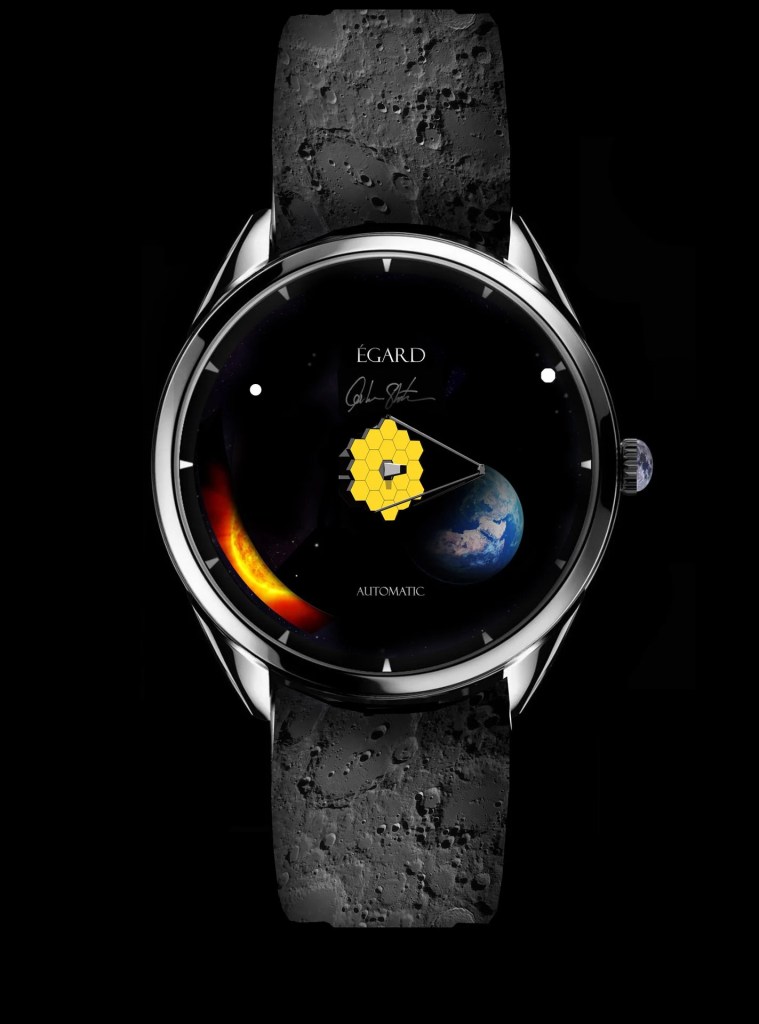
In terms of projects, Mr. Shatner mentioned a variety of interests, including horse shows, television series, and even designing his own watch (shown below). Yes, the man is still busy in his 90s.
I recommend you check it out (the interview starts at about the 11 minute mark).
Note: One of the television series discussed is Fox’s new series Stars on Mars, which premieres today.
Image (Credit): New watch design created by William Shatner and Ilan Muallem Srulovicz. (Egard Watch Co.)
If you are looking for a new podcast as well as a new book, the two come together via the podcast Alienating the Audience. Comedian Andrew Heaton and his buddies have plenty of fun poking various science fiction topics, including Star Wars and Star Trek.
One of the recent episodes discussed a new book, The Sparrow, by author Mary Doria Russell. The story is about a group of Jesuits exploring a new planet with all of the mayhem that follows.
Here is a quick summary from the book itself:
A visionary work that combines speculative fiction with deep philosophical inquiry, The Sparrow tells the story of a charismatic Jesuit priest and linguist, Emilio Sandoz, who leads a scientific mission entrusted with a profound task: to make first contact with intelligent extraterrestrial life. The mission begins in faith, hope, and beauty, but a series of small misunderstandings brings it to a catastrophic end.
You can listen for yourself to this episode here at Jesuits in Space. But be careful, because there are a number of spoilers. You can always start with the book first, which is part of a series.
Image (Credit): Artist’s rending of exoplanet GJ 1132b. (MIT News)
If you are looking for a fun podcast this week, you cannot go wrong with Neil DeGrasse Tyson’s Startalk podcast when it hosts Cool Worlds‘ creator David Kipping. The episode, Cosmic Queries – Cool Worlds with David Kipping, covers questions related to exoplanets, exomoons, and more. It is fun to hear the two scientists play off each other.
You will also learn from this podcast that Cool Worlds should be releasing its own podcast in the near future. Its Youtube videos are already a great source of information, so I expect more of the same in these podcasts.
At the end of the podcast, Professor Kipping also mentioned a few upcoming space missions related to exoplanets, including the European PLAnetary Transits and Oscillations of stars (Plato) mission in 2026. You can learn more about the mission from this European Space Agency factsheet, which notes:
Does a second Earth exist in the Universe? Planet hunter Plato will focus on the properties of rocky planets orbiting Sun-like stars. In particular, Plato will discover and characterise planets in orbits up to the habitable zone – the ‘goldilocks’ region around a star where the temperature is just right for liquid water to exist on a planet’s surface.
Plato will characterise hundreds of rocky (including Earth twins), icy or giant planets by providing exquisite measurements of their radii (3% precision), masses (better than 10% precision) and ages (10% precision). This will revolutionise our understanding of planet formation and the evolution of planetary systems, as well as the potential habitability of these diverse worlds.
As well as looking at these planets, Plato will analyse their host stars. Using data from the mission, scientists hope to perform stellar seismology, gathering evidence of ‘starquakes’ in the imaged stars. This will give insight into the characteristics and evolution of the stars, improving our understanding of entire planetary systems.
The interview is with Peter Visscher, Director of Canadensys West, which is building the rover after receiving a contract from Canadian Space Agency’s Lunar Exploration Accelerator Program. Here is a little more about the rover and the partners on the mission:
The 30-kg lunar rover will be sent to the Moon’s south pole region as early as 2026. The rover will be carrying multiple science payloads from Canada and the US. Canadensys Aerospace is leading a broad team of partners, including NASA Ames Research Center, NGC Aerospace, Maya Heat Transfer Technologies, Nokia, Bubble Technology Industries, Waves in Space, Simon Fraser University, Western University, the University of Winnipeg, l’Université de Sherbrooke, Leap Biosystems, Surrey Satellite Technology, and RF Collins. The team’s scientific investigators are among the leading lunar researchers in Canada and the US and are affiliated with the core team organizations as well as Arizona State University, Planetary Science Institute, and University of Alberta.
The rover will explore the Moon’s South Pole as it searches for water ice. Such ice has already been detected from orbit, but this mission will test the soil in the area where the water was detected. Water on the lunar surface will be of great benefit to future missions on the Moon and elsewhere – it represents not only water itself, but oxygen for breathing and hydrogen for fuel.
The objectives of the mission were recently laid out by the Canadian government:
travel on the surface of the Moon to see how the various systems perform;
showcase the possible applications, feasibility and performance of a new technology;
make scientific measurements that will help determine the amount of hydrogen present in the Moon soil, which is one of the best indicators of water ice while defining at which temperatures it is detected;
analyze the lunar soil to better understand the geology of the site; and
assess lunar surface radiation to find out how much radiation future astronauts will be exposed to.
The interview in the podcast gives you more background on the project as well as potential plans to provide the rover with its own name.
NASA is working on another rover that it plans to send to the Moon’s surface by 2024 – Volatiles Investigating Polar Exploration Rover (VIPER). I can cover that mission and other lunar missions looking for water in a later post.