I found another episode from The Planetary Society’s podcast Planetary Radio that is worth checking out. In this episode, Are we Alone? The Search for Alien Technosignatures, Professor Jean-Luc Margot and doctoral student Megan Li discuss their project at University of California Los Angeles (UCLA) to identify signals from other civilizations in the galaxy and then extract information encoded in those extraterrestrial signals. This project, called UCLA SETI, was also the winner of a Planetary Society STEP Grant as well as a NASA grant to conduct this work.
As of last week, a volunteer site was set up to assist the UCLA SETI team with this project. Here is some key information from its website:
The video is actually a 55-minute talks, but the key section related to this project starts at the 23:38 minute mark where the downloaded data is discussed.
This is your chance to identify something that no one has every seen before. Put some of that time you might have spent watching The Ark toward something useful.
Image (Credit): Venus as captured by NASA’s Mariner 10 spacecraft in February 1974. (NASA)
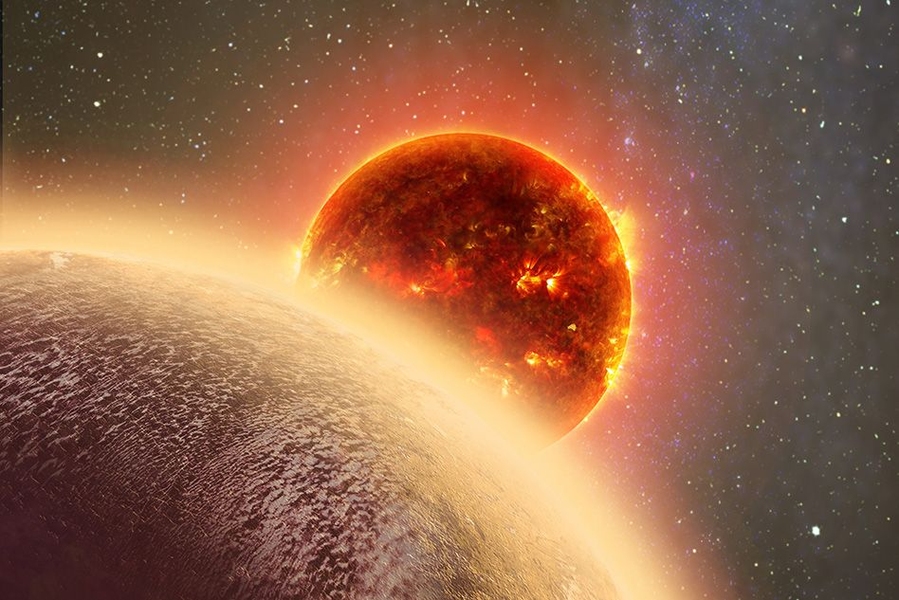
I recommend checking out Alan Alda’s interview with astronomer Sara Seager in a recent Clear + Vivid podcast episode. MIT Professor Seager has focused her work on exoplanet atmospheres as well as another planet nearby – Venus. In the interview, she discusses her early work as well as her theories about the existence of life in the atmosphere of Venus. She also discusses her involvement with MIT’s Transiting Exoplanet Survey Telescope (TESS).
And while I do not remember it coming up during the interview, Professor Seager is also known for the Seager equation (shown below), which is less demanding than the Drake equation and focuses on any form of life on another planet (without reference to technology).
N = the number of planets with detectable signs of life
N* = the number of stars observed
FQ = the fraction of stars that are quiet
FHZ = the fraction of stars with rocky planets in the habitable zone
FO = the fraction of stars with observable planets
FL = the fraction of planets that have life
FS = the fraction of life forms that produce planetary atmospheres with one or more detectable signature gases
But in addition to the science, it was a fascinating discussion about Professor Seager’s life covering the early death of her husband from cancer, her attempts to get her life back on track, and her discovery later in life that she has autism. Most science stories focus on the work, but Mr. Alda has a unique way of drawing out the person in these interviews. It is a great episode, and you can read more about Professor Seager’s life and work in her book The Smallest Lights in the Universe.
Both Andy Weir (author of The Martian, Artemis, and Project Hail Mary) and Rob Manning (Chief Engineer at the Jet Propulsion Laboratory) were shooting the you-know-what as they chatted about science fiction books they read as teenagers, the role of real science in fictional tales, astronomical conspiracy theories, and mankind’s need to expand into the unknown.
It was interesting to hear Andy Weir talk about curiosity being humanity’s survival mechanism. He pointed out that curiosity has allowed humanity to survive disasters here on Earth because we were all spread out rather than clustered on one flood plain. The same applies to expansion beyond the Earth.
Check it out for yourself. You may want to check out some of the earlier podcasts as well, such as:
On a recent episode of the Clear + Vivid podcast, Alan Alda interviewed NASA engineer Les Johnson about his efforts to develop a solar sail that can take us to the stars. He is the Principal Investigator for the NEA Scout, which was launched into space during the Artemis I mission and is now heading towards a near-Earth asteroid via solar sails (see above).
During the interview, Mr. Johnson discussed the NEA Scout as well as his hopes for future human travel to the stars using solar sails, noting that while slow, the sails can outperform modern rocket engines in the long-run. He also pointed out that a solar sail may be able to get us to Proxima Centauri, the closest neighboring star, in hundreds of years versus the 70,000 years it will take the Voyager spacecraft to travel that same distance. I like how he puts such a mission in perspective, pointing out it took hundreds of years to build some of the great cathedrals.
Messrs. Alda and Johnson also discussed the ethics of space travel considering astronauts will be spending generations in space with many humans never seeing either the Earth or the destination in their lifetime. Mr. Johnson said space lasers may be another option for interstellar travel at some point in the future, reducing the travel time to Proxima Centauri to 40-50 years. Given the time spans, he said it may make sense to initially send robots into space first.
Finally, the podcast covered missions closer to Earth, such as mining asteroids for water and minerals, as well as 3D printing to create what we need in space. It sounded a lot like the situation in find in the science fiction TV series The Expanse.
Overall, it was a great conversation worth a few minutes of your day. Check it out.
Extra: Mr. Johnson is also the author of several books, including the co-authored Saving Proxima. Here is a quick summary of that tale:
2072. At the lunar farside radio observatory, an old-school radio broadcast is detected, similar to those broadcast on Earth in the 1940s, but in an unknown language, coming from an impossible source—Proxima Centauri. While the nations of Earth debate making first contact, they learn that the Proximans are facing an extinction-level disaster, forcing a decision: will Earth send a ship on a multiyear trip to render aid?
Interstellar travel is not easy, and by traveling at the speeds required to arrive before disaster strikes at Proxima, humans will learn firsthand the time-dilating effects of Einstein’s Special Relativity and be forced to ponder ultimate questions: What does it mean to be human? What will it take to share the stars with another form of life? What if I return younger than my own children? The answers are far from academic, for they may determine the fate of not one, but two, civilizations.
Image: Chesley Bonestell art printed in “The Conquest of the Moon” (1953). Mr. Bonestell’s art is mentioned in the Moonrise podcast.
If you are looking for a good story that you to listen to during your next car trip, you cannot do better than the Washington Post’sMoonrise podcast. It has a bit of everything, including science fiction stories, Nazi war machines, Russian persecution, American post-WWII politics, and a bit of astronomy as well.
Here is how the program sells itself:
Want to uncover the real origin story behind the United States’ decision to go to the moon? In the 50 years since the moon landing, as presidential documents have been declassified and secret programs revealed, a wild story has begun to emerge. “Moonrise,” a Washington Post audio miniseries hosted by Lillian Cunningham, digs into the nuclear arms race of the Cold War, the transformation of American society and politics — and even the birth of science fiction — to unearth what really drove us to the moon. Come along with us on a fascinating journey from Earth to the moon.
You can learn how President Kennedy tried to get the Soviet Union to join the Apollo program – twice. You can also hear about the Apollo 11 mission competing with a Soviet spacecraft trying to land on the Moon at the same time. And have you heard about the civil rights protests at the Apollo 11 launch site?
The podcast is a well crafted story trying to weave together many threads in a mostly successful way. It is still astonishing that the early Space Race was really lead by a former Nazi representing the United States and a former political prisoner representing the Soviets. Today the Apollo story is mostly a warm blur from the past, but I believe it is worth your time to listen to the full story. It is the foundation of our space exploration efforts, for better or worse.