A Day in Astronomy: First Spaceflight Fatality

Image (Credit): Soviet cosmonaut Vladimir Komarov. (RIA Novosti)

On this day in 1967, the Soviet Union’s Vladimir Komarov became the first spaceflight fatality when his Soyuz 1 spacecraft crashed during reentry as the result of a failed parachute. The accident occurred during what was his second trip to space, his first being aboard the Voskhod 1. Yuri Gagarin served as the backup cosmonaut on the Soyuz 1 flight.

The Soyuz 1 mission was already experiencing problems before reentry, particularly with its solar panels. These problems were enough to end the mission early and delay the launch of a second Soyuz spacecraft that would have met up with the orbiting Soyuz 1. The spacecraft was not up to the mission. Before the crash, Komarov could be heard stating, “This devil ship! Nothing I lay my hands on works properly.”

This fellow cosmonauts had this to say via Pravda:

For the forerunners it is always more difficult. They tread the unknown paths and these paths are not straight, they have sharp turns, surprises and dangers. But anyone who takes the pathway into orbit never wants to leave it. And no matter what difficulties or obstacles there are, they are never strong enough to deflect such a man from his chosen path. While his heart beats in his chest, a cosmonaut will always continue to challenge the universe. Vladimir Komarov was one of the first on this treacherous path.

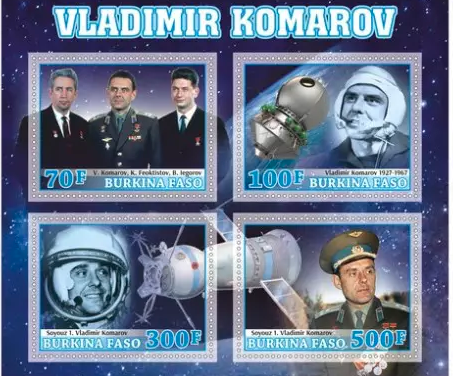
Image (Credit): Burkina Faso stamps commemorating cosmonaut Vladimir Komarov. (stamps-world.eu)

Television: For All Mankind

Image (Credit): Promotion for season two of For All Mankind. (Apple TV+)

While awaiting the return of the Star Trek and Star Wars televisions series (by the way, do not forget that the fifth and final season of Star Trek: Discovery is slated to start tomorrow), I started to watch For All Mankind on Apple TV+. I am only halfway through season two, but I have enjoyed every minute so far. I am just surprised there has not been more press about this impressive series.

I was somewhat skeptical to start the series because I knew it was an alternate reality to our actual space program. Yet what I saw as a weakness was actually the show’s strength. The series re-imagines the space race with the Russians, having the U.S. set up a Moon base after the Russians are the first to step foot on the Moon. It just shows us what could have been if we did not stop the Apollo program 50 years ago and dither around until the Artemis program.

And while the series has plenty of action – almost as though your are watching multiple Apollo 13 movies – what makes it different is that it has heart. It is almost the Mad Men of NASA, showing the good and bad of that period in terms of human lives.

For All Mankind is honest about the period from the 1960s through the 1980s, showing that the real drama was right here on Earth as we dealt with Vietnam, racism, immigration, marital and family issues, and even a lesbian astronaut.

I did not expect all of this in one show, nor the superb acting that makes it all come to life. I am now hooked on the series, finding it strange that I already have nostalgia for an American lunar space program that never existed even though it could have.

The series continues with a Mars program in seasons 3 and 4, but I do not want to get ahead of myself. Let’s just say this other America gets to the Red Planet long before we do.

We are creating plenty of drama today with the real lunar program currently under way, as well as an eventual Mars program. It may in fact lead to some great television series down the line. I just hope we stick to the script and keep the current drama going for years to come.

Another Safe Docking to the International Space Station

Image (Credit): The approach of the Soyuz MS-25 spacecraft as seen from the ISS. (NASA TV)

Earlier today, the two cosmonauts and one astronaut that launched on the Russian Soyuz MS-25 mission over the weekend safely attached themselves to the International Space Station. The station is now hosting a crew of 10.

Both cosmonauts Oleg Novitskiy and cosmonaut Marina Vasilevskaya (of Belarus) from this latest mission will return to Earth in the Soyuz MS-24 capsule in about 12 days along with NASA astronauts Loral O’Hara, who will have spent a total of 204 days on the station.

It’s a game of musical spacecraft, but it seems the routine is working and, other than the occasional leak, all is well with the station and its crew.

New Crew Heads to the International Space Station

Image (Credit): Members of the Soyuz MS-25 crew – commander Oleg Novitskiy (bottom), NASA astronaut Tracy Dyson (middle), and Belarus guest cosmonaut Marina Vasilevskaya (top). (NASA/Bill Ingalls)

Earlier today, a Russian Soyuz rocket launched into space to bring three new crew members to the International Space Station (ISS).

The passengers on today’s delayed flight are cosmonauts Oleg Novitskiy and Marina Vasilevskaya as well as NASA astronaut Tracy Dyson. They are expected to board the ISS on Monday.

Astronaut Dyson, who plans to stay on the station for six months, will assist her fellow astronauts on the ISS with a variety of experiments, including “…[s]tudies of neurological organoids, plant growth, and shifts in body fluids,”

RIP: Thomas Stafford, Apollo 10 Astronaut

Image (Credit): The joint U.S.-USSR crew for the Apollo Soyuz Test Project. Astronaut Thomas P. Stafford (standing on left), commander of the American crew; Cosmonaut Aleksey A. Leonov (standing on right), commander of the Soviet crew; Astronaut Donald K. Slayton (seated on left), docking module pilot of the American crew; Astronaut Vance D. Brand (seated in center), command module pilot of the American crew; and Cosmonaut Valeriy N. Kubasov (seated on right), engineer on the Soviet crew. (NASA)

As we plan our return to the Moon, we cannot forget the Apollo astronauts who showed us the way last century. One of those astronauts, Thomas Stafford, died today at the age of 93.

Among his many achievements, including his Apollo 10 mission that prepared the way for the first Moon landing by Apollo 11, he may be most remembered for his 1975 space encounter with the U.S.S.R. cosmonauts.

The Apollo-Soyuz Test Project was the first international mission in space. It involved an Apollo spacecraft (crew of three) connecting with a Soyuz spacecraft (crew of two) in Earth orbit. The two days of joint activities created a precedent that was later followed by the International Space Station (ISS).

We were in the middle of the Cold War in 1975, so any cooperation with the U.S.S.R. was pretty amazing. It is just as surprising to witness SpaceX bringing cosmonauts to the ISS while the U.S. maintains severe sanctions on Russia.

Thomas Stafford died knowing that his early efforts to blaze a path to the Moon and cooperate with the Russians were still going strong today. That must have provided him with a little bit of peace in his final days.

You can watch a NASA video on Mr. Stafford’s accomplishments here.

You can also read more on Mr. Stafford’s life and career at these sites:

Rest in peace.