Starlink Having Problems in Ukraine

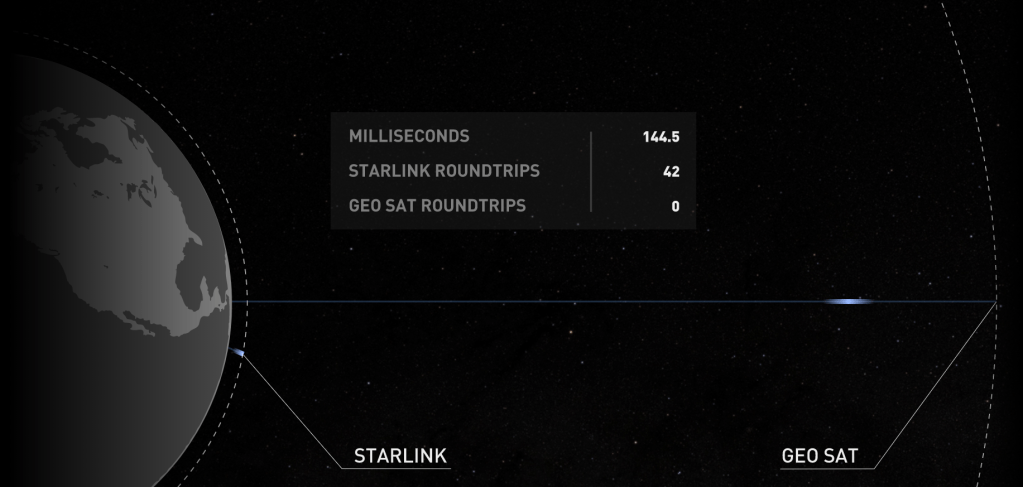
Image (Credit): Starlink page explaining why Starlink satellites are better then geostationary satellites. (SpaceX)

As if Elon Musk doesn’t have enough problems with his Twitter purchase and declining shares at Tesla, now the Ukranians are reporting that SpaceX’s Starlink internet service failed to work during a critical point in their battle to push the Russians out of Ukranian territory. This problem has been going on for weeks, but we are hearing about it now.

SpaceX was silent when these reports came out, but some suggested this may have been a feature rather than a bug in the Starlink system to prevent it from being used by Russians.

Mr. Musk later tweeted on this matter, stating:

Bad reporting by [The Financial Times]. This article falsely claims that Starlink terminals & service were paid for, when only a small percentage have been. This operation has cost SpaceX $80M & will exceed $100M by end of year. As for what’s happening on the battlefield, that’s classified.

Sadly, Mr. Musk did not clear the air but rather boasted about his company and attacked the media. But another media story from The Eurasian Times shed more light on the issue. The newspaper reports that Russia may be using its Tirada-2S satellite communications electronic jamming system to interrupt Starlink signals.

I would rather SpaceX is the cause of the problem rather than the Russians, but whatever it is we can only hope the Ukrainians, SpaceX, and Ukraine’s allies have a quick fix. Mr. Musk should received accolades for adding a novel asset to this war, yet his entire Starlink enterprise, and not just his donated equipment, is now at risk.

Update: Elon Musk is now asking the Pentagon to assume the costs of the Ukrainian Starlink program, expected to cost SpaceX about $100 million by the end of the year. Given the ongoing Twitter battle between Elon Musk and the Ukrainians related to Mr. Musk’s proposed peace plan for the region, the Ukrainians should probably be looking for another funding partner rather than continuing to count on the generosity of Mr. Musk.

Further Update: Elon Musk is now backing off on his attempts to seek more funding for Starlink, but as usual he is not very graceful about it. Here is his recent tweet:

The hell with it … even though Starlink is still losing money & other companies are getting billions of taxpayer $, we’ll just keep funding Ukraine govt for free.

Such drama from the wealthiest man in the world.

Space Quote: The Russians Are All In on the Space Station

“We are going to keep flying [to the] International Space Station as long as our new infrastructure [is being] buil[t]. We don’t know yet how it’s going to be built and what kind of modules we will have, but I’m sure that we will stay in international partnership when we fly [to the] ISS and [the] future station and future infrastructure is also going to be with international partnership.”

Statement by Sergei Krikalev, executive director of human space flight programs at Roscosmos, during an October 5th briefing following the successful SpaceX launch of the latest crew to the International Space Station (ISS), which included Russian cosmonaut Anna Kikina. His comments were seen as part of a continuing Russian clarification of earlier comments about the Russians leaving the ISS in 2024. It appears the Russian will be staying with the station even longer, even if this support does not last until 2030.

Successful Start to NASA’s SpaceX Crew-5 mission

Image (Credit): October 5, 2022 departure of a SpaceX Falcon 9 rocket from the Kennedy Space Center in Florida carrying NASA’s SpaceX Crew-5 mission to the ISS. (NASA/Joel Kowsky)

Earlier today, SpaceX Crew-5 successfully departed from NASA’s Kennedy Space Center in Florida on their way to the International Space Station (ISS). The four members on this flight are NASA astronauts Nicole Mann and Josh Cassada, Japan Aerospace Exploration Agency astronaut Koichi Wakata, and Roscosmos cosmonaut Anna Kikina. The population of the ISS will increase to 11 until 3 astronauts return to Earth a few days later.

Here is NASA’s bio on the new crew members:

  • As commander, Mann is responsible for all phases of flight, from launch to re-entry, and will serve as an Expedition 68 flight engineer. This will be her first spaceflight since becoming an astronaut in 2013. Mann was born in Petaluma, California, and will be the first indigenous woman from NASA in space. She is a colonel in the U.S. Marine Corps, and she served as a test pilot in the F/A-18 Hornet and Super Hornet.
  • Cassada is the spacecraft pilot and second in command for the mission. He is responsible for spacecraft systems and performance. Aboard the station, he will serve as an Expedition 68 flight engineer. This will be his first flight since his selection as an astronaut in 2013. Cassada grew up in White Bear Lake, Minnesota, and is a physicist and U.S. Navy test pilot.
  • Wakata will be making his fifth trip to space and as a mission specialist he will work closely with the commander and pilot to monitor the spacecraft during the dynamic launch and re-entry phases of flight. Once aboard the station, he will serve as a flight engineer for Expedition 68. With Crew-5’s launch, Dragon will be the third different type of spacecraft Wakata has flown to space.
  • Kikina will be making her first trip to space, and will serve as a mission specialist, working to monitor the spacecraft during the dynamic launch and re-entry phases of flight. She will be a flight engineer for Expedition 68.

A Day in Astronomy: Launch of Sputnik

Image (Credit): Artist’s rendering of the orbiting Sputnik 1. (thegravitywell.org/)

On this day in 1957, the Soviet Union launched Sputnik 1, humanity’s first artificial satellite, setting of a space race that continues to this day. The U.S. National Archives has a copy of minutes from an October 9 meeting between President Eisenhower and his advisors to discuss Sputnik I. The text accompanying the minutes demonstrates the shock this event caused:

At first, some in the Eisenhower administration downplayed the satellite as a “useless hunk of iron.” As David Halberstam wrote in The Fifties, “The success of Sputnik seemed to herald a kind of technological Pearl Harbor, which was exactly what Edward Teller said it was.” Others in America and around the world saw Sputnik as an ominous leap ahead in prestige and military ability, whether or not the new missiles could actually hit a target with nuclear weapons. President Eisenhower and some of his advisors, when they realized the significance of the Soviet achievement, met to discuss the alarming developments.

Of course, Russia is more of a wounded bear at the moment while China tries to take the lead in the latest space race. This is not to diminish what the Soviet Union accomplished in the last century, nor what Russia can accomplish tomorrow if it put its energy into science rather than war.

RIP: Cosmonaut Valery Vladimirovich Polyakov

Image (Credit): Cosmonaut Valery Polyakov. (NASA)

Last week cosmonaut Valery Polyakov passed away at the age of 80 (1942 to 2022). He still holds the record for the longest single spaceflight in history when he was aboard the Mir space station for 437 days and 18 hours during one stay between 1994 and 1995. By the time he retired later in 1995, he had spent 678 days in space.

Russians have a history of long tours in space, including four cosmonauts from the last century who spent at least one year in a single tour:

  • Valery Polyakov – 437 days aboard Mir (1994-95)
  • Sergei Avdeyev – 379 days aboard Mir (1998-99)
  • Vladimir Titov – 365 days aboard Mir (1987-88)
  • Musa Manaro – 365 days aboard Mir (1987-88)

When U.S. astronaut Astronaut Scott Kelly returned to Earth with cosmonaut Mikhail Kornienko from the International Space Station in 2016 after 340 days in space, the Russians were not so impressed according to a story in arsTECHNICA. The story notes cosmonaut Talgat Musabayev, serving as the head of the Kazakh space agency, stated, “Congratulations on your record. Of course it was already done 28 years ago.” 

Image (Credit): The Soviet Mir space station. (Encyclopaedia Britannica)