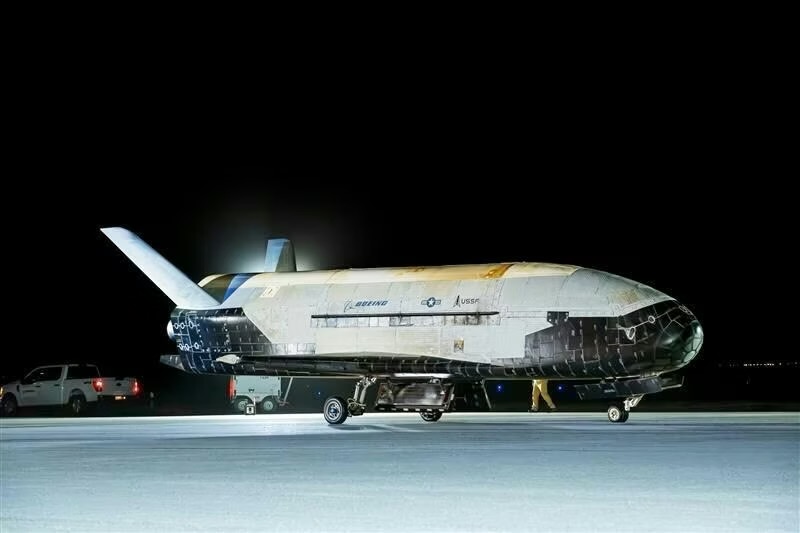
The X37-B Mini-Shuttle Returns to Orbit

Image (Credit): The X37-B space plane. (US Space Force)

While the space shuttles are all safely stored in space museums around the country, the U.S. Space Force’s X37B space plane (or uncrewed mini-shuttle) is still in business.

The spacecraft returned to Earth orbit late last week, launched from the Kennedy Space Center. The X-37B can stay in orbit for multiple years, powered by both batteries and solar cells. The latest launch is the eighth such mission.

While the missions are generally classified, they are thought to be basic experiments to enhance the U.S. Space Forces capabilities. For example, the latest mission is testing a quantum navigation sensor that can detect a spacecraft’s location without GPS. Of course, other have said the spacecraft are spying on the Chinese space station and Russian satellites. It is certainly possible that the little shuttle has been busy with all of this.

The two X-37Bs, called autonomous, reusable orbital test vehicles, were built by Boeing and started flying in 2010, one year before the end of the crewed space shuttles servicing the International Space Station (ISS).

It is odd that Boeing has done so well with this shuttle yet so poorly getting a manned capsule safely to and from the ISS, but maybe it has more to do with the skills of Rockwell International, which build the manned shuttles and was later acquired by Boeing.

Is Ukraine Suggesting an End to US-Russian Cooperation in Space?

In a recent Washington Post editorial titled “How to Shut Down Putin’s War Machine,” Andriy Yermak, who is the head of the presidential office of Ukraine, states that Roscosmos should not be considered as a “neutral civilian institution.” He notes that the space agency helps to guide Russian missile strikes, so it is just another part of the military-industrial complex.

Mr. Yermak goes on to state that Roscosmos “…must be sanctioned in full and banned from cooperating with Western scientific and academic institutions.”

So how would this apply to the International Space Station (ISS), which is clearly a scientific endeavor?

Russia has already threatened to leave the ISS many times, so its departure is something that has been contemplated by the US and Russia. But here we are talking about about pushing them off the station. Will they take their components and head home? Is a partial station solely dependent on the whims of Elon Musk better than a fully-functional station with the Russians?

Of course, a hot war with Russia is something else. Recent threats by both Russia and the US regarding nuclear weapons has not been helpful, but little has really changed on the ground since the initial Russian invasion (much to President Putin’s chagrin).

It is not only Ukraine questioning the Russian presence on the station. Retired NASA astronaut Terry Virts, who served as a commander on the ISS, recently said this to Radio Free Europe:

Cooperating with the Russians on the ISS is like going on an Antarctic expedition with Nazis in 1943…It’s just morally reprehensible.

So far both nations have decided that the current arrangement is working, but that may not last forever if the current spat between the former Russian president and the current American president continue. That would be unfortunate with Russia’s program limping along and the US space program looking at drastic cuts.

The last thing we need is an empty space station orbiting the Earth as a memorial to our foolishness here on the ground.

Business as Usual: Launch of a New Crew to the ISS

Image (Credit): Launch of the SpaceX Falcon 9 rocket from Kennedy Space Center earlier today sending the latest ISS crew into orbit. (NASA)

After a one day delay due to rain, a new crew is heading to the International Space Station (ISS). Earlier today, three astronauts and one cosmonaut departed from Launch Complex 39A at NASA’s Kennedy Space Center in Florida. The crew members are NASA astronauts Zena Cardman and Mike Fincke, Japan Aerospace Exploration Agency (JAXA) astronaut Kimiya Yui, and Roscosmos cosmonaut Oleg Platonov.

Acting NASA Administrator Sean Duffy issued a strange message about “bold leadership,” then praising the launch as though this was something new. He went on to link it to future Moon and Mars missions. I think he is a little too eager to be relevant here.

The bottom line is that this is a typical mission for NASA, showing that the agency can still get a rocket off the ground even as its employees are jumping out of windows (okay, walking out of doors). The Moon and Mars will need to wait for another day (and a new NASA administrator).

The new crew will rendezvous with the ISS early Saturday morning.

Many Departures at NASA, No Clear Path Forward

Credit: Image by Mohamed Hassan from Pixabay.

The problem with a poorly-planned downsizing of an organization is that you may lose too many people in key positions and the disarray demotivates those who remain. Hence, it should be no surprise that this is what we are seeing at NASA as well as other agencies.

NASA is now looking at losing about 20 percent of its workforce, or about 4,000 employees, who have been harassed and prodded towards the door. That represents the loss of an amazing amount of talent. Of course, the White House doesn’t seem to care given its proposed budget cutting NASA’s 2026 budget by about 24 percent.

It will not be long before we have a blame game about “Who lost the Moon?” once China surpasses us in the race to the Moon. We may even be asking “Who lost Mars” now that we have abandoned retrieving a Mars soil sample while China and Japan have plans to bring back Martian soil. All of this is foreseeable to the average person, but for some reason no light seems to penetrate the persistent fog in Washington, DC.

We already read stories about whether Boeing even knows how to build a new airplane, Will we soon have stories about that nation that once put men on the Moon but lost its way?

The United States was behind the Soviets in the space race when it found the will to dream big. I am seeing no signs of dreaming in this nightmarish dismantling of science in this country. We have to work hard to remain ahead of this latest space race, and should we stumble there are plenty of other countries waiting to fill the void.

We are making the same mistake that Russia did when it invaded Ukraine and put its space hopes on hold. The difference here is that we have trained the guns on our own space and science programs.

A Day in Astronomy: China Launches a Puppy into Orbit

Image (Credit): Shan Shan (left) and Xiao Bao. (South China Morning Post)

On this day in 1966, China launched a male puppy named Xiao Bao (meaning Little Leopard) into space. He was used to test the effects of space and was safely recovered after the flight.

Thirteen days later a female puppy named Shan Shan (meaning Coral) was also launched into space. She too was safely recovered.

This is a much better tale than that of Laika, the dog that the USSR sent into orbit in 1957. As stray dog from the streets of Moscow, she only lasted a few hours after the launch, eventually dying of hyperthermia.

Image (Credit): Laika in a training capsule before her mission to space. (Sputnik / Alamy)