Image (Credit): Russia’s MS-19 Mission approaching the ISS yesterday. (NASA)
The International Space Station (ISS) had another visitor on Saturday morning – this time a Russian Soyuz capsule bringing about three tons of food, fuel, and supplies to the station as part of its Progress MS-29 mission (Progress 90 mission to NASA).
The Russian News Agency provided a list of items delivered to the ISS and also noted that the resupply mission also included Christmas gifts for the crew.
Here are the items delivered:
…869 kg of refueling propellant, 420 liters of potable water and 43 kg of pressurized nitrogen, and also 1,155 kg of material and equipment in the dry cargo hold, in particular, for experiments dubbed Vampire (growing crystals in an electric vacuum furnace), BTN-Neutron-2 (studying the neutron spectrum) and 3D Print (3D printing of polymer materials).
It nice that the Russians took the time to assist Santa with his gift giving.
Of course, the U.S. Department of Defense’s North American Aerospace Defense Command (NORAD) will be tracking the actions of Santa here on Earth this year, so be sure to visit the site closer to Christmas next month.
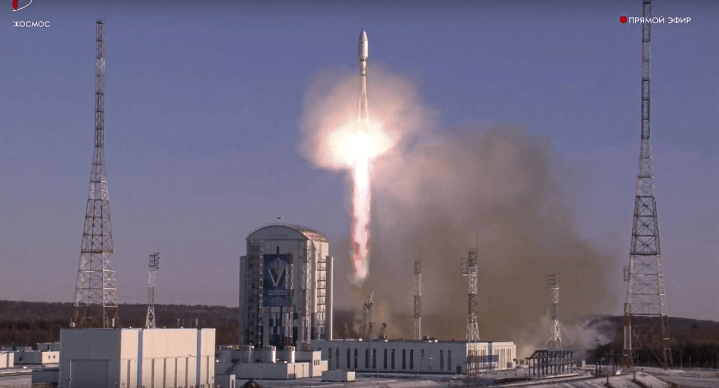
Image (Credit): Russia’s launch of the Kowsar and Hodhod satellites from Vostochny launch-pad in far eastern Russia. (Roscosmos)
While Americans are contemplating this week’s election, the Russians were up to more mischief this week. I am not talking about North Korean soldiers being used to attack Ukraine. I am referring to the Russians launching two Iranian satellites via a Soyuz rocket on Tuesday (yes, the same date as the US election).
One of the satellites is the Kowsar, a high-resolution imaging satellite, and the second the Hodhod, which is a small communications satellite. Both are said to be private sector cubic satellites, representing the first private sector Iranian satellites to be launched to date. Tehran Timesstates that both satellites are being used for agricultural purposes.
Hassan Salarieh, the head of the Iranian Space Agency stated:
Achieving significant goals in this field is unattainable without robust participation from private enterprises. We believe that the private sector should enter this field in a competitive environment, considering market criteria.
The partnership between Russia and Iran regarding potentially dual-use space technology, at a time when both nations are involved in military actions against their neighbors, is not good news for peace.
It was not a good week for the US space industry. One major US space company is looking to exit the business while the head of another US space company is holding secret talks with Putin.
In the first case, Boeing’s bleak finances may be pushing it to consider the sale of its space business, which includes the troubled Starliner capsule most recently stuck at the International Space Station.
Fortune magazine highlighted comments by Boeing’s new CEO, Kelly Ortber, at his first earnings conference call on Wednesday, where he stated:
We’re better off doing less and doing it better than doing more and not doing it well…What do we want this company to look like five and 10 years from now? And do these things add value to the company or distract us?
This follows rumors that Boeing has been talking with Blue Origin about handing off some of its NASA-related portfolio.
It would appear that Boeing, which has been with NASA since the Apollo program, is having some second thoughts about its role in the space program as it deals with Starliner troubles, airplane manufacturing issues, and an ongoing worker strike.
And then we read about Elon Musk having help secret talks with Russia’s Vladimir Putin since at least 2022. You may remember Mr. Musk raised concerns in Washington when it was learned that he turned off his Starlink system when the Ukranians were planning an attack against invading Russian.
Some in Congress are already calling for an investigation into these discussions, given the role of SpaceX in critical Department of Defense contracts. Rep. Adam Smith (D-WA), the House Armed Services Committee’s top Democrat, stated:
We should investigate what Elon Musk is up to to make sure that it is not to the detriment of the national security of the United States.
NASA Administrator Bill Nelson also has some questions, stating:
I don’t know that that story is true. I think it should be investigated…If the story is true that there have been multiple conversations between Elon Musk and the president of Russia, then I think that would be concerning, particularly for NASA, for the Department of Defense, for some of the intelligence agencies.
It has become increasingly apparent that Mr. Musk’s excellence in creating companies will always be trumped by his bone-headed ego. He cannot help but be the center of attention rather than the competent engineer. He should really stay away from social media and social relationships until he can get his ego under control.
As I said, it was not a good week for the US space industry.
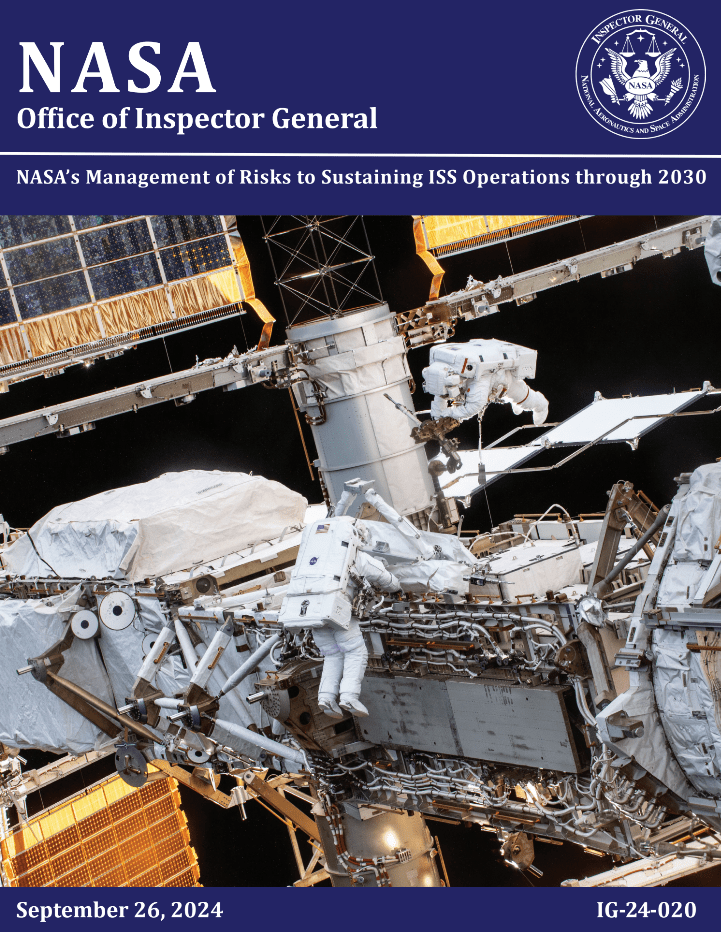
NASA’s Office of Inspect General (OIG) issued an audit report this week, NASA’s Management of Risks to Sustaining ISS Operations through 2030 (IG-24-020), that highlighted the ongoing issues NASA faces to keep the International Space Station (ISS) in orbit as well as plan its decommissioning.
The OIG auditors specifically noted concerns regarding (1) repairing and maintaining the integrity of the station, (2) too little redundancy in the commercial partners carrying crews and supplies to the station, (3) continued risk of micro meteoroids and debris damaging the station, (4) lack of ready-to-use capsules to escape the station in an emergency, and (5) lack of Russian commitment to de-orbiting the station at the end of its life.
That’s a long list of concerns, none of which are surprising given the complexity of the space station and the ongoing environmental issue, be it commercial partners, exterior space, or Russian commitment. It is amazing that the station has had so few major issues to date.
These issues need to be resolved for the current station and be considered as part of any new stations (government-run or commercial), whether they are orbiting the Earth, the Moon, or even Mars.
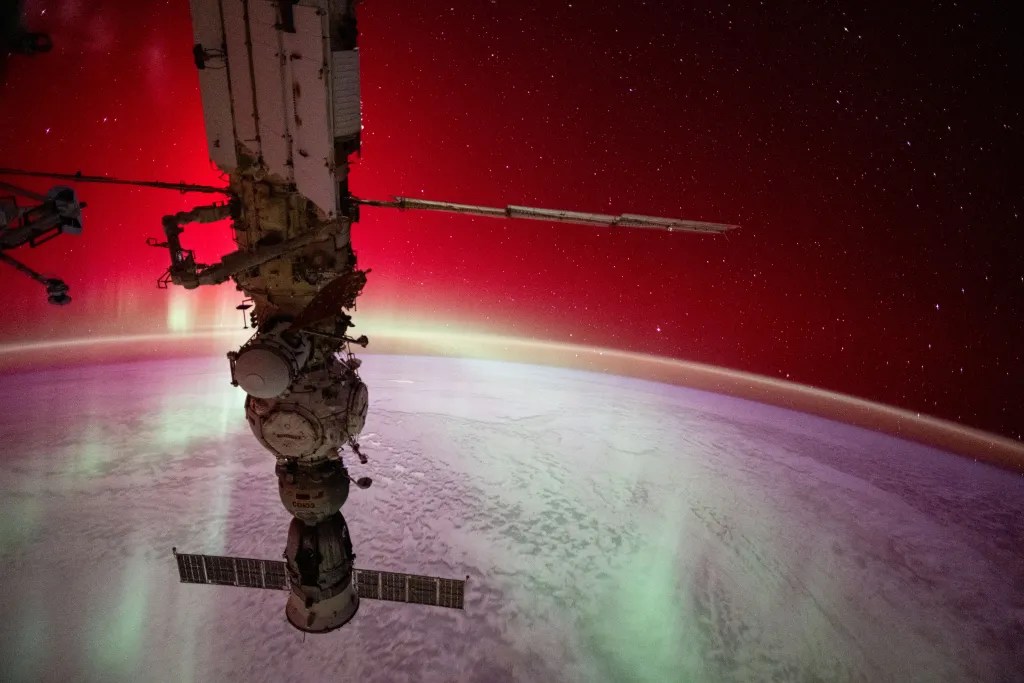
Image (Credit): The Soyuz MS-25 crew ship attached to the ISS as an aurora radiates brightly above the Indian Ocean. (NASA)
Astronaut Tracy C. Dyson is now safely back on Earth thanks to the Russian Soyuz MS-25 spacecraft, which also returned cosmonauts Oleg Kononenko and Nikolai Chub. The no drama return from the International Space Station (ISS) was very different from the recent Boeing Starliner return. The press barely paid attention, which is a good thing.
NASA highlighted Dyson’s six-month tour in this way:
Spanning 184 days in space, Dyson’s third spaceflight covered 2,944 orbits of the Earth and a journey of 78 million miles as an Expedition 70/71 flight engineer. Dyson also conducted one spacewalk of 31 minutes, bringing her career total to 23 hours, 20 minutes on four spacewalks.
I just hope that future Starliner’s can intentionally place astronauts in space for six-months or longer and then return to Earth with little attention. That type of clockwork will be success.


 Our Awesome Universe