Space Quote: A New Threat to Astronauts

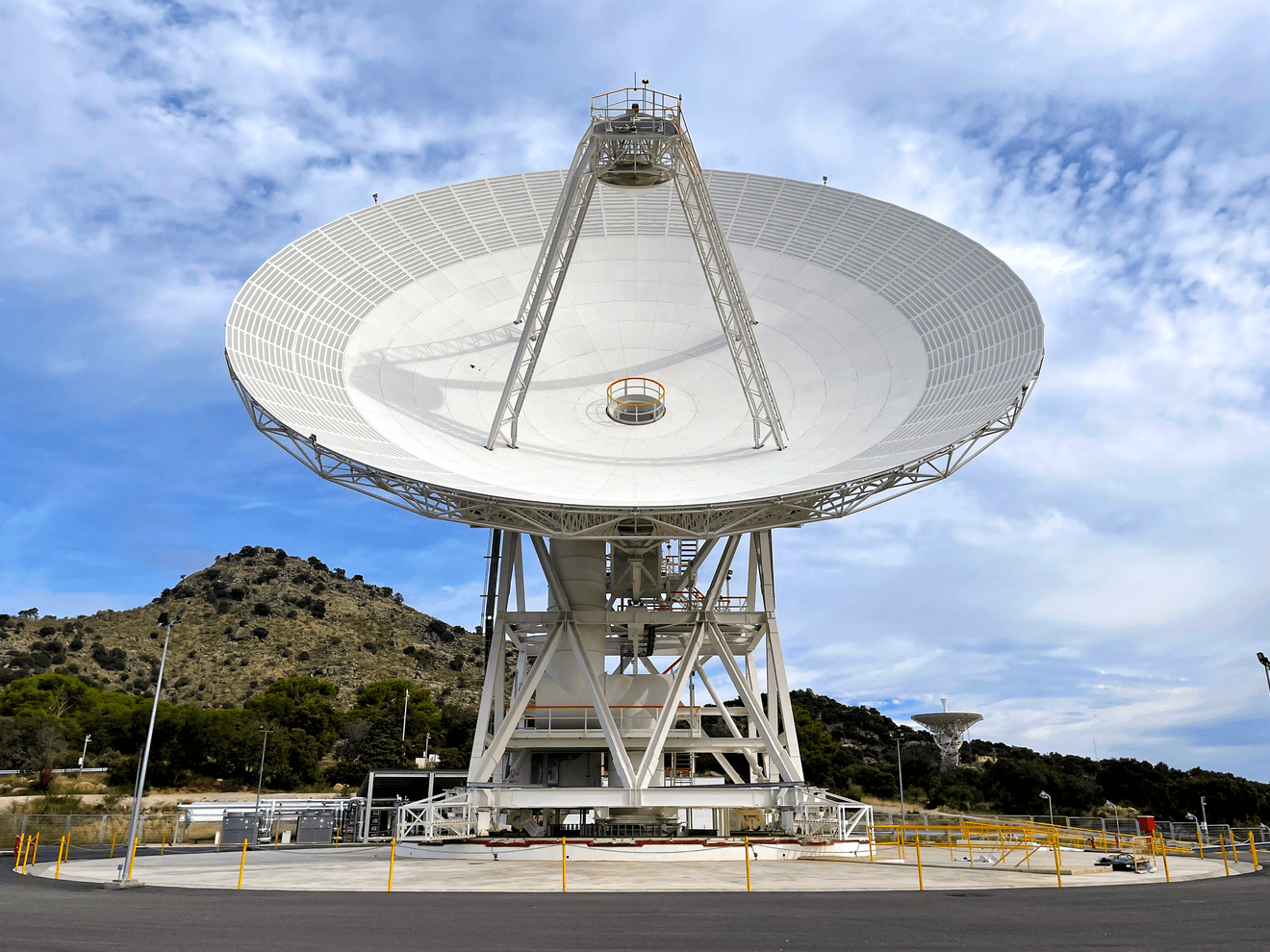
Image (Credit): The DSS-53 antenna at NASA’s Deep Space Network Madrid facility. (NASA/JPL-Caltech)

“And so, any capability that could disrupt that and that could therefore have some impact on services here on Earth and across the world should be of concern to anybody, I think. And including the fact that we have astronauts in — oftentimes in — in low orbit that — that could be at risk from an anti-satellite capability. So, you’re talking about potential human lives here too.”

-Statement during a press briefing by White House National Security Communications Advisor John Kirby regarding reports of a Russian nuclear anti-satellite weapon. Earlier in the week, Ohio Republican Rep. Mike Turner, who serves as the chairman of the House Intelligence Committee, shared sensitive information about this weapon with all Members of Congress.

Pic of the Week: Launch of the PACE Mission

Image (Credit): Engines of the SpaceX rocket carrying the PACE spacecraft into orbit. (SpaceX)

This week’s image is from SpaceX, which launched NASA’s Plankton, Aerosol, Cloud, ocean Ecosystem (PACE) mission into orbit earlier today (the Falcon 9 rocket engines are shown above). 

The spacecraft is designed to monitor the Earth from orbit. NASA explains the mission is this way:

Information collected throughout PACE’s mission will benefit society in the areas of ocean health, harmful algal bloom monitoring, ecological forecasting, and air quality. PACE also will contribute new global measurements of ocean color, cloud properties, and aerosols, which will be essential to understanding the global carbon cycle and ocean ecosystem responses to a changing climate.

The PACE’s mission is designed to last at least three years, though the spacecraft is loaded with enough propellant to expand that timeline more than three times as long.

Space Stories: Finding Water on Mars, Mini Solar Sails, and a Balloon-borne Telescope

Image (Credit): Image of Mars. (NASA)

Here are some recent stories of interest.

Planetary Science Institute: Vast, Potential Ice-Rich Deposit Found in Martian Equatorial Region

A potential ice-rich portion of the Medusae Fossae Formation deposits may contain the largest volume of water in the equatorial region of Mars. Data from the Mars Advanced Radar for Subsurface and Ionospheric Sounding (MARSIS) –  a subsurface radar sounder on the Mars Express orbiter searching for water and studying the Martian atmosphere – reveals layering in the Medusae Fossae Formation (MFF) deposits. These layers are likely due to transitions between mixtures of ice-rich and ice-poor dust, analogous to those in Polar Layered Deposits, according to the paper “Evidence of Ice-Rich Layered Deposits in the Medusae Fossae Formation of Mars” in Geophysical Research Letters. 

University of California: “Small Solar Sails Could be the Next ‘Giant Leap’ for Interplanetary Space Exploration

Nearly 70 years after the launch of the first satellite, we still have more questions than answers about space. But a team of Berkeley researchers is on a mission to change this with a proposal to build a fleet of low-cost, autonomous spacecraft, each weighing only 10 grams and propelled by nothing more than the pressure of solar radiation. These miniaturized solar sails could potentially visit thousands of near-Earth asteroids and comets, capturing high-resolution images and collecting samples.

NASA: “NASA’s GUSTO Prepares to Map Space Between the Stars

On a vast ice sheet in Antarctica, scientists and engineers are preparing a NASA experiment called GUSTO to explore the universe on a balloon. GUSTO will launch from the Ross Ice Shelf, near the U.S. National Science Foundation’s McMurdo Station research base, no earlier than Dec. 21. GUSTO, which stands for Galactic/Extragalactic ULDB Spectroscopic Terahertz Observatory, will peer into the space between stars called the interstellar medium. The balloon-borne telescope will help scientists make a 3D map of a large part of the Milky Way in extremely high-frequency radio waves. Examining a 100-square-degree area, GUSTO will explore the many phases of the interstellar medium and the abundances of key chemical elements in the galaxy.

Space Stories: A Volcanic Moon, an Indian X-ray Launch, and New Chinese Communication Satellites

Image (Credit): JunoCam image of Jupiter’s moon Io during its close encounter. The image was taken at an altitude of about 1,500 miles. (NASA JPL and Southwest Research Institute)

Here are some recent stories of interest.

Forbes: “A NASA Spacecraft Just Had A Close Encounter With A Volcanic Moon—See The Stunning First Image

NASA’s spacecraft Juno just had a super-close encounter with the most volcanic world in the solar system—but its stunning first image could be among its last after 56 orbits of Jupiter. On December 30, the bus-sized spacecraft—orbiting Jupiter since 2016—got very close to Io, the giant moon of Jupiter. It reached a mere 930 miles (1,500 kilometers) from the moon’s surface. However, the spacecraft’s camera has suffered radiation damage and may not last much longer.

Fox51 News: “India Kicks Off 2024 with X-ray Astronomy Satellite Launch

India began 2024 with the launch of an X-ray astronomy satellite aboard the sixtieth flight of its Polar Satellite Launch Vehicle. The PSLV C58 mission lifted off at 9:10 AM local time (03:40 UTC) on Monday, Jan. 1, from the Satish Dhawan Space Centre. XPoSat, or X-ray Polarimeter Satellite, carries a pair of instruments that will be used to study X-ray emissions from astronomical sources. After deploying XPoSat, PSLV C58’s upper stage has remained in orbit as the third flight of the PSLV Orbital Experimental Module (POEM-3), serving as a free-flying platform hosting a range of attached payloads.

SpaceNews: “First Satellite for Chinese G60 Megaconstellation Rolls Off Assembly Line

The first satellite for a second planned Chinese low Earth orbit communications megaconstellation has been produced in new facilities in Shanghai. A new generation flat-panel satellite rolled off the assembly at the G60 digital satellite production factory in Shanghai’s Songjiang District Tuesday, Dec. 27, according to Chinese press reports. The satellite is the first for the G60 Starlink low Earth orbit communications megaconstellation. An initial 108 satellites of a total of around 12,000 G60 Starlink satellites are to be launched across 2024.

ULA is Up for Sale

Image (Credit): ULA’s new Vulcan Centaur rocket. (ULA)

United Launch Alliance (ULA), a space rocket partnership between Boeing and Lockheed Martin, is now being offered for sale. Both Blue Origin and Cerberus are showing interest, which could upset the space business as Blue Origin takes a big step forward or Cerberus gets into the space business.

ULA, formed in 2006, has both a wealth of experience as well as the confidence of the US military, even though SpaceX has been eating into that business. ULA also has ready commercial customers, including a partnership with Amazon to launch 47 rockets to bring the Kuiper broadband constellation into orbit.

The ties to Mr. Bezos, owner of Amazon, go even deeper than that. The ULA’s new rocket, the Vulcan Centaur, will use engines built by Blue Origin, another one of Mr. Bezos’ companies. This may make a Blue Origin a natural new owner to ULA.

The potential buyers may want to wait until the test launch of the Vulcan on January 8th. At that time, the Vulcan rocket will be used to launch the Astrobotic Peregrine commercial lunar lander, the first of NASA’s Commercial Lunar Payload Services initiative designed to deliver science and technology experiments to the lunar surface.

None of this means Boeing or Lockheed Martin are moving away from space altogether. Boeing is still working on its Starliner to bring individuals and cargo to low-Earth orbit as well as its Space Launch System, which serves as the backbone of the Artemis program. Lockheed Martin will be busy as well with its Orion capsule and human landing system (with Blue Origin and Boeing as well), additional key components of the Artemis program.

Any reshuffling is okay as long as it adds to the array of commercial options for NASA. A new player like Cerberus might be welcome, but I also see some value to pushing an experienced and involved Blue Origin to the top of its game a little quicker so it can go head-to-head with SpaceX.

This should be interesting. Stay tuned.