Space Stories: Russia to Re-purpose ISS Section, Second Mars Probe Approaching Lifespan, and Titan’s “Oceans” More Likely Ice

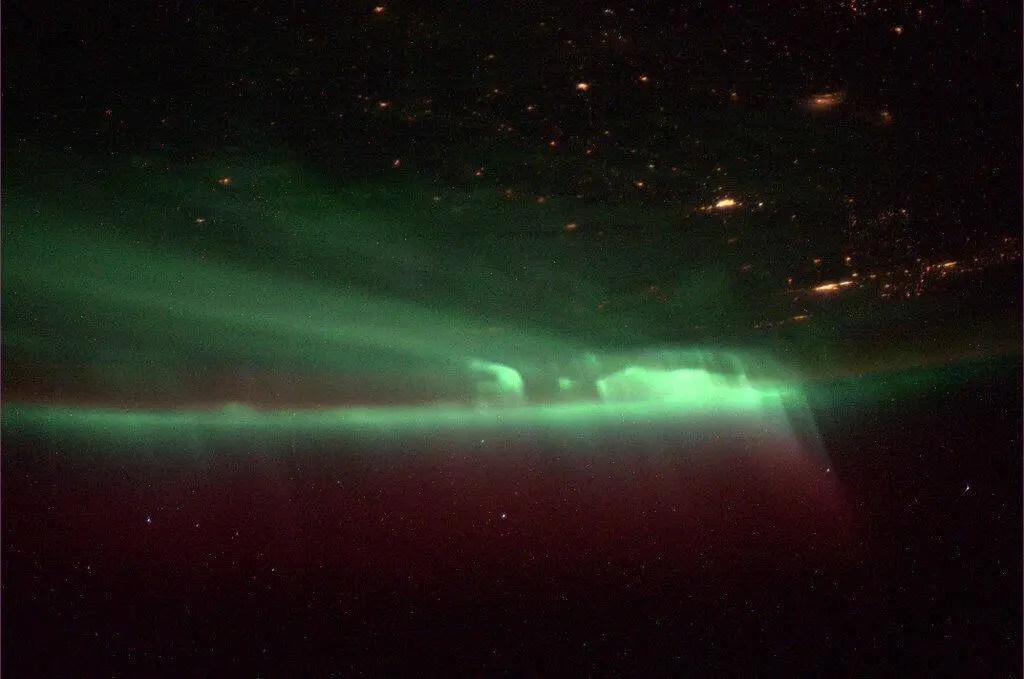
Image (Credit): A portion of the International Space Station’s Russian segment is pictured with docked spacecraft including Europe’s Automated Transfer Vehicle (ATV) and the Soyuz TMA-20 crew vehicle. (NASA)

Here are some recent space-related stories of interest.

ARSTecnica: Russia is About to do the Most Russia Thing Ever with its Next Space Station

For several years now, in discussing plans for its human spaceflight program beyond the International Space Station, Russian officials would proudly bring up the Russian Orbital Station, or ROS…Oleg Orlov, director of the Institute of Biomedical Problems of the Russian Academy of Sciences, said ROS will no longer be composed of entirely new modules. Rather, its core will be the Russian segment of the International Space Station. “The Scientific and Technical Council of Roscosmos supported this proposal and approved the deployment of a Russian orbital station as part of the Russian segment of the ISS,” Orlov reportedly said.

Daily Galaxy: NASA Faces Major Setback: One Mars Orbiter Lost and Another Is Expected to Shut Down Soon!

NASA is losing critical communication links with its Mars missions. After recently losing contact with the MAVEN spacecraft, the agency faces the impending loss of the Mars Odyssey orbiter, which has been circling the Red Planet for over two decades. As both orbiters approach the end of their operational lifespans, NASA will soon have to find ways to maintain data relay capabilities for its rovers and other missions on the fourth planet.

NASA/JPL: NASA Study Suggests Saturn’s Moon Titan May Not Have Global Ocean

A key discovery from NASA’s Cassini mission in 2008 was that Saturn’s largest moon Titan may have a vast water ocean below its hydrocarbon-rich surface. But reanalysis of mission data suggests a more complicated picture: Titan’s interior is more likely composed of ice, with layers of slush and small pockets of warm water that form near its rocky core. Led by researchers at NASA’s Jet Propulsion Laboratory in Southern California and published in the journal Nature on Wednesday, the new study could have implications for scientists’ understanding of Titan and other icy moons throughout our solar system.

Space Stories: Damaged Space Antenna, Dark Matter as Weighty Matter, and a Stable Ocean on Enceladus

Credit: Image by Clker-Free-Vector-Images from Pixabay

Here are some recent space-related stories of interest.

SpaceNews.com: Key Antenna in NASA’s Deep Space Network Damaged

One of the largest antennas in NASA’s Deep Space Network was damaged in September and may be out of service for an extended period, further straining the system. NASA’s Jet Propulsion Laboratory confirmed Nov. 10 that the 70-meter antenna at the Deep Space Network (DSN) site in Goldstone, California, has been offline since Sept. 16, with no timetable for its return to service.

University of Geneva: Dark Matter Does Not Defy Gravity, Study Suggests

Does dark matter follow the same laws as ordinary matter? The mystery of this invisible and hypothetical component of our universe—which neither emits nor reflects light—remains unsolved. A team involving members from the University of Geneva (UNIGE) set out to determine whether, on a cosmological scale, this matter behaves like ordinary matter or whether other forces come into play. Their findings, published in Nature Communications, suggest a similar behavior, while leaving open the possibility of an as-yet-unknown interaction. This breakthrough sheds a little more light on the properties of this elusive matter, which is five times more abundant than ordinary matter.

University of Oxford: Saturn’s Icy Moon May Host a Stable Ocean Fit for Life, New Study Finds

A new study led by researchers from Oxford University and Southwest Research Institute and the Planetary Science Institute in Tucson, Arizona has provided the first evidence of significant heat flow at Enceladus’ north pole, overturning previous assumptions that heat loss was confined to its active south pole. This finding confirms that the icy moon is emitting far more heat than would be expected if it were simply a passive body, strengthening the case that it could support life.

Space Stories: Earth’s Second Moon, Organic Molecules on Enceladus, and Mysterious Gullies on Mars

Image (Credit): Earth as observed by the Apollo 11 spacecraft. (NASA/JSC)

Here are some recent space-related stories of interest.

The Economic Times: NASA Confirms Earth Has a Second Moon, And It Will Stay With Us Until 2083

Earth has received a new cosmic partner, a small asteroid designated as 2025 PN7. NASA confirmed this week that the object, initially found by the University of Hawaii, qualifies as a “quasi-moon” , an uncommon type of celestial body that moves almost similarly in sync with Earth. While not a real moon, it has a similar orbit surrounding the Sun, seeming to shadow our planet as it travels through space. Researchers estimate the asteroid measures 18 to 36 meters wide, approximately the height of a small building, making it small by cosmic standards but noteworthy for Earth’s extended neighborhood.

Sky&Telescope: New Study Identifies Organic Molecules Spewing from Saturn’s Icy Moon Enceladus

Twenty years after the Cassini spacecraft discovered an ocean under the icy surface of Saturn’s moon Enceladus, a new study of previously collected data hints at a much better chance for habitability. The change comes from recording how a plume of ice grains hit Cassini just minutes after it erupted from the moon. The close encounter exposed organic compounds not previously seen on Enceladus.

Utrecht University: “Mysterious Gullies on Mars Appear to Have Been Dug, But by Whom or What?

Did life really exist on Mars after all? Unfortunately, there is no conclusive evidence for this yet. Nevertheless, it would seem that some form of life was the driving force behind the mysterious Martian dune gullies. Earth scientist Dr Lonneke Roelofs from Utrecht University has investigated how these gullies were formed. In a test setup, she observed that blocks of CO2 ice ‘dug’ these gullies in a unique way. “It felt like I was watching the sandworms in the film Dune.”

Space Stories: Dragonfly Issues, NASA Under a Government Shutdown, and Threats from Venus

Image (Credit): Artist’s rendering of the Dragonfly on Titan. (NASA/Johns Hopkins APL)

Here are some recent space-related stories of interest.

Physics World: NASA Criticized Over its Management of $3.3bn Dragonfly Mission to Titan

An internal audit has slammed NASA over its handling of the Dragonfly mission to Saturn’s largest moon, Titan. The drone-like rotorcraft, which is designed to land on and gather samples from Titan, has been hit by a two-year delay, with costs surging by $1bn to $3.3bn. NASA now envisions a launch date of July 2028 with Dragonfly arriving at Titan in 2034.

USAToday: Do Rockets Still Launch During a Government Shutdown? How NASA Could Feel the Effects

NASA is far from immune to the effects of a looming government shutdown if congressional leaders fail to reach an agreement before midnight Oct. 1 to prevent one. At stake for the U.S. space agency if the federal government grinds to a halt? The progress of many of its science missions and access to its public outreach arm. NASA’s contingency plan for a shutdown, outlined in a guide from 2018, emphasizes that only “activities which are necessary to prevent harm to life or property” would be exempt from ceasing operations during a shutdown.

Earth Sky: “‘Invisible’ Asteroids Near Venus: A New Danger to Earth?

Astronomers across the globe are dedicated to identifying the near-Earth asteroids that could one day impact our planet. But there might be a group of potentially dangerous nearby asteroids that have remained invisible to astronomers so far. On September 24, 2025, an international team of researchers at the São Paulo State University (UNESP) in Brazil said that a group of asteroids sharing Venus’ orbit could have remained undetected so far due to their location in the sky. And they could pose a threat to Earth within a few thousand years.

Space Stories: Mystery on Saturn, an Interstellar Visitor, and Hunting a Rogue Planet

Image (Credit): Saturn as captured by NASA’s Cassini spacecraft on February 9, 2004 (NASA/JPL/Space Science Institute)

Here are some recent space-related stories of interest.

New Scientist: Did Something Just Hit Saturn? Astronomers Are Racing to Find Out

Something may have just hit Saturn – and, if so, an amateur astronomer could hold the key to confirming the event, which would be the first ever recorded on the gas giant. About seven asteroids or comets are estimated to impact Saturn every year, but no such event has ever been caught on camera. Now, NASA employee and amateur astronomer Mario Rana has recorded images that appear to show just that.

Astronomy.com: Astronomers Race to Learn More About Third Interstellar Visitor

Astronomers have spotted an object from outside our solar system bolting toward the Sun at around 150,000 mph (240,000 km/h). The big, frozen ball of ice and dust presents a rare chance to study an object that formed around an alien solar system, and potentially much earlier in the Milky Way’s history. The object named 3I/ATLAS — “3I” because it’s the third interstellar object detected so far, and “ATLAS” in honor of the system of telescopes that revealed it, the Asteroid Terrestrial-impact Last Alert System. Because the object is also showing tentative signs of cometary activity, it has also been designated C/2025 N1 (ATLAS).

Universe Today: Old Hubble Space Telescope Photos Unlock the Secret of a Rogue Planet

Astronomers have achieved a first in exoplanet hunting by using the Hubble Space Telescope images to investigate a mysterious event that could reveal the existence of a “rogue planet” drifting through space without a host star. The discovery centers on a brief astronomical phenomenon with the catchy name OGLE-2023-BLG-0524, detected in May 2023 by ground-based telescopes. The event lasted just eight hours and was caused by gravitational microlensing, an effect predicted by Einstein where a massive object acts like a magnifying glass in space, briefly brightening the light from a more distant object as it passes in front.