Space Stories: NASA Spinoffs, Moving the NASA HQ to Ohio, and the Many Moons of Saturn

Credit: NASA

Here are some recent stories of interest.

NASA: NASA Releases its Spinoff 2025 Publication

The work NASA conducts in space leads to ongoing innovations benefiting people on Earth. Some of these latest technologies, which have been successfully transferred from NASA to the commercial sector, are featured in the latest edition of Spinoff 2025 publication now available online. The publication features more than 40 commercial infusions of NASA technologies, including research originated at NASA’s Glenn Research Center in Cleveland.

Cleveland.com: NASA Urged to Move Headquarters to Ohio as D.C. Lease Expires

When the National Aeronautics and Space Administration‘s lease on its current Washington, D.C. headquarters expires in 2028, Ohio members of Congress want NASA to move its headquarters to Ohio. In a Tuesday letter to Vice President JD Vance and President Donald Trump’s nominee to be NASA Administrator, Jared Isaacman, Ohio Congress members argue that bringing the headquarters of the nearly 18,000 employee agency to their state would align with broader government efforts to decentralize federal agencies and reinvigorate parts of the country outside Washington.

USA Today: Moon King: Astronomers Discover 128 New Moons Orbiting Saturn. Here’s What We Know.“

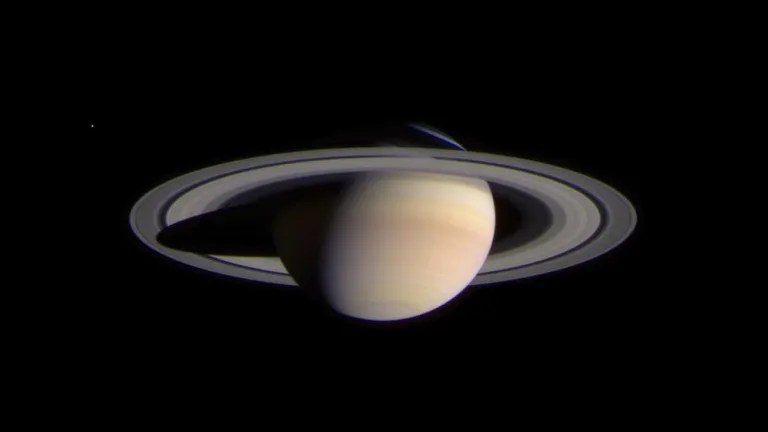
Astronomers have discovered 128 new moons orbiting Saturn, further solidifying the planet as the “moon king” of our solar system. Astronomers from Taiwan, Canada, France and the U.S. announced the discovery on Tuesday. The findings push Saturn’s moon count to 274, towering over the previous record-holder Jupiter, which has 95 moons. The recent discovery points to what astronomers have speculated for decades, that Saturn’s rings were caused by a massive collision about 100 million years ago, researcher Mike Alexandersen, an astronomer at the Center of Astrophysics, told USA TODAY. A collision of such size could explain the small moons that orbit Saturn.

Movie: Slingshot

Credit: bleeckerstreetmedia.com

Just in time for the Labor Day weekend, we are offered a new space film that seemed to have had little publicity until it popped onto the scene. The new film Slingshot, starting today and starring Casey Affleck and Laurence Fishburne, takes us on a trip to Saturn’s moon Titan, or that is the plan.

Here is the general story (and trailer):

A psychological thriller starring Casey Affleck and Laurence Fishburne, SLINGSHOT follows an elite trio of astronauts aboard a years-long, possibly compromised mission to Saturn’s moon Titan. As the team gears up for a highly dangerous slingshot maneuver that will either catapult them to Titan or into deep space, it becomes increasingly difficult for one astronaut to maintain his grip on reality.

The trailer indicates plenty of issues with both the hardware and software – the softest ware being the mind of man on a distant voyage. Yes, we have another story about the struggle of man with himself, with space playing a supporting actor.

Fortunately, we are not dealing with a film that questions the space program, but NASA may be pleased that it is sending a robot to study Europa rather than taking chances with such fragile humans.

Here are a few of the available reviews:

Austin Chronicle:

The derivative look and feel of Slingshot – a little bit of Interstellar, a dash of 2010: The Year We Make Contact for whenever Håfström wants to add some grit, and most especially Steven Soderbergh’s Solaris remake – make it unclear exactly what kind of movie Håfström is trying to make.

The Hollywood Reporter:

It’s fairly boilerplate material, and Håfström frankly seems more interested in exploring John’s memories, nightmares, visions and wavering psyche..If you put aside all the space stuff, Slingshot is basically a one-set, one-character thriller that constantly tests the viewer’s belief in what’s happening.

RogerEbert.com:

It feels like a movie that hates its characters. And hates you too.

Now the movie has some publicity, but maybe not the type it wanted.

Go for the special effects rather than the plot.

That might work.

Space Stories: More Water on Mars, Senators Want Mars Sample Returned to Earth, and the ESA Considers Mission to Enceladus

Here are some recent stories of interest.

Euronews: Photos from NASA’s Curiosity Rover Suggest Mars had More Water for Longer Than Previously Thought

Scientists say Mars may have had more water and stayed wet for longer than they had previously estimated based on photos from NASA’s Curiosity rover. An international team of researchers led by Imperial College London recently found unusual formations in rock and sediment in unexpected places in the crater. The rocks allow scientists to compare the evolving geology of Mars with Earth.

U.S. Senate: Padilla, Butler Urge NASA to Fully Fund Mars Sample Return Program

Today, U.S. Senators Alex Padilla and Laphonza Butler (both D-Calif.) wrote to NASA Administrator Bill Nelson urging him to allocate the full $650 million necessary to fund the Mars Sample Return (MSR) mission in NASA’s FY24 spending plan. The Senators are issuing the letter following the passage of the FY 2024 appropriations package, which reiterated Congress’ strong commitment to the MSR mission.

European Space Agency: Saturn’s Moon Enceladus Top Target for ESA

A fresh, icy crust hides a deep, enigmatic ocean. Plumes of water burst through cracks in the ice, shooting into space. An intrepid lander collects samples and analyses them for hints of life. ESA has started to turn this scene into a reality, devising a mission to investigate an ocean world around either Jupiter or Saturn. But which moon should we choose? What should the mission do exactly? A team of expert scientists has delivered their findings...Aiming for transformational science, considering the characteristics of each moon and future planned missions to Jupiter and Saturn’s ocean worlds, the scientists identified Saturn’s moon Enceladus as the most compelling target, followed by Saturn’s moon Titan and then Jupiter’s moon Europa.

Study Findings: A Recently Formed Ocean Inside Saturn’s Moon Mimas

Image (Credit): Saturn’s moon Mimas and its large Herschel Crater. The moon is also referred to as the “Death Star” from Star Wars. (NASA/JPL-Caltech/Space Science Institute)

Nature  abstract of the study findings:

Moons potentially harbouring a global ocean are tending to become relatively common objects in the Solar System. The presence of these long-lived global oceans is generally betrayed by surface modification owing to internal dynamics. Hence, Mimas would be the most unlikely place to look for the presence of a global ocean. Here, from detailed analysis of Mimas’s orbital motion based on Cassini data, with a particular focus on Mimas’s periapsis drift, we show that its heavily cratered icy shell hides a global ocean, at a depth of 20–30 kilometres. Eccentricity damping implies that the ocean is likely to be less than 25 million years old and still evolving. Our simulations show that the ocean–ice interface reached a depth of less than 30 kilometres only recently (less than 2–3 million years ago), a time span too short for signs of activity at Mimas’s surface to have appeared.

Citation: Lainey, V., Rambaux, N., Tobie, G. et al. A recently formed ocean inside Saturn’s moon Mimas. Nature 626, 280–282 (2024).
https://doi.org/10.1038/s41586-023-06975-9

Study-related stories:

Space Quote: Has the JWST Changed Astronomy Forever?

Image (Credit): On June 25, 2023, NASA’s James Webb Space Telescope conducted its first near-infrared observations of Saturn using its Near-Infrared Camera. (NASA, ESA, CSA, Matthew Tiscareno (SETI Institute), Matthew Hedman (University of Idaho), Maryame El Moutamid (Cornell University), Mark Showalter (SETI Institute), Leigh Fletcher (University of Leicester), Heidi Hammel (AURA))

“Physicists and astronomers are starting to get the sense that something may be really wrong. It’s not just that some of us believe we might have to rethink the standard model of cosmology; we might also have to change the way we think about some of the most basic features of our universe — a conceptual revolution that would have implications far beyond the world of science.”

-Statement by guess essayists Adam Frank and Marcelo Gleiser in a New York Times article about the James Webb Space Telescope titled “The Story of Our Universe May Be Starting to Unravel.” Dr. Frank is an astrophysicist at the University of Rochester. Dr. Gleiser is a theoretical physicist at Dartmouth College.