A Day in Astronomy: The Birth of Ursula Le Guin

On this day in 1929, Ursula K. Le Guin was born in Berkeley, California. She would gain her masters degree in French only to later become a well known author of many fantasy and science fiction stories, including the Earthsea series and stories set in a Hainish universe of her making. She would go on to win eight Hugo Awards and six Nebula Awards.

Her style was different from many other authors of her period, focusing more on planetary culture than spacecraft hardware. When asked about her style, she stated the following:

The “hard”–science fiction writers dismiss everything except, well, physics, astronomy, and maybe chemistry. Biology, sociology, anthropology—that’s not science to them, that’s soft stuff. They’re not that interested in what human beings do, really. But I am. I draw on the social sciences a great deal. I get a lot of ideas from them, particularly from anthropology. When I create another planet, another world, with a society on it, I try to hint at the complexity of the society I’m creating, instead of just referring to an empire or something like that.

Given that her mother an anthropologist, it is not surprising that she saw a different way of telling story.

Her books represented a unique part of the science fiction genre that has only expanded over time as the writing community has expanded.

If you need an entry point to her work, you cannot go wrong starting with the short story “The Ones Who Walk Away from Omelas.” However, one of my favorite short stories is “The Island of the Immortals,” which you can find here.

I doubt you will be able to stop with one short story.

A Day in Astronomy: Happy Star Trek Day!

Credit: OpenClipart-Vectors from Pixabay

Today we remember the beginning of the Star Trek phenomenon that started back on September 8, 1966 with the introduction of the Star Trek television series. Created by Gene Roddenberry, the series initiated books, movies, and more over the years that provided a positive vision of our future in space, though it came after some rough lessons (world war) and still posed constant challenges (Klingons, Borg, Cardassians, and others).

Gene Roddenberry once said:

Star Trek was an attempt to say that humanity will reach maturity and wisdom on the day that it begins not just to tolerate, but take a special delight in differences in ideas and differences in life forms. […] If we cannot learn to actually enjoy those small differences, to take a positive delight in those small differences between our own kind, here on this planet, then we do not deserve to go out into space and meet the diversity that is almost certainly out there.

Wise words during the turmoil of the 1960s as well as the turmoil of today.

A Day in Astronomy: The Birth of Ray Bradbury

On this day in 1920, Ray Douglas Bradbury was born in Waukegan, Illinois. Mr. Bradybury would grow up to be a famous American author and screenwriter.

One of his science fiction works,The Martian Chronicles stories, tells the story of mankind’s colonization of Mars and the ultimate effect on the colonizers.

He wrote numerous other famous books and short story collections, including Fahrenheit 541, Something Wicked This Way Comes, The Illustrated Man, and Dandelion Wine.

Speaking on science fiction, Mr. Bradbury once stated:

Science fiction is any idea that occurs in the head and doesn’t exist yet, but soon will, and will change everything for everybody, and nothing will ever be the same again. As soon as you have an idea that changes some small part of the world you are writing science fiction. It is always the art of the possible, never the impossible.

Asked in a 2004 interview what he thought about the US space program, he stated:

It’s too late, isn’t it? We’ve let 30 years go by. It’s stupid. It’s stupid. We should have stayed on the moon. We should have made moon the base, instead of building space stations, which are fragile and which fly apart. The moon is a good, solid base to build a space travel organization in the community. Then we take off from the moon and we go to Mars. But it’s terribly late. We’ve let too much time go by. We’ve been busy with war instead of being busy with peace. And that’s what space travel is all about. It’s all about peace and exploration and wonder and beauty.

Fortunately, it is not too late to visit the Moon or Mars, as demonstrated by NASA’s Artemis program. It’s the art (and science) of the possible.

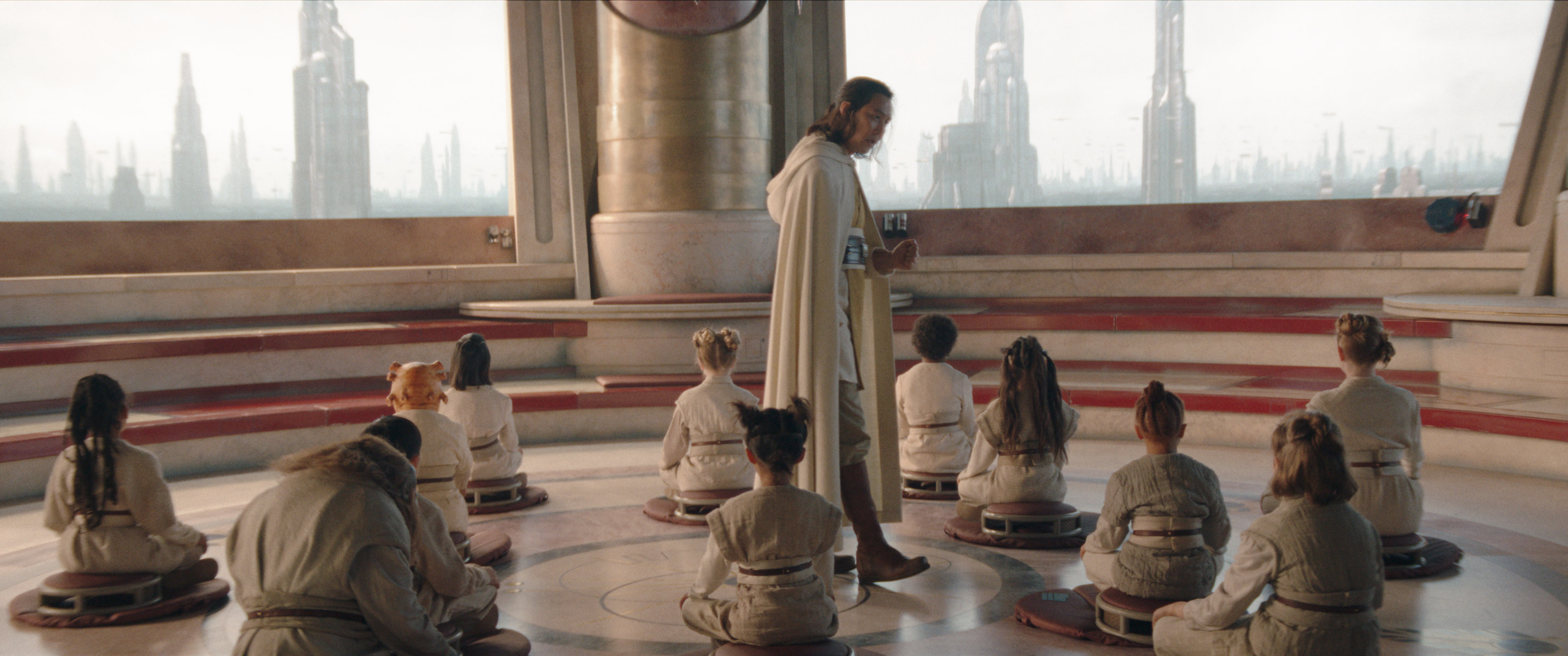
Television: The End of The Acolyte

Image (Credit): Scene from Disney’s Star Wars: Acolyte television series. (Lucasfilm)

I cannot say I am surprised that Disney’s new Star Wars television series The Acolyte has been cancelled after only one season. I watched a few episodes and gave up.

Given that Disney has decided to spread the Star Wars series very thin over multiple storylines, it seems that the goal has been more TV rather than better TV. Even the trick of dropping in the occasional cameo, be it Luke Skywalker or various versions of Darth Vader, has worn thin.

So while the first series, The Mandalorian, is going into its fourth season, the other series are more or less limping along. The best of the lot, Andor, missed 2024 completely and will have its second and last season next year. What if Disney had concentrated more on Andor and less on these other spin-offs (The Book of Boba Fett, Obi-Wan Kenobi, and Ahsoka)? Maybe we would be talking about season three of Andor and the franchise would have some new and true fans.

With all of this busyness with little to show for it, I was surprised to read that Disney was putting out a Mandalorian feature film that mashes together some of the television storylines. Are we now milking to death the still struggling offspring of the Star Wars family? Why?

Disney needs to use its cash and creative talent to come up with new sci-fi series. Look at The Expanse for some ideas or just visit the sci-fi section of the library.

All I know is that turning Star Wars into a money pit is not the way to go.

Movie Quote: Not Such an Alien World

Image (Credit): A scene from the movie Alien: Romulus. (20th Century Studios)

The production design harkens back to both Scott and Cameron’s ALIEN movies. It’s a world we recognize so there’s not much new world-building except for the brief glance at an active mining colony. What’s different is the cinematography by Galo Olivares…ALIEN: ROMULUS works as a stand-alone movie, and is probably a better experience if you come in cold, without any knowledge of the franchise. ALIEN fans bring in too much baggage and rarely can we be satisfied.”

-Statement by movie critic Lupe R Haas in her recent review of the film Alien: Romulus.