The Associated Press reports that “hundreds” of NASA employees have decided to leave the agency. This follows layoffs last year at the Jet Propulsion Laboratory as well as recently announced layoffs at Boeing associated with the Space Launch System. This does not instill confidence in NASA’s ability to meet its upcoming mission goals.
The same report notes that NASA will now be undergoing an review by Musk’s Department of Government Efficiency (DOGE), which recently decided to dump all foreign assistance based on false stories and an incomplete understanding of the role of foreign aid in our foreign policy. What is the chance that Musk, who will be involved in the DOGE review no matter what the White House states, will find merit in contracts to SpaceX while questioning other contracts?
If this was Russia, we would roll our eyes at such sham reviews. Why are we accepting it here? Is there any interest in good science, or is NASA like the oil industry in Russia – something useful to line the pockets of the connected?
Maybe its time to leave the search for extraterrestrial intelligence (SETI) to one side and start asking whether intelligent life is something quickly disappearing here on Earth. Though it may be worth noting that even SETI funding was cut by the Republican Congress years ago.
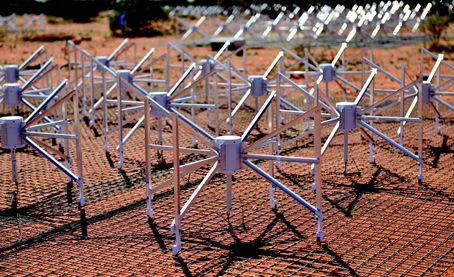
The SETI Institute, the Berkeley SETI Research Center and the International Centre for Radio Astronomy Research announced a groundbreaking study using the Murchison Widefield Array (MWA) in Western Australia. Led by Dr. Chenoa Tremblay of the SETI Institute and Prof. Steven Tingay of Curtin University, this research is the first to search for signs of alien technology in galaxies beyond our own, focusing on low radio frequencies (100 MHz).
This innovative study used the MWA’s large field of view (FOV), allowing the team to cover about 2,800 galaxies in one observation, of which 1300 we know the distance to. Usually, the search for extraterrestrial intelligence (SETI) has focused on signals within our galaxy. This new approach goes further, looking at distant galaxies. This new approach looks at distant galaxies, making it one of the most detailed searches for super civilizations—those more advanced than ours. To send a signal from another galaxy, a civilization would need technology powerful enough to use the energy of their sun or several stars in their galaxy.
NASA needs some help with frozen liquid. As part of the space agency’s planned trip to the moon as part of the Artemis mission, NASA is looking for a way to store “super-chilled” propellants for months on end. They’re asking college students for help. Announced earlier this month, NASA’s 2025 Human Lander Challenge (HuLC) is open for submissions. The competition, now in its second year, is asking for students to develop innovative methods for “in-space cryogenic liquid storage.”
A citizen science project, which invites members of the public to take part in identifying cosmic explosions, has already identified 20 new astronomical discoveries. Over 2,000 volunteers across 105 different countries have worked on 600,000 classifications over a six-month period. The project ‘Kilonova Seekers’ aims to find kilonovae – the cosmic explosions of neutron stars and black holes colliding in distant galaxies. Volunteers are asked to play ‘spot the difference’ using data from the two Gravitational-wave Optical Transient Observer (GOTO) telescopes, which are located on opposite sides of the planet – on La Palma, in Spain’s Canary Islands, and Australia’s Siding Spring Observatory.
If you saw the recent film The Holdovers, you witnessed Paul Giamatti at the top of his game as a private school instructor (which earned him an Oscar nomination).
But if you would like to learn about another side of Mr. Giamatti, then you may want to check out his podcast with Stephen Asma called Chinwag. It is by no means a science or an astronomy podcast, yet it is a fun collection of conversations that often touch on related topics and guests, be it topics such as UFOs and the Drake Equation, or guests including astronaut Mike Massimino, writer Ted Chiang, and actor William Shatner.
Yes, there is plenty here about the occult and mind-numbing drugs, but I recommend you sift though some of this to find the gems. Below are a few of the episodes you may want to try, but don’t expect William Shatner to talk about Captain Kirk and space travel. He is too busy sharing stories about spiritualism, drugs, and his early acting career.
Paul and Stephen dig into our Chinwag mailbag for this SETI-inspired question (that’s Search for Extraterrestrial Intelligence to any novice listeners). The Drake Equation is explained and let’s just say there’s A LOT of math involved.
It’s been 60+ years since last estimates were made on the odds of finding intelligent life in the Milky Way, and Chinwag listener Rick B. wants to know, how long could a civilization broadcast its presence through technology, and what current factors might affect a civilization’s ability to remain detectable? Is there a ticking clock to our existence, and what’s Twinkie-lung got to do with all this?
In this Chinwag, Paul and Stephen are thrilled to be subject to fascinating thought experiments by award-winning fiction writer Ted Chiang. Up for the discussion?
The difference between fact and fiction when it comes to the existence of alien life, and whether Paul is indeed an assassin because he played one in an action film Ted once saw. Imaginations are running amok and people can’t differentiate between what’s real and what isn’t. Is social media to blame or was The National Enquirer the social media of yester-year? Online echo chambers and the dangerous speed of information may be a culprit for conspiracy theories. And is belief in aliens and monsters in pop culture a direct response to higher anxiety levels and an externalization of neuroses? Then, what is singularity and was it born with the invention of the wheel?
Paul and Stephen are happy to learn that Ted’s not afraid that AI will take over, but the natural desire to do less work may lead to more romances between humans and AI robots. So buckle up and plug in your lady-cyborg and get ready for an all new fascinating Chinwag!
Paul and Stephen are obsessed with UFOs and life beyond earth–so who better to add to the conversation than a guy who’s been to space twice?
This week, our intrepid Chinwaggers are joined by former NASA astronaut Mike Massimino, a man who decided that a fear of heights would be best overcome by a trip to space. In this week’s classified file: space toilets, robot arms, and why there should never be more than one comedian per space shuttle.
Stephen Asma and Paul Giamatti are giddy to speak with lifelong hero and Star Trek alum William Shatner on tequila tastings, space travel, bum drug trips, holding on to your inner child and that time he beat up an Australian Olympic swimmer on stage.
If you looking for some deep probes into astronomy studies and discussions, then you may want to visit the Centauri Dreams site. The site’s focus is about the possibility of interstellar travel at some point in the future.
Alpha Centauri and other nearby stars seem impossible destinations not just for manned missions but even for robotic probes like Cassini or Galileo. Nonetheless, serious work on propulsion, communications, long-life electronics and spacecraft autonomy continues at NASA, ESA and many other venues, some in academia, some in private industry. The goal of reaching the stars is a distant one and the work remains low-key, but fascinating ideas continue to emerge. This site will track current research. I’ll also throw in the occasional musing about the literary and cultural implications of interstellar flight. Ultimately, the challenge may be as much philosophical as technological: to reassert the value of the long haul in a time of jittery short-term thinking.
Mr. Gilster has a way of walking you through some dense scientific papers that makes them come alive, in part by bringing in additional information and insights to make it all relatable (that is, as much as possible).
Some of his recent articles include:
—Close Stellar Encounters and Earth’s Orbit: The essay notes the continual changes of stars in our neighborhood over time, including one that may venture close enough to enter our solar system’s Oort Cloud:
Stars do indeed get that close, as the example of Gliese 710 shows. If we’re patient, we can wait out the 1.3 million years it is projected for this to happen, for this star, on the borderline between M-dwarf and K-class, is headed our way from its current vantage in the constellation Serpens Cauda. As it will eventually be well inside the Oort Cloud, we can imagine quite an impact on cometary orbits and planetary ones as well over the long haul, as the paper I’m about to discuss shows.
—To the Stars with Human Crews?: The essay discusses the potential role of solar sails in space travel, the ideas of both NASA’s Les Johnson and American physicist and science fiction writer Robert L. Forward, and various science fiction stories trying to envision such sails connecting humans with other planetary systems.
—Alone in the Cosmos?: The essay discusses Louis Friedman’s new book Alone But Not Lonely: Exploring for Extraterrestrial Life, pulling apart various points for greater discussion.
In discussing the likelihood of finding intelligent life elsewhere, Mr. Gilster states:
The point is simply to cast something as evidently evanescent as our human culture against the inexorable backdrop of geological time. And to contrast even that with a galaxy that is over 13 billion years old, where processes like these presumably occurred in multitudes of stellar systems. What are the odds that, if intelligence is rare, two civilizations would emerge at the same time and live long enough to become aware of each other?
These are just a few of the many interesting articles that you can find on the site. Just roll through the collection of essays and I am sure you find plenty to capture your imagination for some time to come.
Fine dust from pulverized rock generated by the Chicxulub impact likely played a dominant role in global climate cooling and the disruption of photosynthesis following the event. This is suggested by a new study published in Nature Geoscience, in which researchers Cem Berk Cenel, Özgür Karatekin and Orkun Temel of the Royal Observatory of Belgium contributed.
A team of Spanish astronomers is leading the investigation into one of stargazing’s most perplexing mysteries. Three bright stars photographed in the night sky above southern California in 1952 vanished just an hour later. Generations of scientists have sought to explain the rare phenomenon over the past half-century, but nothing has yet convinced the community. Researchers at the Centre for Astrobiology (CAB) in Madrid tried to solve the riddle of the “triple transient” that has “remained absent from telescope exposures for 71 years” in a new paper published online.
A stable-frequency transmitter with relative radial acceleration to a receiver will show a change in received frequency over time, known as a ‘drift rate.’ For a transmission from an exoplanet, astronomers must account for multiple components of drift rate: the exoplanet’s orbit and rotation, the Earth’s orbit and rotation, and other contributions. Understanding the drift rate distribution produced by exoplanets relative to Earth, can help scientists constrain the range of drift rates to check in a Search for Extraterrestrial Intelligence (SETI) project to detect radio technosignatures, and help them decide validity of signals-of-interest, as they can compare drifting signals with expected drift rates from the target star. In a new study, University of California, Los Angeles astronomer Megan Grace Li and colleagues modeled the drift rate distribution for over 5,300 confirmed exoplanets, using parameters from the NASA Exoplanet Archive.




 Our Awesome Universe