Image (Credit): Members of the Soyuz MS-25 crew – commander Oleg Novitskiy (bottom), NASA astronaut Tracy Dyson (middle), and Belarus guest cosmonaut Marina Vasilevskaya (top). (NASA/Bill Ingalls)
Earlier today, a Russian Soyuz rocket launched into space to bring three new crew members to the International Space Station (ISS).
The passengers on today’s delayed flight are cosmonauts Oleg Novitskiy and Marina Vasilevskaya as well as NASA astronaut Tracy Dyson. They are expected to board the ISS on Monday.
Astronaut Dyson, who plans to stay on the station for six months, will assist her fellow astronauts on the ISS with a variety of experiments, including “…[s]tudies of neurological organoids, plant growth, and shifts in body fluids,”
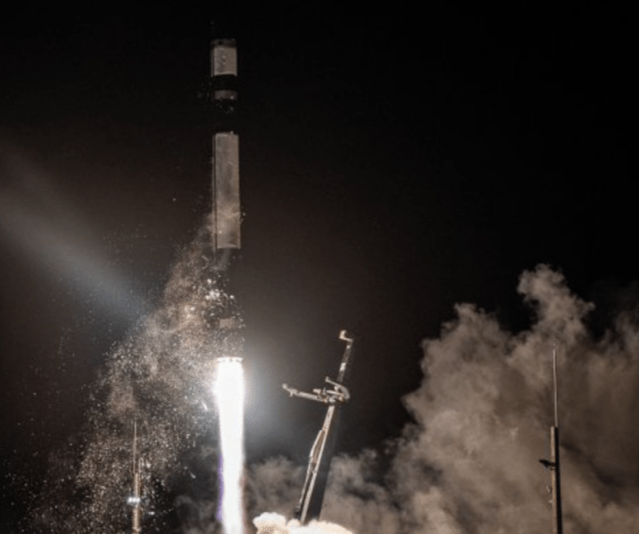
Image (Credit): Rocket Lab’s Electron rocket successfully deploying a fourth synthetic aperture radar satellite to Synspective’s Earth-observation constellation. (Rocket Lab)
Earlier this week, Japanese cargo was launched towards space by two commercial companies. Unfortunately, only of the rockets made it into space.
On March 13, US company Rocket Lab launched a payload for Japan’s Synspective, an Earth-imaging company, from its launch site in New Zealand. The launch was successful and the StriX-3 satellite was placed into Earth orbit.
The second launch on the same day by Japan’s Space One, which would have been the first commercial launch by a Japanese firm, ended quickly when the rocket burst into flames just a few seconds after liftoff. The rocket was carrying a mock-up of a government spy satellite.
Space One President Masakazu Toyoda stated, “We will find out the cause as soon as possible and clarify our measures to prevent a recurrence.”
Getting it right may take time, as we are seeing with SpaceX’s Starship. Japan wants to maintain strong launch capabilities in both the public and private sectors, and this is just part of the process to make that happen.
Image (Credit): Photos showing the launch and midair explosion of Space One’s Kairos rocket. (KYODO)
Image (Credit): An artist’s rending of NASA’s VIPER at the Moon’s south pole. (NASA/Daniel Rutter)
You have until midnight today to submit your name to NASA and be part of the Agency’s first robotic Moon rover, called Volatiles Investigating Polar Exploration Rover (VIPER). Go to this link and provide your name and PIN code to ensure your name goes to the Moon (and you also get your boarding pass as a virtual souvenir).
VIPER is expected to head to the Moon in late 2024 as part of NASA’s Commercial Lunar Payload Services initiative. Once on the lunar surface, it will spend 100 days on the Moon’s south pole to sample the soil and locate frozen water.
If you missed the chance to have your name aboard the Europa Clipper, you still have a chance to be part of this local moon mission.
Image (Credit): One side of the panel attached to the Europa Clipper showing “water” ” in 103 languages (explained below). (NASA/JPL-Caltech)
In past NASA missions to the outer planets of our solar system, we attached messages for any distant civilization that might be out there. Both the Pioneer and Voyager missions contained such messages.
So what about NASA’s Europa Clipper mission to Jupiter’s moon set to launch in October? It too will have some messages, but these appear to be for the inhabitants of the moon rather than some distant civilization.
A triangular 7″ x 11″ metal plate attached to the spacecraft destined for Europa will carry messages on both sides. The image above shows one of these sides containing features waveforms that are visual representations of the sound waves formed by the word “water” in 103 languages.
The other side of the plate (shown below) contains a variety of messages:
the Drake Equation, which estimate the possibility of finding advanced civilizations beyond Earth;
U.S. Poet Laureate Ada Limón’s handwritten “In Praise of Mystery: A Poem for Europa”;
a reference to the radio frequencies considered plausible for interstellar communication; and
a portrait Ron Greeley, whose early efforts laid the foundation for Europa Clipper.
The spacecraft will also carry a silicon microchip containing more than 2.6 million names that were submitted by the public as part of NASA’s “Message in a Bottle” campaign.
This is all interesting in itself, but not really a message to others. I expect it is not intended for anyone else but ourselves because the Europa Clipper is not expected to leave the solar system but instead crash into another of Jupiter’s moons – Ganymede.
Note: You may wonder about the message on the New Horizons spacecraft that is also travelling to the edges of our solar system. That message is somewhat controversial. I will let you read about that one in this Slate article, “Ashes and Small Change.”
Image (Credit): One side of the panel attached to the Europa Clipper showing a poem, portrait, and more (explained above). (NASA/JPL-Caltech)
Image (Credit): Moving the Artemis I mission into place. (NASA)
With the recent glitches related to the two commercial Moon missions, an earlier NASA video on the Artemis program became all too relevant. In the video, “Farther and Faster: NASA’s Journey to the Moon with Artemis,” we hear that the stakes are high as we attempt to return to the Moon, and how we could be the generation that loses the Moon if we don’t get it right.
In addition to the risks, the video also highlights the great successes already with the Artemis I mission, as you may recall from back in 2022:
Over the course of 25.5 days, Orion performed two lunar flybys, coming within 80 miles (129 kilometers) of the lunar surface. At its farthest distance during the mission, Orion traveled nearly 270,000 miles (435,000 kilometers) from our home planet. On Dec. 11, 2022, NASA’s Orion spacecraft successfully completed a parachute-assisted splashdown in the Pacific Ocean at 9:40 a.m. PST (12:40 p.m. EST) as the final major milestone of the Artemis I mission.
Artemis I set new performance records, exceeded efficiency expectations, and established new safety baselines for humans in deep space. This is a prelude to what comes next—following the success of Artemis I, human beings will fly around the Moon on Artemis II.
It is worth pondering what we have ahead of us. NASA may be having a few issues with its commercial partners, but the main mission has done well. We cannot be discouraged with a few delays as long as we keep the course. We have done it before and there is no reason we cannot do it again. I say slow and steady.
Mars is the goal, but we need to prove ourselves with the Moon. Check out the video and determine for yourself if we have already made a fair amount of progress.




 Our Awesome Universe