Juno Views Lava Lake on Io

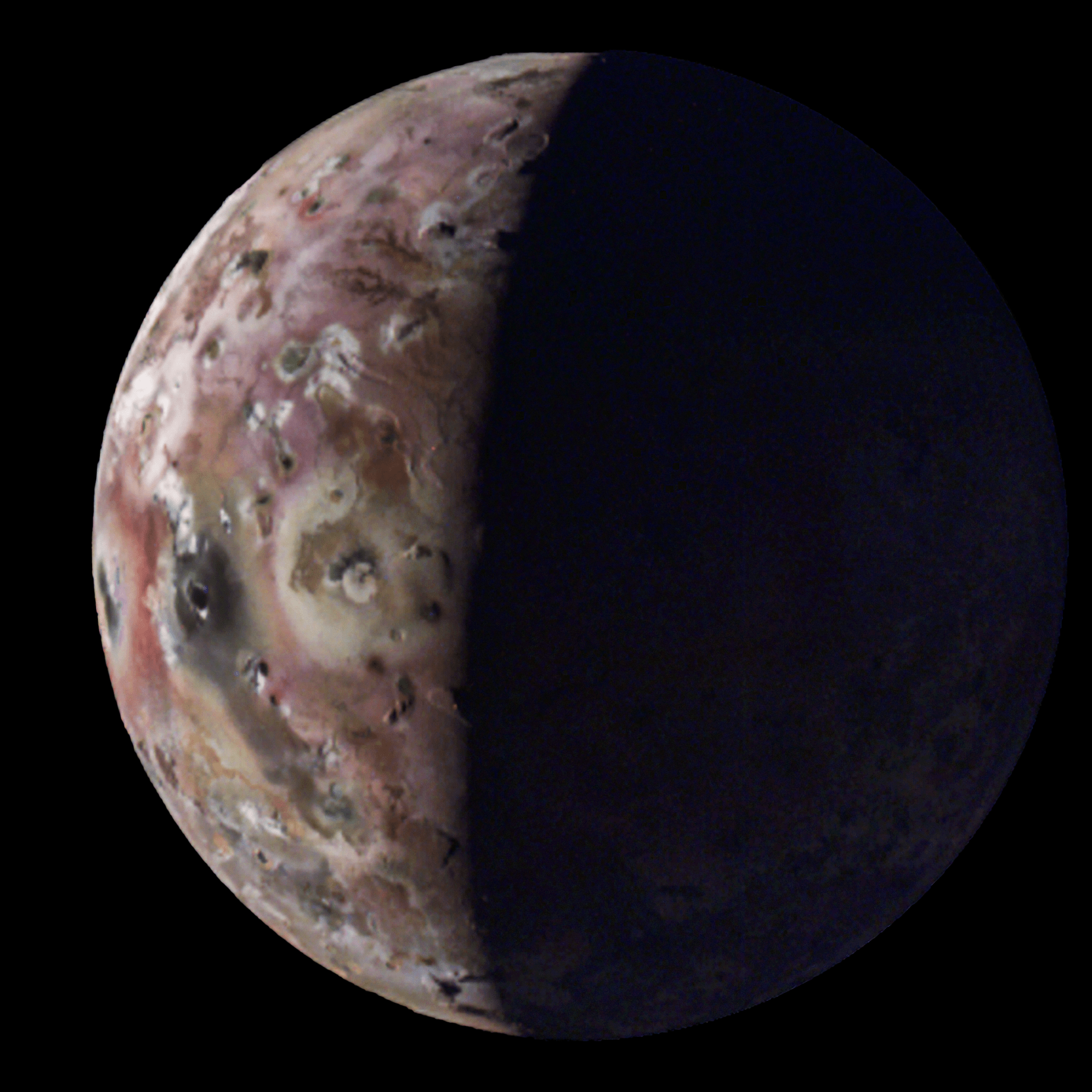
Image (Credit): View of Jupiter’s moon Io as seen by the Juno spacecraft on April 9. It was the first-ever image of the moon’s south polar region. (NASA/JPL-Caltech/SwRI/MSSS. Image processing: Gerald Eichstädt/Thomas Thomopoulos (CC BY))

The Juno spacecraft is still hard a work in the vicinity of Jupiter, with its latest mission being a flyby of the moon Io earlier this month (shown above).

Two recent flybys of the moon were also combined to create an image of a lake of cooling lava (shown below and via the video here). Juno’s principal investigator Scott Bolton explained the new image:

Io is simply littered with volcanoes, and we caught a few of them in action. We also got some great close-ups and other data on a 200-kilometer-long (127-mile-long) lava lake called Loki Patera. There is amazing detail showing these crazy islands embedded in the middle of a potentially magma lake rimmed with hot lava. The specular reflection our instruments recorded of the lake suggests parts of Io’s surface are as smooth as glass, reminiscent of volcanically created obsidian glass on Earth.

Juno has been zipping around Jupiter’s neighborhood since 2016. It’s main task is to study the origin and evolution of Jupiter, believed to be the first planet to have formed in our solar system. By doing so, NASA hopes to learn more about the solar system and the Earth as well.

Image (Credit): An artist’s rendering of Loki Patera, a lava lake on Jupiter’s moon Io, created using data from the JunoCam imager aboard NASA’s Juno spacecraft. (NASA/JPL-Caltech/SwRI/MSSS)

Space Stories: Protests to Save Chandra, Problems Retrieving Martian Sample, and TESS is Getting Testy

Here are some recent stories related to NASA missions.

PhysicsWorld: US Astronomers Slam Cuts to the Chandra X-ray Observatory

X-ray astronomers in the US have begun a campaign to save the Chandra X-ray Observatory from budget cuts that would effectively end the mission. They assert that the craft, which was launched in 1999, has plenty of life left in it. Cancelling support could, they say, damage scientific efforts to understand the universe and the careers of an emerging generation of X-ray astronomers.

CNN: NASA Rethinks Plan to Return Rare Mars Samples to Earth

“Mars Sample Return will be one of the most complex missions NASA has ever undertaken. The bottom line is, an $11 billion budget is too expensive, and a 2040 return date is too far away,” Nelson said. “Safely landing and collecting the samples, launching a rocket with the samples off another planet — which has never been done before — and safely transporting the samples more than 33 million miles (53 million kilometers) back to Earth is no small task. We need to look outside the box to find a way ahead that is both affordable and returns samples in a reasonable time frame.”

NASA: NASA’s TESS Temporarily Pauses Science Observations

NASA’s TESS (Transiting Exoplanet Survey Satellite) entered into safe mode April 8, temporarily interrupting science observations. The team is investigating the root cause of the safe mode, which occurred during scheduled engineering activities. The satellite itself remains in good health. The team will continue investigating the issue and is in the process of returning TESS to science observations in the coming days.

Pic of the Week: The Gediz Vallis Channel

Image (Credit): Panoramic shot of Mar’s Gediz Vallis channel taken by the Curiosity rover. (NASA/JPL-Caltech)

This week’s image comes from NASA’s Curiosity rover in the Gediz Vallis channel. It is a 360-degree panorama shot from back on February 3. The rover has diligently continued its exploration of the Martian surface since it first landed in 2012.

In terms of this latest rover location, NASA stated:

NASA’s Curiosity rover has begun exploring a new region of Mars, one that could reveal more about when liquid water disappeared once and for all from the Red Planet’s surface. Billions of years ago, Mars was much wetter and probably warmer than it is today. Curiosity is getting a new look into that more Earth-like past as it drives along and eventually crosses the Gediz Vallis channel, a winding, snake-like feature that – from space, at least – appears to have been carved by an ancient river.

That possibility has scientists intrigued. The rover team is searching for evidence that would confirm how the channel was carved into the underlying bedrock. The formation’s sides are steep enough that the team doesn’t think the channel was made by wind. However, debris flows (rapid, wet landslides) or a river carrying rocks and sediment could have had enough energy to chisel into the bedrock. After the channel formed, it was filled with boulders and other debris. Scientists are also eager to learn whether this material was transported by debris flows or dry avalanches.

Wallops Flight Facility to Launch Rockets to Study Eclipse

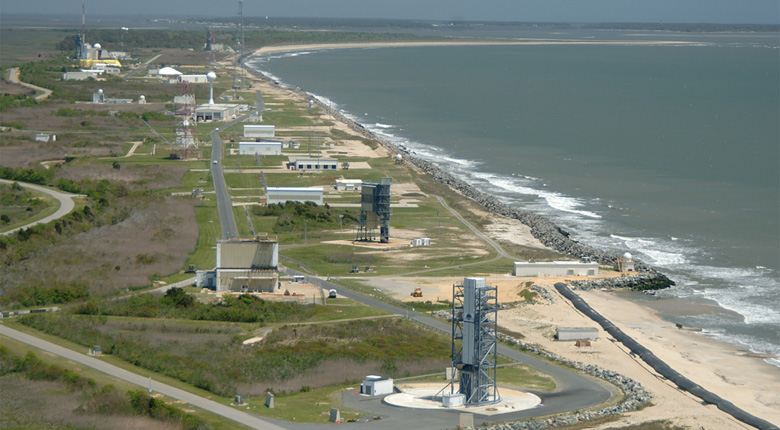
Image (Credit): NASA’s Wallops Flight Facility in Virginia. (Timmons Group)

While Virginia will not be in the direct path of the upcoming Total Solar Eclipse, it will be playing a role related to the eclipse that day.

NASA’s Wallops Flight Facility on the Virginia coast will be launch three rockets to study disturbances in the Earth’s ionosphere during the eclipse. The rockets will be launched 45 minutes before, during, and 45 minutes after the peak local eclipse.

These launches are part of NASA’s Atmospheric Perturbations around Eclipse Path (APEP) mission. Such launches during an eclipse are not unusual as NASA hopes to learn a few things from this study.

Aroh Barjatya, a professor of engineering physics at Florida’s Embry-Riddle Aeronautical University campus, stated:

Understanding the ionosphere and developing models to help us predict disturbances is crucial to making sure our increasingly communication-dependent world operates smoothly.

Space Stories: More Water on Mars, Senators Want Mars Sample Returned to Earth, and the ESA Considers Mission to Enceladus

Here are some recent stories of interest.

Euronews: Photos from NASA’s Curiosity Rover Suggest Mars had More Water for Longer Than Previously Thought

Scientists say Mars may have had more water and stayed wet for longer than they had previously estimated based on photos from NASA’s Curiosity rover. An international team of researchers led by Imperial College London recently found unusual formations in rock and sediment in unexpected places in the crater. The rocks allow scientists to compare the evolving geology of Mars with Earth.

U.S. Senate: Padilla, Butler Urge NASA to Fully Fund Mars Sample Return Program

Today, U.S. Senators Alex Padilla and Laphonza Butler (both D-Calif.) wrote to NASA Administrator Bill Nelson urging him to allocate the full $650 million necessary to fund the Mars Sample Return (MSR) mission in NASA’s FY24 spending plan. The Senators are issuing the letter following the passage of the FY 2024 appropriations package, which reiterated Congress’ strong commitment to the MSR mission.

European Space Agency: Saturn’s Moon Enceladus Top Target for ESA

A fresh, icy crust hides a deep, enigmatic ocean. Plumes of water burst through cracks in the ice, shooting into space. An intrepid lander collects samples and analyses them for hints of life. ESA has started to turn this scene into a reality, devising a mission to investigate an ocean world around either Jupiter or Saturn. But which moon should we choose? What should the mission do exactly? A team of expert scientists has delivered their findings...Aiming for transformational science, considering the characteristics of each moon and future planned missions to Jupiter and Saturn’s ocean worlds, the scientists identified Saturn’s moon Enceladus as the most compelling target, followed by Saturn’s moon Titan and then Jupiter’s moon Europa.