I did not follow up on yesterday’s post when Astrobotic said it was moving onto its Griffin mission. What is that?
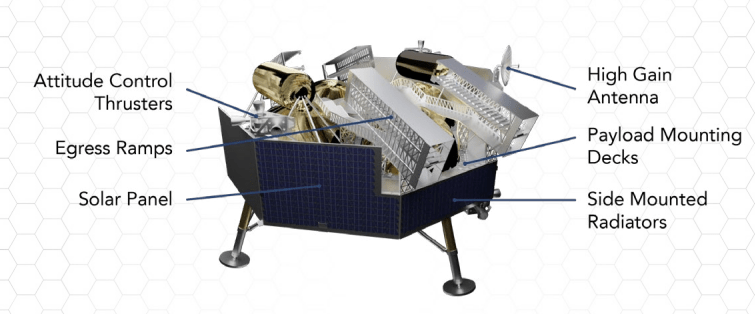
The Griffin mission involved a lunar lander as well, but this time the destination will be the Moon’s South Pole. The lander will deploy NASA’s Volatiles Investigating Polar Exploration Rover (VIPER), which will be searching for water.
The Griffin/VIPER duo was supposed to be on the Moon already, but we already know about delays. I expect the delays will only lengthen as NASA and Astrobotic try to better understand what happened earlier this week with the Peregine lunar lander. NASA does not want to lose a rover.
NASA’s launch website now still has the VIPER landing scheduled for late 2024.
You can read more about the Griffen lander specs here.
Image (Credit): Apollo 11 Lunar Module captured by NASA’s Lunar Reconnaissance Orbiter. (NASA)
NASA said we would have weeks like this one.
First we have the compromised Peregrine Lunar Lander floating in space. Astrobotic posted this update earlier today:
Given the propellant leak, there is, unfortunately, no chance of a soft landing on the Moon. However, we do still have enough propellant to continue to operate the vehicle as a spacecraft. The team has updated its estimates, and we currently expect to run out of propellant in about 40 hours from now — an improvement from last night’s estimate. The team continues to work to find ways to extend Peregrine’s operational life. We are in a stable operating mode and are working payload and spacecraft tests and checkouts. We continue receiving valuable data and proving spaceflight operations for components and software relating to our next lunar lander mission, Griffin.
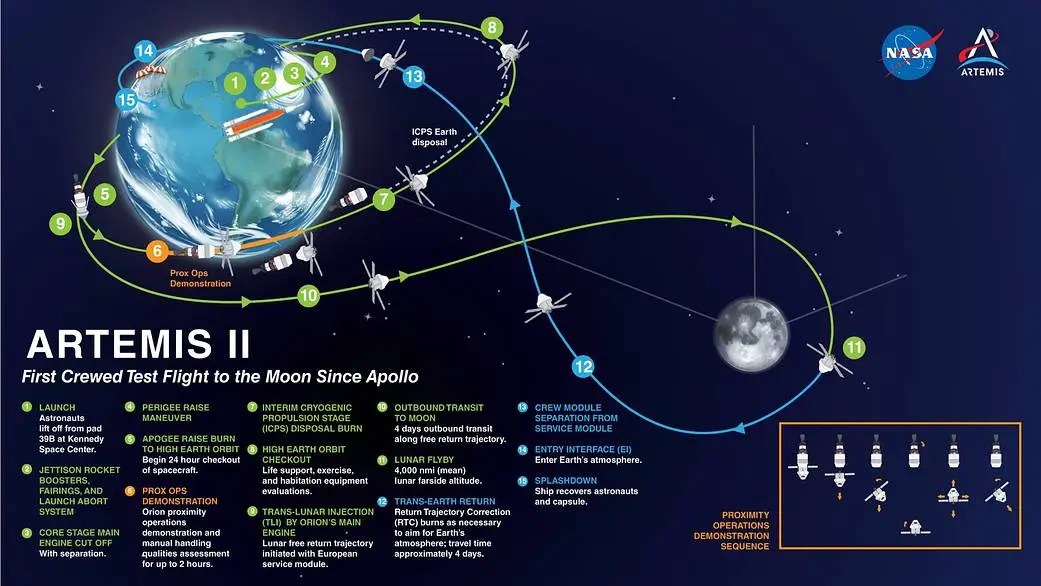
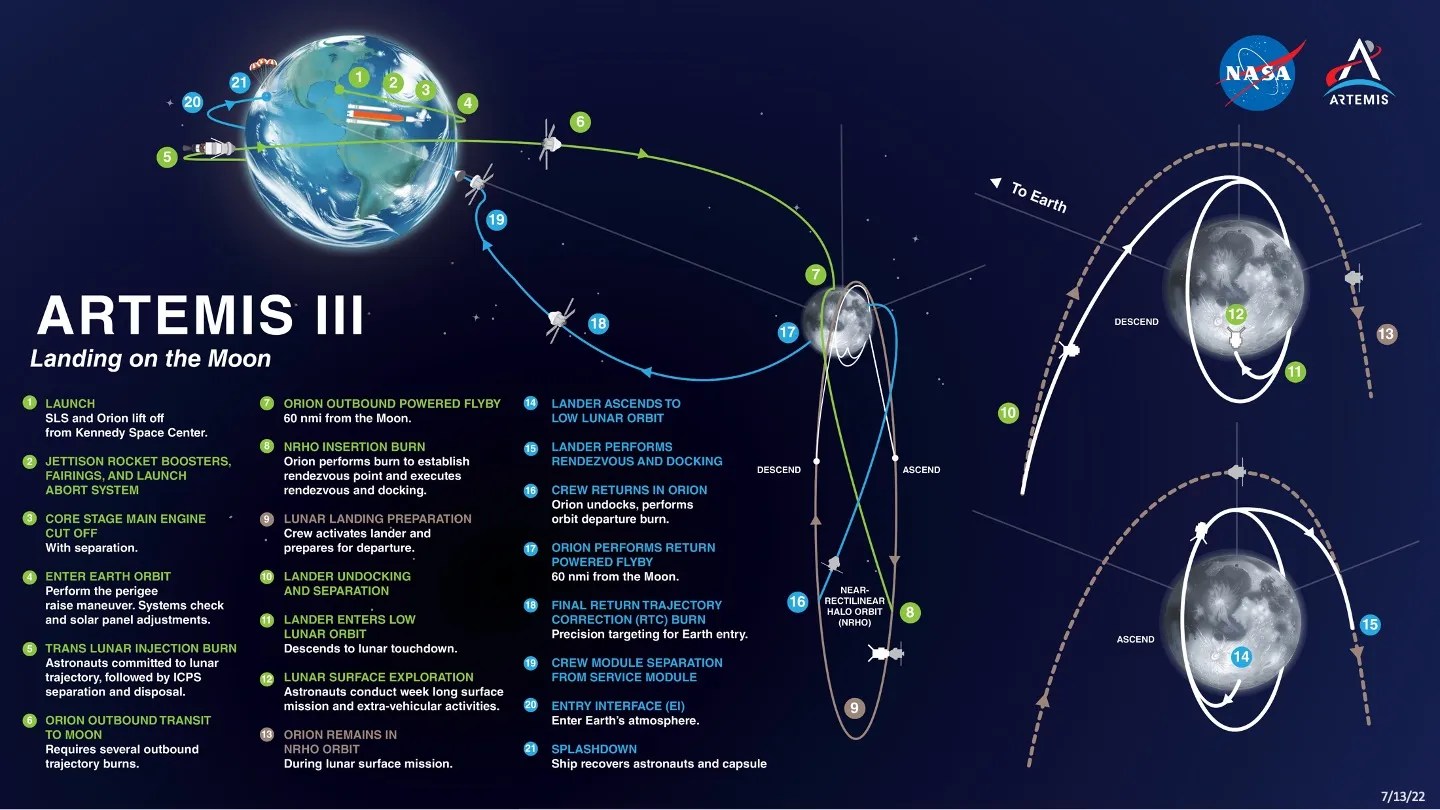
Second, we now have an official delay of the Artemis II and III missions, which is the crewed trips around the Moon and then to the surface of the Moon. NASA made the following statement:
NASA will now target September 2025 for Artemis II, the first crewed Artemis mission around the Moon, and September 2026 for Artemis III, which is planned to land the first astronauts near the lunar South Pole. Artemis IV, the first mission to the Gateway lunar space station, remains on track for 2028.
Rumors about a delay in the Artemis missions has been floating around for some time based on earlier audit reports, so this is not a big surprise. It is possible that NASA decided to dump the Artemis news this week to get everything on the table with this latest Peregrine problem rather than have two bad weeks.
If you were the operator of an airline yet you refused to share the planned destination of your planes, I can assure you that the Federal Aviation Administration would have issues. Yet AstroForge is planning to do just that – set off into the wild blue (or black) yonder in a spacecraft named Odin towards an asteroid that it refuses to name. Needless to say, but I will say it, some people are not very happy.
The New York Times had a story on this adventure, which quoted Jonathan McDowell, an astronomer at the Harvard-Smithsonian Center for Astrophysics in Massachusetts:
I’m very much not in favor of having stuff swirling around the inner solar system without anyone knowing where it is…It seems like a bad precedent to set.
The Odin spacecraft’s goal is to observe the satellite(s) in question so that AstroForge can identify those worth revisiting as part of a mining mission. Here is the plan in the words of AstroForge:
…get to deep space, perform a flyby of the asteroid target, and take high resolution images of the surface. It’s important to note that meeting just one of these objectives would be a groundbreaking achievement not just for AstroForge but for commercial space at-large.
While asteroid visits are not new, nor the idea of mining them, AstroForge would be the first commercial company to do so. The economics of such ventures are still being determined, but the company appears to have enough believers to fund such missions for now.
No specific date for the Odin launch has been set, but it is expected to occur in 2024.
Image (Credit): JunoCam image of Jupiter’s moon Io during its close encounter. The image was taken at an altitude of about 1,500 miles. (NASA JPL and Southwest Research Institute)
NASA’s spacecraft Juno just had a super-close encounter with the most volcanic world in the solar system—but its stunning first image could be among its last after 56 orbits of Jupiter. On December 30, the bus-sized spacecraft—orbiting Jupiter since 2016—got very close to Io, the giant moon of Jupiter. It reached a mere 930 miles (1,500 kilometers) from the moon’s surface. However, the spacecraft’s camera has suffered radiation damage and may not last much longer.
India began 2024 with the launch of an X-ray astronomy satellite aboard the sixtieth flight of its Polar Satellite Launch Vehicle. The PSLV C58 mission lifted off at 9:10 AM local time (03:40 UTC) on Monday, Jan. 1, from the Satish Dhawan Space Centre. XPoSat, or X-ray Polarimeter Satellite, carries a pair of instruments that will be used to study X-ray emissions from astronomical sources. After deploying XPoSat, PSLV C58’s upper stage has remained in orbit as the third flight of the PSLV Orbital Experimental Module (POEM-3), serving as a free-flying platform hosting a range of attached payloads.
The first satellite for a second planned Chinese low Earth orbit communications megaconstellation has been produced in new facilities in Shanghai. A new generation flat-panel satellite rolled off the assembly at the G60 digital satellite production factory in Shanghai’s Songjiang District Tuesday, Dec. 27, according to Chinese press reports. The satellite is the first for the G60 Starlink low Earth orbit communications megaconstellation. An initial 108 satellites of a total of around 12,000 G60 Starlink satellites are to be launched across 2024.
Japan is determined to get onto the moon as soon as possible. An attempt to land on the Moon earlier this year by a private Japanese company ended in failure, but things are looking good so far with the latest mission.
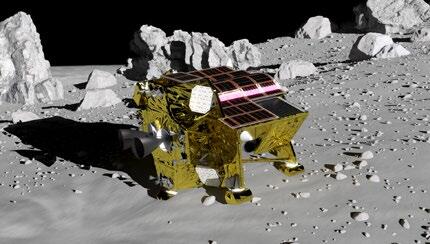
Launched on September 6th, the Japan Aerospace Exploration Agency (JAXA) spacecraft, called the Smart Lander for Investigating Moon (SLIM) and nicknamed the “Moon Sniper” lander, is now in orbit around the Moon. The plan is to place a robotic explorer on the lunar surface by mid-January.
Demonstrate the accurate lunar landing techniques embodied in a small explorer; and
Accelerate the study of the moon and other planets using the lighter exploration system.
In terms of the upcoming events, JAXA stated the following in a press release:
From now until mid-January 2024, the apolune point will be lowered, and the orbit adjusted to a circular orbit at an altitude of approximately 600km. The perilune point will then lower and preparations for landing will begin. On January 19, the perilune point will be lowered to an altitude of 15km, and the descent towards the Moon will start at around 0:00am (JST) on January 20. Landing on the lunar surface is scheduled for around 0:20am (JST) on January 20.




 Our Awesome Universe