A Day in Astronomy: Flyby of Asteroid Gaspra

Image (Credit): Asteroid Gaspra as photographed by the Galileo spacecraft. (NASA)

On this day in 1991, NASA’s Galileo spacecraft conducted a flyby of asteroid Gaspra, an asteroid that orbits in the asteroid belt between Mars and Jupiter. The asteroid is about 10.5 miles long. Gaspra was discovered in 1916 by Russian astronomer G. N. Neujmin, who named it after a famous Russian spa retreat in Crimea.

The Galileo spacecraft’s primary mission was to visit Jupiter and its moons, but it also conducted other observations along the way, including flybys of asteroids Gaspra and Ida.

Here are a few facts about the Galileo mission from NASA:

  • Galileo was the first spacecraft to orbit an outer planet.
  • It was the first spacecraft to deploy an entry probe into an outer planet’s atmosphere.
  • It completed the first flyby and imaging of an asteroid (Gaspra, and later, Ida).
  • It made the first, and so far only, direct observation of a comet colliding with a planet’s atmosphere (Shoemaker-Levy 9).
  • It was the first spacecraft to operate in a giant planet magnetosphere long enough to identify its global structure and to investigate its dynamics.

Pic of the Week: Get Ready for Halloween!

Image (Credit): View of Jupiter taken by the NASA’s Juno mission. (NASA/JPL-Caltech/SwRI/MSSS, Vladimir Tarasov)

NASA has an image for all of us just in time for Halloween. The strange face you see above is a view of Jupiter taken on September 7, 2023 by NASA’s Juno spacecraft on its 54th close flyby of the planet.

NASA explains what you are seeing in this northern region of Jupiter:

The image shows turbulent clouds and storms along Jupiter’s terminator, the dividing line between the day and night sides of the planet. The low angle of sunlight highlights the complex topography of features in this region, which scientists have studied to better understand the processes playing out in Jupiter’s atmosphere.

Now I want to see the images from the first 53 flybys to understand what we might have missed.

Space Stories: Distant Spacecraft Updates, Lucy Gets Ready for a Flyby, and Lunar Near-Earth Asteroids

Image (Credit): Voyager II spacecraft instruments. (NASA)

Here are some recent stories of interest.

Space.com: “NASA’s interstellar Voyager Probes Get Software Updates Beamed from 12 Billion Miles Away

About 46 years after NASA’s Voyager 1 and Voyager 2 launched on an epic journey to explore space, the probes’ antique hardware continues to receive tweaks from afar. One update, a software fix, ought to tend to the corrupted data that Voyager 1 began transmitting last year, and another set aims to prevent gunk from building up in both spacecraft’s thrusters. Together, these updates intend to keep the spacecraft in contact with Earth for as long as possible.

NASA: “NASA’s Lucy Spacecraft Preparing for its First Asteroid Flyby

NASA’s Lucy spacecraft is preparing for its first close-up look at an asteroid. On Nov. 1, it will fly by asteroid Dinkinesh and test its instruments in preparation for visits in the next decade to multiple Trojan asteroids that circle the Sun in the same orbit as Jupiter. Dinkinesh, less than half a mile, or 1 kilometer, wide, circles the Sun in the main belt of asteroids located between the orbits of Mars and Jupiter. Lucy has been visually tracking Dinkinesh since Sept. 3; it will be the first of 10 asteroids Lucy will visit on its 12-year voyage. To observe so many, Lucy will not stop or orbit the asteroids, instead it will collect data as it speeds past them in what is called a “flyby.”

UC San Diego: “How Could a Piece of the Moon Become a Near-Earth Asteroid? Researchers Have an Answer

A team of astronomers has found a new clue that a recently discovered near-Earth asteroid, Kamooalewa, might be a chunk of the moon. They hypothesized that the asteroid was ejected from the lunar surface during a meteorite strike–and they found that a rare pathway could have allowed Kamooalewa to get into orbit around the sun while remaining close to the orbits of the Earth and the Moon. The research team details their findings in the Oct. 23 issue of the journal Nature Communications Earth & Environment. Kamo`oalewa has been the object of several astronomy studies in recent years. As a result, a Chinese mission launching in 2025 is set to land on the asteroid and return samples to Earth.

Can Someone Give NASA a Hand with its Asteroid Canister?

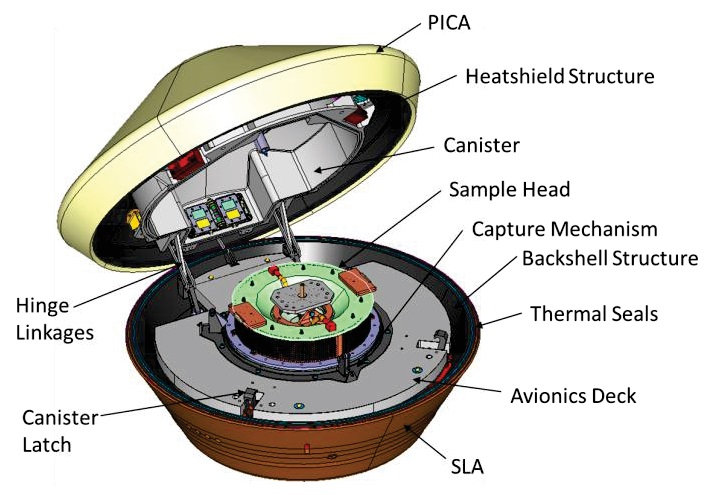
Image (Credit): OSIRIS-REx Sample Return Capsule. (NASA/Lockheed Martin)

Remember when you had to run the pickle jar under the faucet before you could take off the lid? Well, this can even happen to scientists. In fact, it has happened with NASA’s Origins, Spectral Interpretation, Resource Identification, and Security–Regolith Explorer (OSIRIS-REx) sample canister.

NASA has reported that it is still trying to get the lid off of the canister, though it has been able to collect material from outside the container. On Friday, NASA stated:

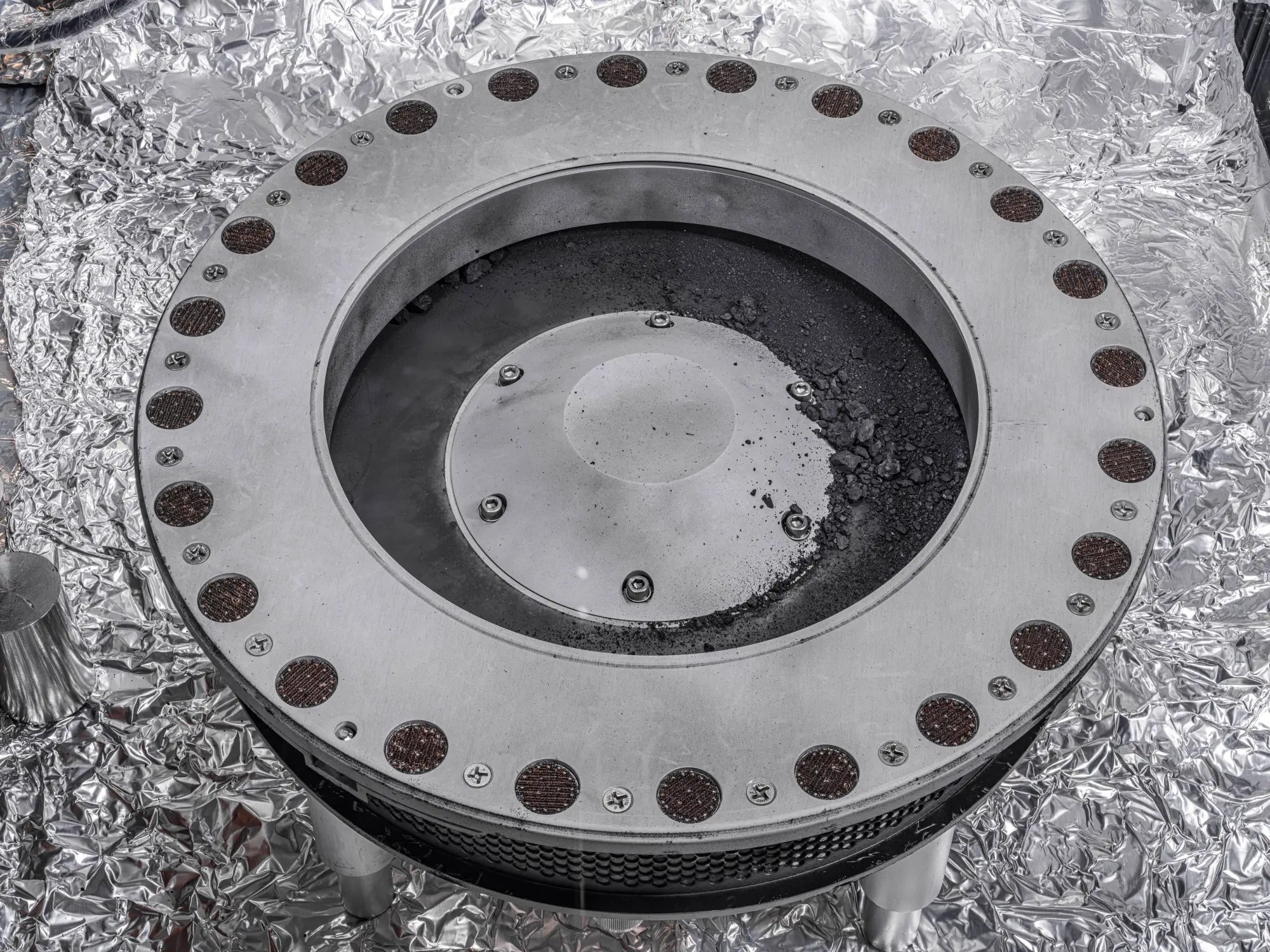
In the last week, the team at NASA’s Johnson Space Center in Houston changed its approach to opening the TAGSAM head, which contained the bulk of the rocks and dust collected by the spacecraft in 2020. After multiple attempts at removal, the team discovered two of the 35 fasteners on the TAGSAM head could not be removed with the current tools approved for use in the OSIRIS-REx glovebox. The team has been working to develop and implement new approaches to extract the material inside the head, while continuing to keep the sample safe and pristine.

NASA stated it may take a few more weeks to resolve since the scientists need to be careful with the tools they use in the confined space.

The good news is that, even without the additional material, the team has already recovered about 70 grams of material from asteroid Bennu sample, which surpasses the agency’s goal of bringing at least 60 grams to Earth.

It is a pretty odd ending after the sample has gone through a multi-year journey before landing in the Utah desert. At least the sample canister is in a safe place while the scientists play with it.

Space Quote: Rich Bounty from the Asteroid Bennu Sample

Image (Credit): Outside view of the OSIRIS-REx sample collector. You an see sample material from asteroid Bennu on the middle right. (NASA/Erika Blumenfeld & Joseph Aebersold)

“As we peer into the ancient secrets preserved within the dust and rocks of asteroid Bennu, we are unlocking a time capsule that offers us profound insights into the origins of our solar system…The bounty of carbon-rich material and the abundant presence of water-bearing clay minerals are just the tip of the cosmic iceberg. These discoveries, made possible through years of dedicated collaboration and cutting-edge science, propel us on a journey to understand not only our celestial neighborhood but also the potential for life’s beginnings. With each revelation from Bennu, we draw closer to unraveling the mysteries of our cosmic heritage.”

Statement by Dante Lauretta, OSIRIS-REx principal investigator, regarding the recently-arrived sample collected from asteroid Bennu. NASA and its partners are expected to study the sample for the next two years to learn more about the asteroid and our solar system.